
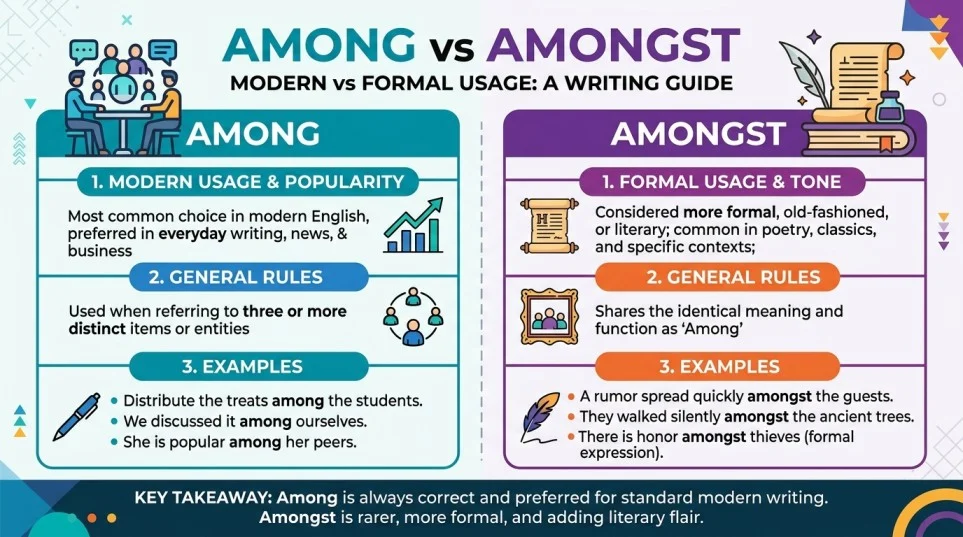
Quick Ans: The difference between among or amongst is mainly a matter of style rather than meaning. Both words mean “in the middle of” or “surrounded by,” but among is far more common in modern English, while amongst is considered more formal, traditional, or literary.
Many English learners and native speakers wonder whether they should use among or amongst. The two words look similar. They sound similar. Most importantly, they carry the same meaning in almost every situation.
Despite this similarity, confusion still exists.
Some people believe amongst is more correct. Others think among should always be used. In reality, both words are grammatically correct. The choice usually depends on writing style, audience, and regional preference.
Modern business writing, academic papers, and everyday communication generally favor among. Meanwhile, amongst appears more often in literature, formal speeches, and traditional forms of English.
Understanding the difference between among or amongst helps improve writing clarity and confidence. It also prevents unnecessary mistakes when choosing words for professional, academic, or creative content.
This guide explains everything you need to know. You will learn definitions, usage rules, advantages and disadvantages, examples, common mistakes, exercises, and frequently asked questions.
Quick Answer: Among or Amongst
If you need a simple answer, use among in most situations.
| Feature | Among | Amongst |
|---|---|---|
| Meaning | Surrounded by or in the middle of | Same meaning |
| Modern Usage | Very common | Less common |
| Formality | Neutral | More formal |
| Business Writing | Preferred | Rare |
| Academic Writing | Preferred | Less common |
| Literary Writing | Common | Often used |
In short, among is the standard choice in modern English. However, amongst remains correct and acceptable.
What Does “Among” Mean?
Among is a preposition that means being surrounded by people, objects, groups, or things.
It is one of the most frequently used prepositions in English.
Examples of Among
Consider these sentences:
- She was sitting among friends.
- The keys were hidden among the books.
- Success was shared among the team members.
- The teacher walked among the students.
In each example, something exists within a group or is surrounded by other things.
Why Among Is Popular
Modern English favors simplicity and clarity. Because of that trend, among has become the preferred option in most forms of communication.
You will regularly see it in:
- Emails
- Business reports
- Academic papers
- News articles
- Websites
- Everyday conversations
As a result, many style guides recommend using among whenever possible.
What Does “Amongst” Mean?
Amongst has exactly the same meaning as among.
The word functions as a preposition and indicates being surrounded by or included within a group.
Examples of Amongst
Here are some examples:
- She stood amongst the crowd.
- The treasure was hidden amongst the trees.
- Trust developed amongst the employees.
- The discussion continued amongst the committee members.
Notice that the meaning remains identical to sentences using among.
Why Amongst Exists
Historically, English often added the ending “-st” to certain words. Similar examples include:
- Whilst and while
- Amidst and amid
Over time, shorter forms became more common. Nevertheless, longer forms remained in use, particularly in formal and literary writing.
Key Differences Between Among or Amongst
Meaning
There is no difference in meaning between among or amongst.
Both words mean:
- In the middle of
- Surrounded by
- Included within a group
Style
The primary difference is style.
Among sounds modern and neutral.
Amongst sounds more formal, traditional, or literary.
Frequency
Modern English uses among far more frequently.
Writers choose amongst much less often.
Readability
Most readers find among simpler and more natural.
Consequently, professional writers often prefer it.
Advantages and Disadvantages
Advantages of Using Among
- Widely accepted
- Easy to read
- Common in modern English
- Preferred by most style guides
- Suitable for professional writing
Disadvantages of Using Among
- May sound less formal in literary contexts
- Lacks the traditional tone some writers prefer
Advantages of Using Amongst
- Creates a formal tone
- Works well in literature
- Adds a traditional style
- Suitable for historical writing
Disadvantages of Using Amongst
- Less common today
- Can sound outdated
- May appear overly formal
- Not preferred in most business writing
Therefore, understanding your audience is important when deciding between among or amongst.
Real World Examples
Business Communication
Modern businesses almost always choose among.
Example:
“The responsibilities were divided among the team members.”
This version sounds natural and professional.
Academic Writing
Universities generally favor concise language.
Example:
“The survey was distributed among participants.”
Because clarity matters, among is usually preferred.
Literary Writing
Authors sometimes choose amongst to create a specific tone.
Example:
“The knight wandered amongst the ancient ruins.”
In this context, amongst adds a slightly traditional feel.
Everyday Conversation
Most native speakers use among naturally.
For instance:
“I found my wallet among the papers on my desk.”
This sounds more conversational than using amongst.
Regional and Global Usage
American English
American English strongly prefers among.
The word amongst appears occasionally but is much less common.
British English
British English uses both forms.
Even so, among remains more frequent in everyday writing.
Australian English
Writers in Australia generally use among. However, amongst sometimes appears in formal or literary contexts.
Global English
International communication usually favors among because it is widely understood and recognized.
As English becomes more global, shorter and simpler forms continue to dominate.
Grammar Rules for Among or Amongst
Use Both With Groups
Both words work when referring to groups.
Examples:
- The award was shared among employees.
- The award was shared amongst employees.
Both sentences are correct.
Use Both With Collections
Each word can describe being surrounded by objects.
Examples:
- The letter was among the documents.
- The letter was amongst the documents.
Again, both options work.
Maintain Consistency
Choose one style and stick with it throughout a document.
For example, if you start with among, continue using among unless there is a specific reason to switch.
Consistency improves readability.
Related Concepts and Comparisons
Among vs Between
This is one of the most common grammar comparisons.
Use between for distinct individual items.
Example:
- The agreement was between the two companies.
Use among or amongst for groups.
Example:
- The agreement was discussed among the employees.
Amid vs Amidst
These words follow a similar pattern.
| Short Form | Longer Form |
|---|---|
| Among | Amongst |
| Amid | Amidst |
| While | Whilst |
The shorter forms dominate modern English.
The longer forms remain acceptable in formal or literary contexts.
Common Mistakes About Among or Amongst
Thinking One Is Incorrect
Many people believe one version is wrong.
In reality, both words are grammatically correct.
Mixing Styles Unnecessarily
Switching repeatedly between among and amongst can make writing feel inconsistent.
Choose one style and maintain it.
Using Amongst to Sound Smarter
Some writers use amongst simply to appear more sophisticated.
However, unnecessary formality can reduce clarity.
Confusing Among With Between
This mistake happens frequently.
Remember:
- Between = distinct items
- Among or amongst = groups
Understanding this rule prevents many grammar errors.
Beginner to Advanced Usage Tips
Beginner Level
Use among in all situations.
This approach is simple and correct.
Intermediate Level
Learn when amongst appears in formal or literary writing.
Notice how authors use it to create tone.
Advanced Level
Match your word choice to your audience.
Business readers usually prefer among.
Literary audiences may appreciate amongst in selected contexts.
As your writing skills improve, you can make style choices more intentionally.
Step By Step Usage Scenario
Imagine you are writing an email to coworkers.
Sentence:
“The tasks were divided among team members.”
This is the best choice because the audience expects modern business language.
Now imagine you are writing a historical novel.
Sentence:
“The travelers wandered amongst the ancient forests.”
In this case, amongst may fit the desired tone better.
Therefore, context often determines which option works best.
Exercises With Answers
Exercise 1
Which word is more common in modern English?
Answer: Among.
Exercise 2
Do among and amongst have different meanings?
Answer: No.
Exercise 3
Which form is usually preferred in business writing?
Answer: Among.
Exercise 4
Which form sounds more traditional or literary?
Answer: Amongst.
Exercise 5
True or False: Amongst is grammatically incorrect.
Answer: False.
When Should You Choose Among or Amongst?
Choose among if you:
- Write business documents
- Create academic content
- Want maximum clarity
- Use modern English
Choose amongst if you:
- Write literature
- Want a traditional tone
- Prefer formal style
- Create historical content
Most writers will benefit from using among in everyday situations.
FAQs About Among or Amongst
What is the difference between among or amongst?
The difference is mainly stylistic. Both words have the same meaning, but among is more common in modern English.
Is amongst more formal than among?
Yes. Amongst often sounds more formal, traditional, or literary.
Which is correct: among or amongst?
Both are correct. The choice depends on style and audience.
Should I use among or amongst in business writing?
Among is generally preferred because it sounds clearer and more modern.
Is amongst old-fashioned?
Some readers consider it slightly old-fashioned, though it remains grammatically correct.
Do Americans use amongst?
Americans usually prefer among. Amongst appears much less frequently in American English.
Can I use among and amongst interchangeably?
Yes. Since the meaning is identical, they can usually be exchanged without changing the sentence.
Which word appears more often in academic writing?
Among appears more often because academic writing values clarity and simplicity.
Is amongst wrong in modern English?
No. Amongst is still correct and accepted in modern English.
Which should English learners use: among or amongst?
English learners should generally use among because it is more common and widely preferred.
Conclusion
The debate over among or amongst is much simpler than many people think. Both words have the same meaning and are grammatically correct. The real difference lies in style rather than grammar.
Among is the preferred choice in modern English. It appears more frequently in business communication, academic writing, journalism, websites, and everyday conversations. Because it is shorter and more familiar, readers often find it easier to understand.
Amongst remains a valid alternative. Writers sometimes use it to create a formal, traditional, or literary tone. For that reason, it still appears in novels, historical writing, and certain forms of British English.
For most situations, choosing among is the safest and most practical option. Nevertheless, amongst can be effective when used intentionally and consistently.
By understanding the differences between among or amongst, you can write with greater confidence, improve readability, and select the style that best matches your audience.
Discove More:-
- iOS or Android: Full Comparison Guide for Features, Security, and Performance
- Greatful or Grateful: Which Spelling Is Correct and Why?

Lisa Thompson is a USA-based content writer and language specialist focused on grammar, writing improvement and digital publishing.
She holds a degree in English Language and Communication and has professional experience in educational and web content creation.
As the author of Gramtivo.Com, she aims to help readers improve their writing skills through clear and practical guidance.