
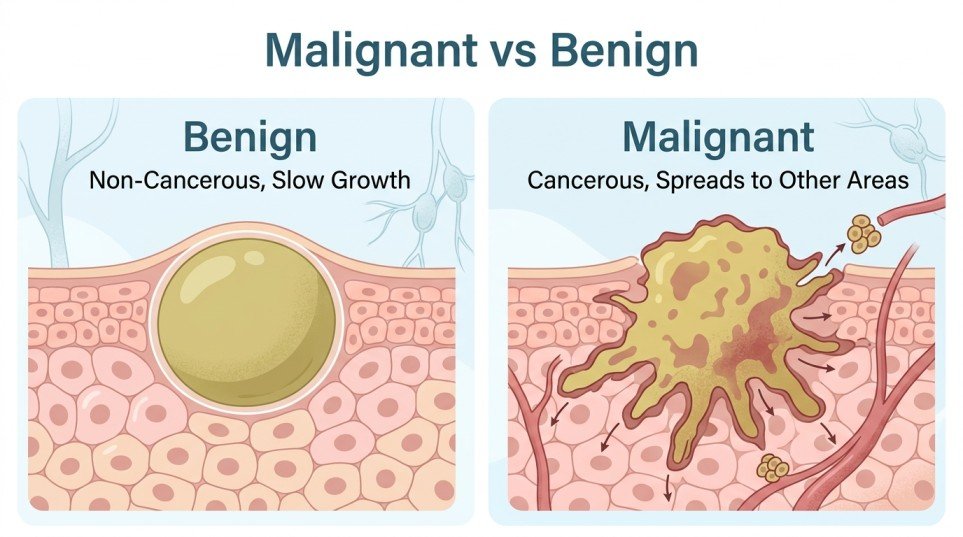
Quick Ans: The main difference between malignant or benign tumors is whether the growth spreads and harms nearby tissues. A benign tumor stays in one place and is usually non cancerous, while a malignant tumor is cancerous and can spread to other parts of the body. Understanding this difference is important for diagnosis, treatment, and long term health.
Many people hear the words malignant or benign after a medical scan or doctor visit. These terms often create fear and confusion. However, they describe two very different types of growths in the body.
A benign tumor is usually non cancerous and grows slowly. In contrast, a malignant tumor is cancerous and may spread to nearby tissues or distant organs. Because of this difference, doctors treat them differently.
For example, a harmless fatty lump under the skin may be benign. Meanwhile, an aggressive cancerous mass in the lungs could be malignant. Although both are abnormal growths, the health risks are not the same.
Learning the difference between malignant or benign helps patients understand medical reports and treatment plans more clearly. It also reduces unnecessary panic when doctors discover a growth during testing.
This complete guide explains definitions, symptoms, causes, diagnosis, treatment options, common mistakes, and practical examples. By the end, you will clearly understand how benign and malignant conditions differ.
Quick Answer: Malignant or Benign
The easiest way to understand malignant or benign is by looking at behavior and risk.
| Feature | Benign | Malignant |
|---|---|---|
| Cancerous | No | Yes |
| Growth Speed | Slow | Often fast |
| Spread to Other Areas | No | Yes |
| Threat Level | Usually low | Can be life threatening |
| Treatment Urgency | Less urgent | Often urgent |
In simple terms, benign tumors stay localized, while malignant tumors can spread through the body.
What Does Benign Mean?
A benign tumor is a non cancerous growth of abnormal cells. It usually grows slowly and stays in one area.
Most benign tumors do not invade nearby tissues. In many cases, they are not life threatening.
Common Examples of Benign Tumors
Several common conditions are benign, including:
- Lipomas
- Fibroids
- Skin moles
- Adenomas
- Certain cysts
Doctors may still remove benign tumors if they cause pain or pressure.
Characteristics of Benign Tumors
Benign growths often show these features:
- Slow growth
- Smooth borders
- Limited movement into nearby tissue
- Lower chance of recurrence
Because they remain localized, treatment is often simpler.
Can Benign Tumors Become Dangerous?
Some benign tumors can still create problems.
For example:
- Brain tumors may press on important structures
- Large fibroids can cause pain or bleeding
- Certain adenomas may later become cancerous
Therefore, doctors still monitor many benign conditions carefully.
What Does Malignant Mean?
A malignant tumor is a cancerous growth that can invade nearby tissue and spread to distant parts of the body.
This spreading process is called metastasis.
Unlike benign tumors, malignant tumors often grow aggressively and damage healthy tissue.
Common Examples of Malignant Tumors
Examples include:
- Breast cancer
- Lung cancer
- Colon cancer
- Leukemia
- Melanoma
These cancers require medical treatment and monitoring.
Characteristics of Malignant Tumors
Malignant growths often have:
- Rapid cell growth
- Irregular borders
- Ability to invade nearby tissue
- Potential to spread through blood or lymphatic system
Because of these traits, malignant tumors can become life threatening.
Key Differences Between Malignant or Benign
Growth Pattern
Benign tumors usually grow slowly. Malignant tumors may grow quickly and unpredictably.
Spread
The biggest difference between malignant or benign involves spreading. Benign tumors stay in one place. Malignant tumors can spread throughout the body.
Cell Appearance
Under a microscope, benign cells often resemble normal cells. Malignant cells usually appear abnormal and disorganized.
Treatment Needs
Benign tumors may only require monitoring. Malignant tumors often need surgery, chemotherapy, radiation, or targeted therapy.
Advantages and Disadvantages
Benign Tumor Advantages
Benign tumors have several positive features:
- Usually non life threatening
- Lower treatment urgency
- Rarely spread
- Easier to remove in many cases
Benign Tumor Disadvantages
However, some risks still exist:
- Pressure on nearby organs
- Cosmetic concerns
- Pain or discomfort
- Possible recurrence
Malignant Tumor Advantages
Although cancer is serious, early detection offers important benefits:
- Some cancers are highly treatable early
- Modern therapies improve survival rates
- Screening increases early diagnosis success
Malignant Tumor Disadvantages
Malignant tumors can create major health problems:
- Tissue destruction
- Spread to organs
- Intensive treatment needs
- Higher mortality risk
Therefore, early diagnosis is critical in malignant conditions.
Real World Examples
Example 1: Skin Lump
A person discovers a soft lump under the skin. Testing shows it is a lipoma, which is benign.
Example 2: Breast Mass
A mammogram identifies a suspicious mass. After biopsy, doctors diagnose malignant breast cancer.
Example 3: Brain Tumor
Some brain tumors are benign. However, even non cancerous growths may become dangerous because they press against vital brain tissue.
These examples show why medical testing is necessary.
Regional and Global Usage
Worldwide Cancer Awareness
The terms malignant or benign are used globally in hospitals, laboratories, and medical research.
Screening Programs
Many countries encourage cancer screening programs for:
- Breast cancer
- Colon cancer
- Cervical cancer
- Lung cancer
Early detection improves survival rates significantly.
Healthcare Differences
Access to diagnosis and treatment varies between countries. Developed healthcare systems often detect malignant disease earlier.
Related Concepts and Comparisons
Tumor vs Cancer
Not every tumor is cancer. A benign tumor is not cancerous, while malignant tumors are cancer.
Cyst vs Tumor
A cyst usually contains fluid or air. A tumor involves abnormal tissue growth.
Malignant vs Metastatic
Malignant means cancerous. Metastatic means the cancer has already spread.
Malignant or Benign vs Precancerous
Precancerous cells are abnormal cells that may later become malignant if untreated.
Common Mistakes About Malignant or Benign
Assuming All Tumors Are Cancer
Many tumors are benign and non cancerous.
Ignoring Symptoms
People sometimes ignore lumps or unusual symptoms because they feel no pain. However, painless growths still require medical evaluation.
Self Diagnosing Online
Internet searches cannot replace professional testing. Doctors use scans, biopsies, and laboratory analysis for accurate diagnosis.
Believing Benign Means Harmless Forever
Some benign conditions require monitoring because changes may occur over time.
Avoiding these mistakes improves medical decision making.
Beginner to Advanced Medical Understanding
Beginner Level
Learn the basic difference:
- Benign equals non cancerous
- Malignant equals cancerous
Intermediate Level
Understand diagnostic tools such as:
- MRI scans
- CT scans
- Ultrasound
- Biopsy testing
Advanced Level
Study concepts including:
- Metastasis
- Tumor grading
- Cancer staging
- Genetic mutations
- Targeted cancer therapy
This progression builds deeper medical understanding over time.
Step By Step Diagnosis Scenario
Imagine a patient finds a lump.
- The doctor performs a physical exam
- Imaging tests are ordered
- A biopsy collects tissue samples
- Pathologists examine the cells
- Results determine whether the tumor is malignant or benign
This process helps doctors create the correct treatment plan.
Exercises With Answers
Exercise 1
Which type of tumor spreads to other body parts?
Answer: Malignant tumor.
Exercise 2
Are benign tumors cancerous?
Answer: No.
Exercise 3
What is metastasis?
Answer: The spread of cancer to other areas of the body.
Exercise 4
Which diagnostic test commonly confirms malignant or benign tumors?
Answer: Biopsy.
Exercise 5
True or False: All tumors are dangerous cancers.
Answer: False.
When Should You See a Doctor?
Seek medical advice if you notice:
- Unexplained lumps
- Sudden weight loss
- Persistent pain
- Unusual bleeding
- Changes in skin moles
- Long lasting fatigue
Early evaluation improves treatment success.
FAQs About Malignant or Benign
What is the main difference between malignant or benign tumors?
Benign tumors stay localized and are non cancerous, while malignant tumors are cancerous and can spread.
Can a benign tumor become malignant?
Some benign tumors may later become cancerous, although many never change.
Are malignant tumors always fatal?
No. Many cancers are treatable, especially when diagnosed early.
How do doctors determine malignant or benign growths?
Doctors use imaging tests and biopsies to examine tissue cells.
Do benign tumors need treatment?
Some do. Treatment depends on size, symptoms, and location.
Can malignant tumors spread quickly?
Yes. Certain cancers spread rapidly without treatment.
Are all cysts benign?
Most cysts are benign, but doctors may still evaluate suspicious growths.
What symptoms suggest malignant cancer?
Warning signs may include weight loss, pain, fatigue, unusual bleeding, or changing lumps.
Is surgery required for benign tumors?
Not always. Doctors may monitor harmless tumors instead of removing them.
Can lifestyle affect cancer risk?
Yes. Smoking, poor diet, alcohol use, and lack of exercise can increase cancer risk.
Conclusion
Understanding malignant or benign is important for interpreting medical diagnoses and reducing fear during health evaluations. Although both involve abnormal cell growth, their behavior and risks differ greatly.
Benign tumors are non cancerous and usually remain localized. Many grow slowly and cause few health problems. However, some still require treatment if they create pressure or discomfort.
Malignant tumors are cancerous and can spread through the body. Because they damage healthy tissue, early detection and treatment are extremely important.
Doctors use imaging tests, biopsies, and laboratory analysis to determine whether a tumor is malignant or benign. Accurate diagnosis allows proper treatment planning and better long term outcomes.
If you notice unusual symptoms or growths, seek medical advice promptly. Early medical evaluation often leads to better treatment success and improved peace of mind.
Discover More:-
- Shiesty or Sheisty: Correct Spelling, Meaning, and Usage Explained
- Mathew or Matthew: Correct Spelling, Meaning, and Key Differences

Lisa Thompson is a USA-based content writer and language specialist focused on grammar, writing improvement and digital publishing.
She holds a degree in English Language and Communication and has professional experience in educational and web content creation.
As the author of Gramtivo.Com, she aims to help readers improve their writing skills through clear and practical guidance.