
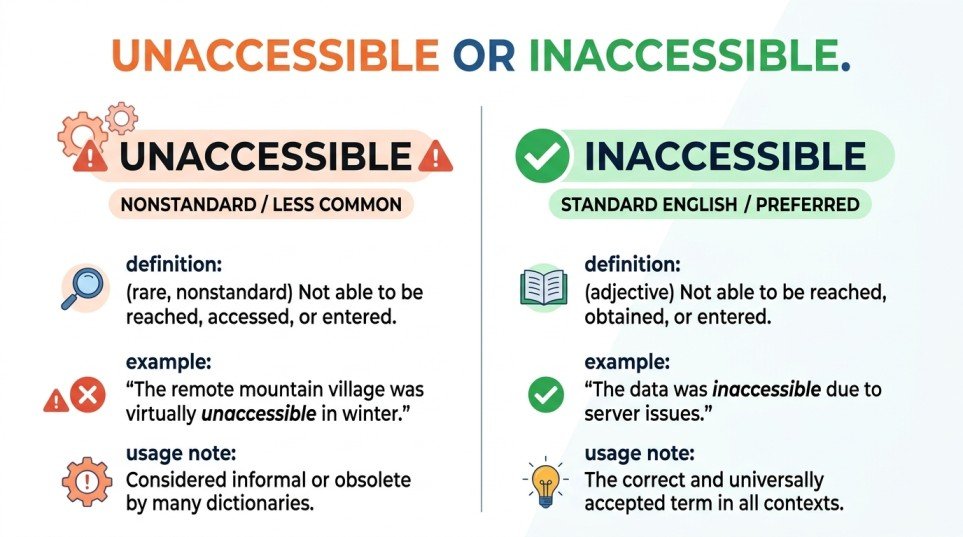
Quick Ans: The correct and widely accepted word is inaccessible. Although some people use unaccessible, it is considered nonstandard and rarely appears in professional writing. In most situations, dictionaries, teachers, editors, and style guides recommend using “inaccessible.”
Many English learners and writers become confused about unaccessible or inaccessible. Both words seem logical. Both appear to describe something that cannot be reached or accessed. However, only one is considered correct in standard English.
That word is inaccessible.
The confusion usually happens because English often allows both “un” and “in” prefixes. For example, words like “unhappy” and “incorrect” follow different patterns. As a result, people sometimes assume “unaccessible” should also work.
In casual conversation, you may occasionally hear someone say “unaccessible.” However, professional writing, academic papers, websites, and dictionaries almost always prefer “inaccessible.”
Understanding the difference between unaccessible or inaccessible helps improve grammar, writing quality, and communication. It also prevents mistakes in emails, essays, business documents, and online content.
This guide explains the meanings, grammar rules, examples, mistakes, and practical usage of both terms. By the end, you will confidently know which word to use.
Quick Answer: Unaccessible or Inaccessible
If you need a fast answer, here it is:
| Word | Correct in Standard English? | Common Usage |
|---|---|---|
| Unaccessible | Rare and nonstandard | Very uncommon |
| Inaccessible | Yes | Widely accepted |
Therefore, you should almost always use inaccessible.
Example:
- Correct: “The website is inaccessible.”
- Incorrect or uncommon: “The website is unaccessible.”
What Does Inaccessible Mean?
The word inaccessible describes something that cannot be reached, entered, understood, or used easily.
Common Meanings of Inaccessible
“Inaccessible” can refer to:
- A location that cannot be reached
- Information that is difficult to understand
- A website that does not work properly
- A person who is emotionally distant
Because the word has several meanings, it appears frequently in both spoken and written English.
Examples of Inaccessible in Sentences
Here are some common examples:
- The road became inaccessible after the storm.
- The building is inaccessible to wheelchair users.
- Some academic books are inaccessible to beginners.
- The website was temporarily inaccessible.
Each example shows something difficult to reach or use.
What Does Unaccessible Mean?
The word unaccessible technically exists, but it is extremely rare. Most dictionaries either label it as nonstandard or avoid recommending it entirely.
Although the meaning is similar to “inaccessible,” native English speakers rarely use it.
Why Some People Use Unaccessible
People often create “unaccessible” by applying normal English word patterns.
For example:
- Happy → Unhappy
- Clear → Unclear
- Fair → Unfair
Therefore, some writers assume:
- Accessible → Unaccessible
However, English does not always follow consistent rules. In this case, “inaccessible” became the accepted standard.
Is Unaccessible Always Wrong?
In informal speech, some people still say it. Nevertheless, editors, teachers, and professional writers generally avoid it.
As a result, using “unaccessible” may make your writing appear incorrect or unpolished.
Why Inaccessible Is Preferred
The preference for inaccessible comes from language history and standard usage.
Historical Development
The word “inaccessible” entered English through Latin and French influences. Over time, it became the accepted form in dictionaries and formal writing.
Meanwhile, “unaccessible” never gained widespread acceptance.
Dictionary Support
Most major dictionaries recognize “inaccessible” as the standard word.
Examples include:
- Oxford Dictionary
- Merriam Webster
- Cambridge Dictionary
Because professional references prefer “inaccessible,” writers should also use it.
Professional Writing Standards
Academic institutions, businesses, and publishers almost always choose “inaccessible.”
For example:
- “The document is inaccessible.”
- “The data remains inaccessible.”
These forms sound natural and professional.
Key Differences Between Unaccessible or Inaccessible
Standard Usage
“Inaccessible” is standard English. “Unaccessible” is nonstandard or extremely uncommon.
Professional Acceptance
Editors and teachers accept “inaccessible.” Many consider “unaccessible” incorrect.
Frequency
“Inaccessible” appears far more often in books, websites, and professional documents.
Readability
Readers immediately recognize “inaccessible.” In contrast, “unaccessible” may look awkward or unfamiliar.
Advantages and Disadvantages
Advantages of Using Inaccessible
- Grammatically accepted
- Professional sounding
- Widely understood
- Preferred by dictionaries
Disadvantages of Using Inaccessible
- Slightly longer pronunciation for some learners
Advantages of Using Unaccessible
- May sound logical to beginners
- Easy to form from “accessible”
Disadvantages of Using Unaccessible
- Considered nonstandard
- May confuse readers
- Looks unprofessional in formal writing
Therefore, “inaccessible” remains the safer and smarter choice.
Real World Examples
In Business Writing
Professional emails often use “inaccessible.”
Example:
- “The shared folder is currently inaccessible.”
Using “unaccessible” in business communication may appear careless.
In Technology
Web developers frequently discuss accessibility.
Example:
- “The webpage became inaccessible during maintenance.”
This usage appears in technical support, software documentation, and IT reports.
In Education
Teachers and professors commonly use “inaccessible” when discussing difficult materials.
Example:
- “The textbook language feels inaccessible to beginners.”
These examples show why standard wording matters.
Regional and Global Usage
American English
American English strongly prefers “inaccessible.”
British English
British English also favors “inaccessible” in professional and academic writing.
Global English Usage
International English learners are usually taught “inaccessible” because it is universally accepted.
Consequently, “unaccessible” rarely appears in global communication.
Related Concepts and Comparisons
Accessible vs Inaccessible
| Word | Meaning |
|---|---|
| Accessible | Easy to reach or use |
| Inaccessible | Difficult or impossible to reach or use |
Unavailable vs Inaccessible
These words are similar but not identical.
- Unavailable means not currently obtainable.
- Inaccessible means difficult or impossible to access.
Example:
- The manager is unavailable today.
- The office is inaccessible due to flooding.
Difficult vs Inaccessible
“Difficult” describes challenge level. “Inaccessible” describes inability to reach or use something.
Common Mistakes About Unaccessible or Inaccessible
Using Unaccessible in Formal Writing
This is the most common mistake. Professional documents should use “inaccessible.”
Assuming Both Words Are Equal
Although both words exist, they are not equally accepted in standard English.
Confusing Accessibility Terms
Some writers mix up:
- inaccessible
- unavailable
- unreachable
Each word has a slightly different meaning.
Overthinking Prefix Rules
English prefixes do not always follow strict patterns. Therefore, logical guessing may produce incorrect words.
Beginner to Advanced Usage Tips
Beginner Level
Always choose “inaccessible” when writing essays, emails, or assignments.
Intermediate Level
Learn context based meanings. “Inaccessible” can describe places, ideas, technology, or people.
Advanced Level
Use accessibility vocabulary accurately in professional fields such as:
- Web development
- Education
- Business communication
- Technical writing
Strong vocabulary improves clarity and professionalism.
Step By Step Usage Scenario
Imagine you are writing an email about a broken website.
Incorrect version:
- “The website is unaccessible.”
Correct version:
- “The website is inaccessible.”
Now imagine writing an academic paper.
Incorrect:
- “The research article was unaccessible to students.”
Correct:
- “The research article was inaccessible to students.”
Using the correct word improves credibility immediately.
Exercises With Answers
Exercise 1
Which word is standard English?
Answer: Inaccessible.
Exercise 2
Which word is considered nonstandard?
Answer: Unaccessible.
Exercise 3
Choose the correct sentence:
A. The file is unaccessible.
B. The file is inaccessible.
Answer: B.
Exercise 4
True or False: Most dictionaries prefer “unaccessible.”
Answer: False.
Exercise 5
Which word appears more often in professional writing?
Answer: Inaccessible.
When Should You Use Inaccessible?
Use “inaccessible” when describing:
- Blocked roads
- Broken websites
- Difficult books
- Restricted locations
- Emotional distance
Avoid “unaccessible” in:
- Academic essays
- Business communication
- Professional websites
- Published content
Using standard English improves trust and readability.
FAQs About Unaccessible or Inaccessible
Which is correct: unaccessible or inaccessible?
“Inaccessible” is the correct and widely accepted word in standard English.
Is unaccessible a real word?
Yes, but it is extremely rare and considered nonstandard by many dictionaries and editors.
Why do people say unaccessible?
People often form it logically from the word “accessible,” but standard English prefers “inaccessible.”
Can I use unaccessible in formal writing?
No. Professional and academic writing should use “inaccessible.”
Do dictionaries recognize unaccessible?
Some dictionaries mention it, but most label it uncommon or nonstandard.
Is inaccessible used in American English?
Yes. American English strongly prefers “inaccessible.”
Is inaccessible used in British English?
Yes. British English also uses “inaccessible” as the standard form.
What is an example of inaccessible in a sentence?
Example: “The mountain road became inaccessible after heavy snow.”
Does inaccessible only describe physical places?
No. It can also describe ideas, websites, people, or information that are difficult to access or understand.
Why is inaccessible more professional?
Because dictionaries, style guides, and professional writers recognize it as the accepted standard.
Conclusion
Understanding unaccessible or inaccessible is important for clear and professional communication. Although both words may seem logical, standard English strongly prefers “inaccessible.”
The word appears in business writing, education, technology, and everyday communication. Dictionaries, teachers, editors, and style guides consistently recommend it.
Meanwhile, “unaccessible” remains rare and nonstandard. Using it in formal writing can make your work appear less polished or grammatically incorrect.
Whenever you describe something difficult to reach, understand, or use, choose “inaccessible.” This simple choice improves readability, credibility, and professionalism.
By mastering the difference between unaccessible or inaccessible, you can write more confidently and avoid a very common English mistake.
Discover More:-
- Mathew or Matthew: Correct Spelling, Meaning, and Key Differences
- Shiesty or Sheisty: Correct Spelling, Meaning, and Usage Explained

Robert Mitchell is a U.S.-based writer at Gramtivo.Com who focuses on grammar, writing improvement, and language-related content. He holds a degree in English and Linguistics from a U.S. university. His work aims to help readers enhance their writing skills with clear and practical guidance.