
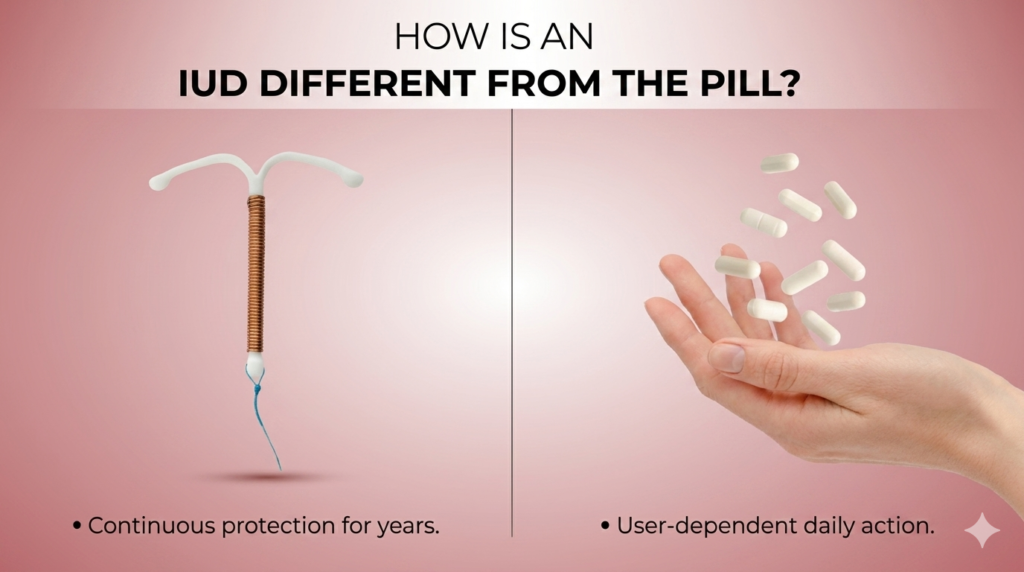
Quick Ans: The main difference between IUD vs pill is how birth control is used and how long it lasts. An IUD is a small device placed inside the uterus that provides long term contraception, while the pill is a daily oral medication that prevents pregnancy. Both are effective, but they differ in convenience, hormones, and usage method.
Many people compare IUD vs pill when choosing birth control options. Both methods are widely used for preventing pregnancy. Both can be highly effective when used correctly. However, they work in very different ways.
An IUD is inserted once and can last for years. The pill must be taken every day at the same time. Because of this difference, lifestyle plays a big role in choosing between them.
Some users prefer the pill because it feels more flexible. Others prefer an IUD because it requires less daily attention. Hormone levels, side effects, and cost also influence the decision.
Understanding IUD vs pill helps people make informed reproductive health choices. It also helps reduce confusion when talking to doctors or researching options.
In this guide, you will learn definitions, advantages, disadvantages, comparisons, real world examples, FAQs, and practical exercises. The goal is to make the topic simple and easy to understand.
Quick Answer: IUD vs Pill
A simple IUD vs pill comparison shows how different these methods are.
| Feature | IUD | Pill |
|---|---|---|
| Type | Intrauterine device | Oral contraceptive |
| Usage | Inserted once | Taken daily |
| Duration | 3 to 10 years | 24 hours per dose |
| Hormones | Hormonal or non hormonal | Usually hormonal |
| Effectiveness | Very high | High with correct use |
| Maintenance | Minimal | Daily responsibility |
In short, an IUD is long acting, while the pill is short term and daily.
What Is an IUD?
An IUD (Intrauterine Device) is a small T shaped device placed inside the uterus by a healthcare provider. It prevents pregnancy for several years depending on the type.
There are two main types:
- Hormonal IUD
- Copper IUD (non hormonal)
How the IUD Works
The IUD works in different ways depending on its type:
- Hormonal IUD thickens cervical mucus
- Copper IUD creates an environment toxic to sperm
- Both prevent fertilization
Because of these mechanisms, IUDs are highly effective at preventing pregnancy.
Duration of Protection
Different IUD types last for different periods:
- 3 years
- 5 years
- Up to 10 years
This long duration makes IUDs a popular choice for long term contraception.
How It Is Inserted
The insertion process includes:
- A medical exam
- Placement of device into uterus
- Short adjustment period
Although the procedure is quick, it must be done by a trained professional.
What Is the Birth Control Pill?
The birth control pill is a daily tablet taken to prevent pregnancy. It contains hormones that regulate the reproductive cycle.
There are two main types:
- Combination pill (estrogen and progestin)
- Progestin only pill
How the Pill Works
The pill prevents pregnancy by:
- Stopping ovulation
- Thickening cervical mucus
- Changing uterine lining
Because of these effects, sperm cannot easily reach or fertilize an egg.
How It Is Taken
The pill is taken:
- Once daily
- At the same time each day
- Without skipping doses
Consistency is very important for effectiveness.
Types of Pill Packs
Common pack types include:
- 21 day packs
- 28 day packs
- Continuous cycle pills
Each type follows a slightly different schedule.
Key Differences Between IUD vs Pill
Usage Method
The biggest difference in IUD vs pill is usage. The IUD is inserted once and works long term. The pill requires daily intake.
Duration
IUDs last several years. Pills last only 24 hours per dose.
Convenience
IUDs require minimal maintenance after insertion. Pills require daily discipline.
Hormonal Exposure
Some IUDs release hormones locally. Pills distribute hormones throughout the body.
Effectiveness
IUDs are more consistent because they do not depend on user memory. Pills are effective but can fail if doses are missed.
Advantages and Disadvantages
IUD Advantages
- Long term protection
- Very low maintenance
- Highly effective
- Reversible anytime
IUD Disadvantages
- Requires medical procedure
- May cause initial discomfort
- Possible side effects like cramping
- Higher upfront cost
Pill Advantages
- Easy to start or stop
- No procedure required
- Can regulate menstrual cycles
- Widely available
Pill Disadvantages
- Must be taken daily
- Effectiveness drops if missed
- Can cause hormone related side effects
- Requires routine discipline
Therefore, IUD vs pill choice depends on lifestyle and comfort level.
Real World Examples
Busy Lifestyle
A person with a busy schedule may prefer an IUD because it removes daily responsibility.
Teen or First Time User
Some may choose the pill first because it feels less invasive and easier to stop if needed.
Long Term Planning
Someone who wants long term pregnancy prevention may choose an IUD for several years of protection.
Short Term Control
A person planning pregnancy in the near future may prefer the pill for flexibility.
These examples show how IUD vs pill depends on personal goals.
Regional and Global Usage
Global Trends
Both methods are widely used worldwide. However, preference varies by healthcare access and education.
Developed Countries
In many developed regions, IUD use is increasing due to long term effectiveness.
Developing Countries
The pill remains popular because it is easier to access and does not require a procedure.
Cultural Factors
Cultural beliefs and medical awareness also influence the IUD vs pill decision in different regions.
Related Concepts and Comparisons
IUD vs Implant
Both are long acting methods, but implants go under the skin instead of the uterus.
Pill vs Patch
Both use hormones, but the patch is worn on the skin weekly instead of taken daily.
IUD vs Injection
Injections provide protection for a few months, while IUDs last for years.
| Method | Duration | Maintenance |
|---|---|---|
| IUD | Years | Very low |
| Pill | Daily | High |
| Injection | Months | Medium |
These comparisons help clarify IUD vs pill choices.
Common Mistakes About IUD vs Pill
Missing Pill Doses
Skipping pills reduces effectiveness significantly.
Assuming IUDs Are Permanent
IUDs can be removed anytime, so they are not permanent.
Ignoring Side Effects
Both methods can have hormonal side effects that vary by person.
Self Medicating Without Guidance
Choosing contraception without medical advice can lead to poor results.
Avoiding these mistakes improves safety and effectiveness.
Beginner to Advanced Guidance
Beginner Level
Start by consulting a healthcare provider before choosing any method.
Intermediate Level
Track side effects and cycle changes after starting a method.
Advanced Level
Work with a doctor to adjust hormone types or switch methods if needed.
This stepwise approach makes IUD vs pill easier to manage.
Step By Step Comparison Scenario
Imagine choosing contraception for yourself.
If you choose an IUD:
- Visit a clinic
- Get device inserted
- Follow up after placement
- Enjoy long term protection
If you choose the pill:
- Get prescription
- Start daily schedule
- Take pill at same time daily
- Maintain strict routine
Both methods work, but daily responsibility differs greatly.
Exercises With Answers
Exercise 1
Which method is long acting in the IUD vs pill comparison?
Answer: IUD.
Exercise 2
Which method requires daily intake?
Answer: Pill.
Exercise 3
Which method is inserted into the uterus?
Answer: IUD.
Exercise 4
Which method depends heavily on user consistency?
Answer: Pill.
Exercise 5
True or False: IUDs must be taken every day.
Answer: False.
When Should You Choose IUD vs Pill?
Choose an IUD if you:
- Want long term protection
- Prefer low maintenance
- Do not want daily reminders
Choose the pill if you:
- Want flexibility
- Prefer non invasive methods
- Plan short term contraception
Ultimately, IUD vs pill depends on lifestyle, comfort, and medical advice.
FAQs About IUD vs Pill
What is the main difference between IUD vs pill?
The main difference is that an IUD is a long acting device, while the pill is a daily medication.
Which is more effective, IUD or pill?
In the IUD vs pill comparison, IUDs are generally more effective because they do not rely on daily use.
Does an IUD hurt to insert?
Some discomfort may occur, but the procedure is quick and done by professionals.
Can I switch from pill to IUD?
Yes. A healthcare provider can help transition safely between methods.
Is the pill safe for long term use?
Yes, many people use it long term under medical supervision.
Can IUDs be removed anytime?
Yes, they can be removed by a healthcare provider whenever needed.
Which is better for teenagers, IUD or pill?
It depends on health needs and comfort, but both are commonly used with medical guidance.
Do IUDs stop periods?
Some hormonal IUDs can reduce or stop periods over time.
What happens if I miss a pill?
Effectiveness may decrease, so backup protection may be needed.
Is IUD vs pill decision permanent?
No. Both methods can be changed based on future needs.
Conclusion
The comparison of IUD vs pill shows that both are effective birth control methods, but they work differently. An IUD offers long term protection with minimal maintenance. The pill requires daily attention but offers flexibility and easy control.
Choosing between them depends on lifestyle, comfort, and medical advice. People who prefer convenience often choose IUDs. Those who want flexibility often choose pills.
Both methods are widely used and trusted worldwide. With proper guidance, either option can be safe and effective.
Understanding IUD vs pill helps you make informed reproductive health decisions with confidence.
Discover More:-
- Beaver vs Woodchuck: Key Differences, Habitat, Behavior, and Identification Guide
- Nashville vs Austin: Differences, Cost, Lifestyle, and Which City Is Better

Lisa Thompson is a USA-based content writer and language specialist focused on grammar, writing improvement and digital publishing.
She holds a degree in English Language and Communication and has professional experience in educational and web content creation.
As the author of Gramtivo.Com, she aims to help readers improve their writing skills through clear and practical guidance.