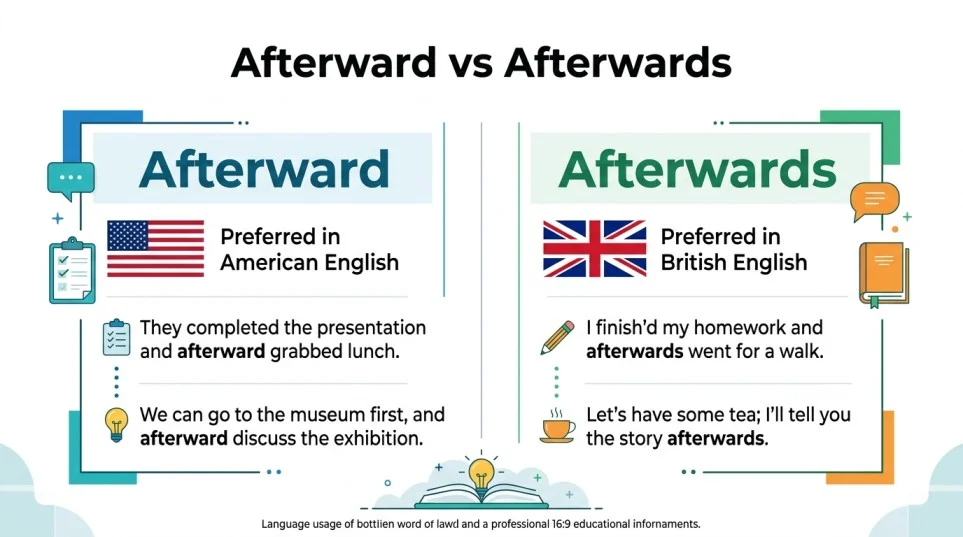
Quick Ans: The difference between afterward or afterwards is mainly regional preference, not meaning. Both words mean “at a later time” or “after something happens.” Generally, afterward is more common in American English, while afterwards is preferred in British English.
Many English learners and writers wonder about afterward or afterwards. The two words look almost identical. They sound the same. They also carry the same meaning.
As a result, people often assume one must be correct and the other wrong.
However, that is not the case.
Both words are accepted in modern English. The real difference comes from regional usage and writing style. American writers usually prefer afterward, while British writers often choose afterwards. Despite this distinction, readers understand both versions easily.
The confusion becomes more noticeable when writing essays, business emails, blog posts, academic papers, or professional documents. Many writers worry about consistency and correctness.
Understanding afterward or afterwards helps you write more confidently and avoid unnecessary editing mistakes. It also improves consistency when writing for international audiences.
This guide explains the meaning, differences, advantages, disadvantages, examples, common mistakes, exercises, and frequently asked questions. By the end, you will know exactly when to use each form.
Quick Answer: Afterward or Afterwards
The simplest answer is that both words are correct.
| Feature | Afterward | Afterwards |
|---|---|---|
| Meaning | Later, after that | Later, after that |
| American English | Preferred | Less common |
| British English | Less common | Preferred |
| Formal Writing | Accepted | Accepted |
| Informal Writing | Accepted | Accepted |
In short:
- Afterward is more common in American English.
- Afterwards is more common in British English.
- Both mean exactly the same thing.
What Does Afterward Mean?
Afterward is an adverb that means “later” or “after that time.”
It refers to something that happens following an earlier event.
Examples of Afterward
- We finished dinner and afterward went for a walk.
- She completed the exam and afterward met her friends.
- The meeting ended at noon. Afterward, everyone returned to work.
In each sentence, afterward describes an action that occurred later.
Why American English Prefers Afterward
American English often drops the final s from certain adverbs.
Examples include:
- Toward instead of towards
- Forward instead of forwards
- Backward instead of backwards
- Afterward instead of afterwards
Because of this pattern, afterward appears more frequently in American publications.
What Does Afterwards Mean?
Afterwards is also an adverb meaning “later” or “following that event.”
The definition remains identical to afterward.
Examples of Afterwards
- We visited the museum and afterwards had lunch.
- He finished the presentation and afterwards answered questions.
- The movie ended, and afterwards everyone discussed it.
These examples show that afterwards functions exactly like afterward.
Why British English Prefers Afterwards
British English commonly retains the ending s in several adverbs.
Examples include:
- Towards
- Forwards
- Backwards
- Afterwards
Therefore, British publications often favor afterwards.
Key Differences Between Afterward or Afterwards
Meaning
There is no difference in meaning.
Both words mean:
- Later
- After that
- Following an event
Regional Preference
The primary distinction involves geography.
Afterward appears more often in:
- United States
- American publications
- American business writing
Afterwards appears more often in:
- United Kingdom
- Australia
- New Zealand
- Many British English publications
Style Consistency
Consistency matters more than the choice itself.
For example, if you use American spelling throughout a document, choose afterward. If you use British spelling, choose afterwards.
Advantages and Disadvantages
Advantages of Afterward
- Preferred in American English
- Common in US business writing
- Fits American style guides
- Widely recognized
Disadvantages of Afterward
- May appear less familiar to some British readers
- Less common in British publications
Advantages of Afterwards
- Preferred in British English
- Common in international publications
- Matches British spelling conventions
- Familiar to many global readers
Disadvantages of Afterwards
- Less common in American style guides
- May seem inconsistent in US-focused writing
Because both forms are correct, the choice depends largely on audience and style.
Real World Examples
Business Email
American English:
“The conference ended at 3 p.m. Afterward, we met with clients.”
British English:
“The conference ended at 3 p.m. Afterwards, we met with clients.”
Academic Writing
American university paper:
“The experiment concluded. Afterward, researchers analyzed the data.”
British university paper:
“The experiment concluded. Afterwards, researchers analysed the data.”
Blog Writing
Both versions work:
- Afterward, I shared my experience online.
- Afterwards, I shared my experience online.
Readers will understand either choice.
Regional and Global Usage
United States
Most American publications prefer afterward.
Examples include:
- Newspapers
- Business reports
- Educational materials
United Kingdom
British publications generally use afterwards.
Common examples include:
- Newspapers
- Government documents
- Academic journals
International English
International audiences usually accept both forms. However, consistency throughout a document remains important.
Therefore, writers should choose one style and maintain it.
Related Concepts and Comparisons
Afterward vs Then
Both can indicate sequence.
Examples:
- We ate dinner. Then we watched television.
- We ate dinner. Afterward, we watched television.
However, afterward specifically emphasizes something occurring after an earlier event.
Afterward vs Later
These words are often interchangeable.
Examples:
- I’ll call you later.
- I’ll call you afterward.
In some contexts, though, later sounds more natural.
Afterward vs Subsequently
Subsequently is more formal.
Examples:
- The company launched a product. Subsequently, sales increased.
- The company launched a product. Afterward, sales increased.
Business and academic writing may prefer subsequently for a formal tone.
Common Mistakes About Afterward or Afterwards
Thinking One Is Incorrect
Many writers assume only one version is acceptable.
In reality, both forms are grammatically correct.
Mixing Styles
Switching between American and British spelling can create inconsistency.
Example:
❌ The event ended afterward. Afterwards, everyone left.
Better:
✔ The event ended afterward. Afterward, everyone left.
Or:
✔ The event ended afterwards. Afterwards, everyone left.
Using Them as Adjectives
These words function as adverbs, not adjectives.
Incorrect:
❌ The afterward meeting was important.
Correct:
✔ The meeting happened afterward.
Overusing Them
Repeating either word too often can make writing sound repetitive.
Instead, vary your language with words such as:
- Then
- Later
- Subsequently
- Next
Beginner to Advanced Writing Tips
Beginner Level
Choose the version that matches your country’s English style.
Intermediate Level
Check spelling consistency throughout documents.
Advanced Level
Adapt usage based on audience expectations.
For example:
- American readers often expect afterward.
- British readers often expect afterwards.
Professional writers frequently adjust wording for regional audiences.
Step By Step Usage Scenario
Imagine you are writing a report.
If your audience is American:
- Use American spelling.
- Write “afterward.”
- Keep the style consistent.
- Review for uniform language.
If your audience is British:
- Use British spelling.
- Write “afterwards.”
- Maintain British conventions.
- Check consistency before publishing.
The meaning remains unchanged in both cases.
Exercises With Answers
Exercise 1
Which word is preferred in American English?
Answer: Afterward.
Exercise 2
Which word is more common in British English?
Answer: Afterwards.
Exercise 3
Do afterward and afterwards have different meanings?
Answer: No.
Exercise 4
Choose the correct sentence:
A. We went home afterward.
B. We went home afterwards.
Answer: Both are correct.
Exercise 5
True or False: Afterwards is grammatically incorrect.
Answer: False.
When Should You Choose Afterward or Afterwards?
Choose afterward if you:
- Write for American readers
- Follow American style guides
- Use American spelling conventions
Choose afterwards if you:
- Write for British readers
- Follow British style guides
- Use British spelling conventions
If audience location is unclear, either form works. The most important rule is consistency.
FAQs About Afterward or Afterwards
What is the difference between afterward or afterwards?
The difference is regional preference. Afterward is more common in American English, while afterwards is more common in British English.
Is afterward or afterwards more correct?
Neither is more correct. Both forms are grammatically acceptable.
Do afterward and afterwards mean the same thing?
Yes. Both words mean “later” or “after that.”
Which form should I use in American English?
American English typically prefers afterward.
Which form should I use in British English?
British English generally prefers afterwards.
Can I use afterward in academic writing?
Yes. Afterward is perfectly acceptable in academic writing that follows American English conventions.
Can I use afterwards in professional writing?
Yes. Afterwards is appropriate in professional writing, especially when using British English.
Should I use both forms in the same document?
No. Choose one version and remain consistent.
Is afterwards old-fashioned?
No. Afterwards remains common in modern British English.
Which version is more common globally?
Both are widely understood, although usage often depends on regional writing standards.
Conclusion
Understanding afterward or afterwards is simpler than many people think. Both words share the same meaning and serve the same grammatical purpose. Neither form is incorrect.
The main difference comes from regional preference. American English usually favors afterward, while British English commonly uses afterwards. Because readers understand both versions, communication rarely suffers regardless of the choice.
What matters most is consistency. If you follow American spelling conventions, use afterward throughout your document. If you follow British conventions, choose afterwards and maintain that style from beginning to end.
Professional writers, students, bloggers, and business professionals all benefit from understanding this distinction. Consistent usage improves readability and creates a polished appearance.
When deciding between afterward or afterwards, think about your audience first. Then select the version that matches the language style you are using. Doing so will ensure clear, professional, and confident writing.
Discover More:-
- Theragun vs Hypervolt: Detailed Comparison, Features, and Buying Guide
- Balcony vs Patio: Differences, Uses, and Outdoor Space Guide

Jennifer Collins is a professional grammar expert and language educator at gramtivo.com, specializing in English grammar, writing skills, and language improvement. She holds a Master’s degree in English Language and Literature from a recognized university in the United States. With years of teaching and content development experience, she is dedicated to helping learners improve their communication skills with clear and practical guidance.