
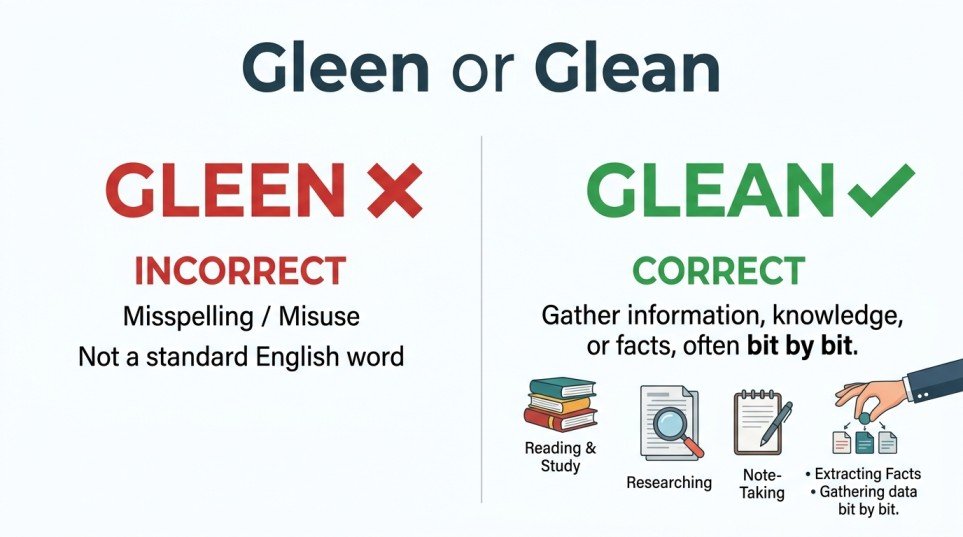
Quick Ans: The correct word is “glean.” The spelling “gleen” is usually a misspelling or typing error. “Glean” means to collect information, ideas, or leftover items carefully from different sources.
Many people search for gleen or glean because the two words look very similar. One letter changes, yet the meaning and correctness become completely different.
The confusion usually happens while typing quickly. Some people hear the pronunciation and assume “gleen” is a real word. Others accidentally mix it with words like “green” or “gleam.”
However, standard English dictionaries recognize only one correct spelling in most situations: glean.
Understanding the difference matters because spelling errors can affect writing quality, school assignments, emails, and professional communication. A small mistake may confuse readers or make content appear less polished.
Fortunately, the explanation is simple.
In this complete guide, you will learn the meaning of glean, why “gleen” is incorrect, common mistakes, grammar examples, pronunciation tips, exercises with answers, and frequently asked questions. By the end, you will confidently know when and how to use the correct word.
Quick Answer: Gleen or Glean
Here is the simple answer.
| Word | Correct or Incorrect | Meaning |
|---|---|---|
| Glean | Correct | To gather information or leftover items |
| Gleen | Usually incorrect | Common misspelling of “glean” |
Therefore, if you are choosing between gleen or glean, the correct word is almost always glean.
What Does Glean Mean?
The word glean means to gather something little by little. People often use it when talking about collecting information, ideas, facts, or leftover crops.
Common Meanings of Glean
Glean can mean:
- Collecting useful information
- Learning gradually from different sources
- Gathering leftover crops from fields
Because of these meanings, the word appears in both everyday English and professional writing.
Examples of Glean in Sentences
Here are some simple examples:
- She gleaned useful advice from the meeting.
- Researchers gleaned data from several reports.
- Farmers once gleaned leftover grain after harvest.
- He gleaned important facts from the interview.
In each example, the idea involves collecting something carefully.
Origin of the Word Glean
The word comes from old agricultural practices. Poor workers collected leftover grain after fields were harvested. Over time, the meaning expanded beyond farming.
Today, people mostly use glean when discussing information or knowledge.
Is Gleen a Real Word?
In standard English, gleen is generally not considered a correct word.
Most dictionaries do not recognize it as a valid spelling. Instead, they identify it as a typo or misspelling of “glean.”
Why People Type “Gleen”
Several reasons cause this mistake:
- Fast typing
- Pronunciation confusion
- Mixing similar sounding words
- Autocorrect errors
Since English spelling can be confusing, mistakes like this happen often.
When You Might See “Gleen”
You may occasionally notice “gleen” in:
- Online comments
- Social media posts
- Informal writing
- Typing mistakes
However, professional writing should use “glean.”
Key Differences Between Gleen or Glean
Correctness
The biggest difference between gleen or glean is correctness.
- Glean is correct.
- Gleen is usually incorrect.
Dictionary Recognition
Major dictionaries include “glean.” Most do not include “gleen.”
Usage in Writing
Professional writers, teachers, editors, and businesses use “glean.”
Misspellings like “gleen” should be avoided in formal communication.
Meaning
“Glean” has a clear meaning related to gathering information or items carefully. “Gleen” usually has no accepted meaning in modern English.
Advantages and Disadvantages of Using the Correct Spelling
Advantages of Using “Glean”
Using the correct spelling provides many benefits:
- Improves writing quality
- Builds credibility
- Prevents confusion
- Helps professional communication
- Matches dictionary standards
Disadvantages of Using “Gleen”
Using the incorrect spelling may cause problems:
- Creates spelling mistakes
- Confuses readers
- Looks unprofessional
- May affect grades or work quality
Therefore, choosing the correct spelling matters in both academic and business writing.
Real World Examples
In School Writing
Students often write essays and reports. Using “glean” correctly shows good grammar and vocabulary skills.
Example:
- The student gleaned information from several books.
In Business Communication
Professionals use “glean” when discussing research or data collection.
Example:
- The company gleaned customer insights from surveys.
In Journalism
Reporters frequently glean facts from interviews, documents, and public records.
These examples show how common the word “glean” is in real communication.
Regional and Global Usage
American English
American English strongly favors the spelling “glean.”
British English
British English also uses “glean” as the standard spelling.
International English
Writers around the world recognize “glean” as the correct form. Therefore, the confusion between gleen or glean appears mostly because of typing mistakes rather than regional language differences.
Related Concepts and Comparisons
Glean vs Gather
Both words involve collecting something. However, “glean” often suggests gathering small pieces carefully over time.
Glean vs Learn
Learning means gaining knowledge generally. Gleaning usually means collecting bits of information from multiple sources.
Glean vs Collect
Collect is broader. Glean often implies effort and careful observation.
| Word | Main Meaning | Usage Style |
|---|---|---|
| Glean | Gather gradually | Specific and careful |
| Gather | Bring together | General |
| Learn | Gain knowledge | Educational |
| Collect | Accumulate items | Broad use |
Understanding these related words helps clarify the meaning of “glean.”
Common Mistakes About Gleen or Glean
Using “Gleen” in Formal Writing
This is the most common mistake. Formal writing should use “glean.”
Confusing Pronunciation
Some people spell words based on sound. Since “glean” sounds similar to other words ending in “een,” confusion happens easily.
Ignoring Spell Check
Spell check tools often catch “gleen.” Ignoring corrections may leave mistakes in final writing.
Mixing Similar Words
People sometimes confuse glean with:
- Gleam
- Green
- Clean
Careful proofreading helps avoid these errors.
Beginner to Advanced Usage Tips
Beginner Level
Remember this simple rule:
- Glean = correct
- Gleen = incorrect
Intermediate Level
Practice using “glean” in sentences about gathering information.
Example:
- I gleaned useful tips from the article.
Advanced Level
Use “glean” naturally in professional or academic writing.
Examples include:
- market research
- customer feedback
- historical analysis
- investigative journalism
As vocabulary skills improve, the word becomes easier to use correctly.
Step By Step Learning Scenario
Imagine reading several news articles.
First, you read one report.
Next, you compare different sources.
Then, you gather useful details from each article.
In this situation, you glean information from multiple sources.
Now imagine typing “gleen information.” That spelling would be incorrect in professional English.
Exercises With Answers
Exercise 1
Which spelling is correct in standard English?
Answer: Glean.
Exercise 2
What does “glean” usually mean?
Answer: To gather information or items gradually.
Exercise 3
Is “gleen” accepted in most dictionaries?
Answer: No.
Exercise 4
Choose the correct sentence:
- She gleaned useful facts from the report.
- She gleened useful facts from the report.
Answer: She gleaned useful facts from the report.
Exercise 5
True or False: “Glean” can refer to collecting information carefully.
Answer: True.
When Should You Use Glean?
Use “glean” when talking about:
- Collecting information
- Learning from different sources
- Gathering small details
- Finding useful insights
Examples include:
- gleaning research data
- gleaning customer feedback
- gleaning historical facts
Avoid using “gleen” in professional or academic communication.
FAQs About Gleen or Glean
Which is correct, gleen or glean?
The correct spelling is “glean.” “Gleen” is usually a misspelling.
What does glean mean?
Glean means to gather information, ideas, or leftover items carefully and gradually.
Is gleen a real English word?
Most dictionaries do not recognize “gleen” as a standard English word.
Why do people confuse gleen or glean?
The confusion often comes from pronunciation, fast typing, or spelling mistakes.
Can glean be used in professional writing?
Yes. Writers commonly use “glean” in business, journalism, and academic writing.
How do you remember the correct spelling of glean?
Think of “glean” as gathering knowledge carefully from different places.
What is an example sentence with glean?
Example: Researchers gleaned valuable insights from customer surveys.
Is glean a formal word?
Yes. It appears often in formal and professional English.
Can glean refer to physical objects?
Yes. Historically, it referred to collecting leftover crops after harvest.
Should I ever use gleen instead of glean?
No. Standard English writing should use “glean.”
Conclusion
Understanding gleen or glean is actually very simple once you know the correct spelling. “Glean” is the accepted English word, while “gleen” is usually a typing mistake or misspelling.
The word “glean” means gathering information, ideas, or leftover items carefully over time. Because of this meaning, it appears frequently in academic writing, journalism, research, and business communication.
Using the correct spelling improves professionalism and writing clarity. It also prevents confusion for readers. Although many people accidentally type “gleen,” proofreading and spell check tools can help avoid the mistake.
Whenever you need to describe collecting useful knowledge or details, choose “glean.” With regular practice, the correct spelling becomes easy to remember and use confidently.
Discover More:-

Jennifer Collins is a professional grammar expert and language educator at gramtivo.com, specializing in English grammar, writing skills, and language improvement. She holds a Master’s degree in English Language and Literature from a recognized university in the United States. With years of teaching and content development experience, she is dedicated to helping learners improve their communication skills with clear and practical guidance.