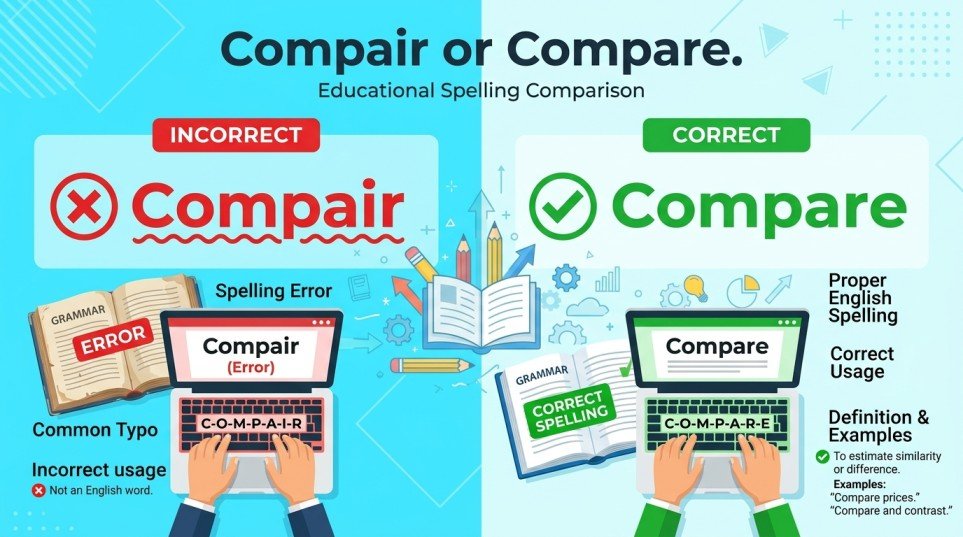
Quick Ans: The correct spelling is compare, not compair. “Compare” means to examine two or more things to find similarities or differences. “Compair” is a common spelling mistake and is not accepted in standard English dictionaries.
Many English learners and writers search for compair or compare because the two words look and sound similar. The confusion often happens during typing or spelling. Since English contains many words with unusual spelling patterns, mistakes like this are common.
However, only one spelling is correct.
The word compare is the proper English verb used in writing, speaking, education, and business communication. On the other hand, compair is considered incorrect in modern English.
People frequently make this mistake because words such as “pair” and “repair” contain the “air” spelling pattern. As a result, some writers accidentally type “compair” instead of “compare.”
Understanding the difference between compair or compare is important for students, professionals, bloggers, and anyone learning English grammar. Correct spelling improves communication, writing quality, and search engine visibility.
This guide explains the meaning, usage, grammar rules, examples, common mistakes, exercises, and related comparisons. By the end, you will know exactly which spelling to use.
Quick Answer: Compair or Compare
The correct word is compare.
| Word | Correct or Incorrect | Meaning |
|---|---|---|
| Compare | Correct | To examine similarities and differences |
| Compair | Incorrect | Misspelling of compare |
Therefore, always use compare in formal and informal writing.
What Does Compare Mean?
The word compare means to examine two or more things to identify similarities, differences, or both.
People use “compare” in:
- School assignments
- Business reports
- Product reviews
- Daily conversations
- Academic writing
Simple Definition
To compare means:
- To look at similarities
- To notice differences
- To evaluate two things side by side
For example:
- “Teachers compare student progress.”
- “Customers compare prices before buying.”
- “Writers compare ideas in essays.”
Because comparison helps people make decisions, the word appears frequently in English communication.
Why Do People Write “Compair”?
The spelling mistake happens for several reasons.
Similar Sound Patterns
Words like these influence spelling:
- Pair
- Repair
- Fair
- Stair
Since “pair” sounds similar to the ending of compare, many people mistakenly write “compair.”
Fast Typing Errors
Typing quickly can also create spelling mistakes. Autocorrect sometimes fails to catch uncommon errors.
English Learning Challenges
English spelling rules are not always consistent. Therefore, learners often confuse vowel combinations such as:
- Are
- Air
- Ear
As a result, “compair” becomes a common mistake.
Correct Usage of Compare
The word “compare” works as a verb.
Examples in Sentences
- “Please compare the two products.”
- “Scientists compare research results carefully.”
- “Parents often compare schools before enrollment.”
- “Customers compare prices online.”
Each sentence uses the correct spelling and grammar structure.
Compare With vs Compare To
English grammar includes two common structures.
| Phrase | Usage |
|---|---|
| Compare with | Shows similarities and differences |
| Compare to | Shows resemblance or analogy |
Examples:
- “Compare this phone with that model.”
- “She compared his voice to music.”
Although both forms are correct, they serve different purposes.
Key Differences Between Compair or Compare
Dictionary Acceptance
The word “compare” appears in English dictionaries. “Compair” does not.
Professional Writing
Teachers, editors, and employers expect correct spelling. Using “compair” may reduce credibility.
Search Engine Recognition
Search engines recognize “compare” as the standard word. Incorrect spelling may affect SEO and readability.
Grammar Accuracy
Using proper spelling strengthens grammar and communication quality.
Therefore, understanding compair or compare improves both writing and professionalism.
Advantages of Using Correct Spelling
Better Communication
Correct spelling helps readers understand ideas quickly.
Improved Academic Writing
Students earn better grades when grammar and spelling are accurate.
Professional Credibility
Business communication requires polished language. Correct spelling creates a stronger impression.
Stronger SEO Performance
Search engines favor properly spelled keywords and content.
Because of these benefits, writers should always choose “compare.”
Disadvantages of Using “Compair”
Looks Unprofessional
Misspelled words reduce writing quality.
Confuses Readers
Readers may stop and question the meaning.
Hurts Search Rankings
Incorrect spelling can reduce search engine optimization performance.
Weakens Academic Work
Teachers and professors often mark spelling mistakes as grammar errors.
For these reasons, avoiding “compair” is important.
Real World Examples
In Schools
Students compare books, essays, and historical events during assignments.
Example:
- “Compare the two characters in the story.”
In Business
Companies compare products, prices, and performance data.
Example:
- “Managers compare sales reports every month.”
In Technology
Consumers compare smartphones, laptops, and software before buying.
Example:
- “Buyers compare features online before making decisions.”
These examples show how often “compare” appears in daily life.
Regional and Global Usage
American English
American English uses “compare” as the standard spelling.
British English
British English also uses “compare.” There is no regional variation for “compair.”
International English Learning
English learners around the world study “compare” in grammar and vocabulary lessons.
Therefore, the correct spelling remains consistent globally.
Related Concepts and Comparisons
Compare vs Contrast
| Word | Meaning |
|---|---|
| Compare | Focus on similarities and differences |
| Contrast | Focus mainly on differences |
Example:
- “Compare the two phones.”
- “Contrast their prices.”
Compare vs Compete
Although these words sound somewhat similar, their meanings differ completely.
| Word | Meaning |
|---|---|
| Compare | Examine similarities or differences |
| Compete | Try to win against someone |
Compare vs Match
“Compare” means analyze. “Match” means pair or fit together.
Understanding these related words improves vocabulary accuracy.
Common Mistakes About Compair or Compare
Using “Compair” in Essays
Students sometimes type “compair” during exams or assignments. Spell check tools may not always catch the mistake.
Confusing Compare and Contrast
Some writers assume both words mean exactly the same thing. However, contrast focuses mainly on differences.
Incorrect Grammar Structure
Writers sometimes misuse “compare to” and “compare with.”
Correct examples:
- “Compare this car with that one.”
- “He compared her smile to sunshine.”
Relying Only on Autocorrect
Autocorrect tools help, but they do not catch every error. Proofreading remains important.
Avoiding these mistakes improves writing quality significantly.
Beginner to Advanced Writing Tips
Beginner Level
Read sentences aloud to check spelling and grammar.
Intermediate Level
Practice using “compare with” and “compare to” correctly in writing exercises.
Advanced Level
Use comparison techniques in essays, reports, and analytical writing.
For example:
- Compare historical events
- Compare business strategies
- Compare scientific results
As your writing improves, correct word usage becomes automatic.
Step By Step Memory Trick
Here is an easy way to remember the correct spelling.
- Focus on the word “pare” inside compare
- Notice that “compare” ends with “pare”
- Avoid adding “air” like in “pair”
- Practice typing the correct spelling regularly
This simple method helps reduce spelling mistakes.
Exercises With Answers
Exercise 1
Which spelling is correct?
- Compair
- Compare
Answer: Compare.
Exercise 2
Fill in the blank:
“Please ______ the two products carefully.”
Answer: Compare.
Exercise 3
True or False: “Compair” is accepted in standard English dictionaries.
Answer: False.
Exercise 4
Which phrase is correct?
- Compare with
- Compair with
Answer: Compare with.
Exercise 5
Which word focuses mainly on differences?
Answer: Contrast.
When Should You Use Compare?
Use “compare” when you want to:
- Examine similarities
- Evaluate differences
- Analyze products or ideas
- Discuss choices
- Write academic essays
The word works in formal and informal situations.
FAQs About Compair or Compare
Which is correct, compair or compare?
The correct spelling is “compare.” “Compair” is a spelling mistake.
Is compair a real English word?
No. Standard English dictionaries do not recognize “compair.”
Why do people misspell compare as compair?
People often confuse spelling patterns because words like “pair” contain similar sounds.
How can I remember the correct spelling of compare?
Remember that the word ends with “pare,” not “pair.”
Can using compair hurt professional writing?
Yes. Misspelled words can reduce credibility and professionalism.
What does compare mean in English?
It means to examine similarities and differences between two or more things.
Is compare used in academic writing?
Yes. Teachers and researchers frequently use comparison in essays and reports.
What is the difference between compare and contrast?
Compare examines similarities and differences, while contrast focuses mostly on differences.
Do British and American English spell compare differently?
No. Both use the spelling “compare.”
Can spell check tools detect compair?
Some tools can detect it, but proofreading is still important.
Conclusion
Understanding compair or compare is simple once you know the correct spelling. The proper word is compare, which means to examine similarities and differences between things. Meanwhile, “compair” is only a spelling mistake.
This confusion often happens because English spelling patterns can be tricky. Words like “pair” influence how people type similar sounding words. However, professional writing, academic work, and business communication all require the correct spelling.
Using “compare” improves grammar, readability, and credibility. It also helps search engine optimization and overall communication quality.
Whenever you write essays, reports, emails, or online content, double check spelling carefully. Small corrections can make writing look far more professional.
By mastering the difference between compair or compare, you strengthen your English skills and avoid a very common mistake.
Discover More:-
- Malignant or Benign: Key Differences, Symptoms, and Diagnosis Guide
- Right or Racist: Understanding the Difference Between Opinion and Racism

Lisa Thompson is a USA-based content writer and language specialist focused on grammar, writing improvement and digital publishing.
She holds a degree in English Language and Communication and has professional experience in educational and web content creation.
As the author of Gramtivo.Com, she aims to help readers improve their writing skills through clear and practical guidance.