
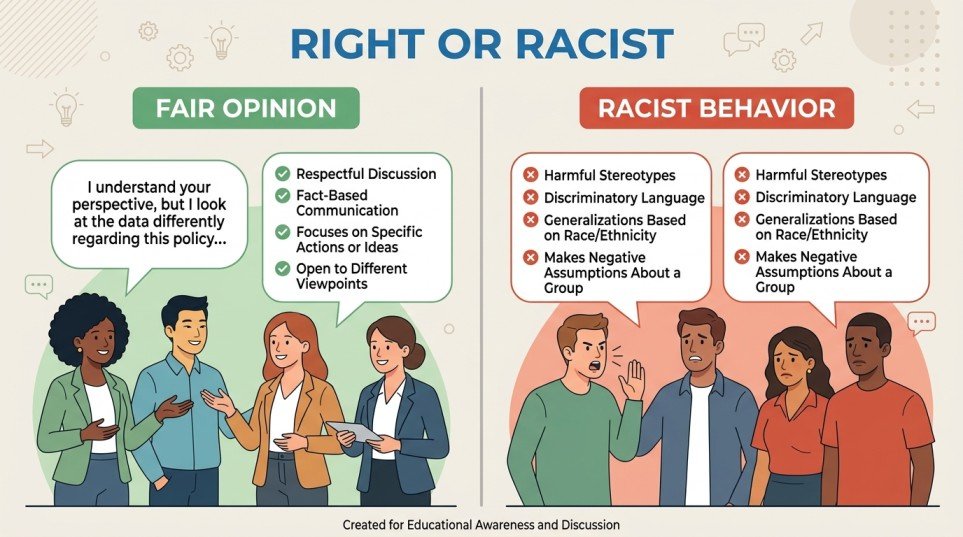
Quick Ans: The difference between being “right or racist” depends on intention, language, behavior, and impact. A statement can express an opinion or concern without being racist, but it becomes racist when it unfairly stereotypes, discriminates against, or attacks people based on race or ethnicity.
Many people search for right or racist when trying to understand whether a comment, opinion, joke, or public statement crosses the line into racism. Conversations about race happen every day online, at work, in schools, and in politics. Because of that, confusion often appears when people debate sensitive topics.
Sometimes a person believes they are simply expressing an opinion. However, others may view the same words as offensive or discriminatory. This difference in perception creates arguments and misunderstanding.
The challenge becomes even harder because context matters. Tone, wording, history, and intent can all change how a statement is understood. In addition, social and cultural differences influence how people react.
Understanding the distinction between right or racist helps improve communication and reduce harmful behavior. It also encourages respectful discussion without unfairly attacking others.
This guide explains the topic clearly and professionally. You will learn definitions, examples, common mistakes, social impact, and practical exercises that make the concept easier to understand.
Quick Answer: Right or Racist
To understand right or racist, focus on whether the statement targets ideas or unfairly targets people because of race or ethnicity.
| Situation | Right or Fair Opinion | Racist Behavior |
|---|---|---|
| Criticizing a policy | Yes | No |
| Stereotyping a racial group | No | Yes |
| Discussing crime statistics carefully | Sometimes | Depends on wording |
| Insulting people based on race | No | Yes |
| Treating people equally | Yes | No |
In simple terms, criticism becomes racist when it attacks or stereotypes people because of race rather than addressing actions, policies, or individual behavior.
What Does “Right” Mean in Discussions About Race?
In conversations about race, “right” usually means a person believes their opinion is factual, fair, or justified.
People may discuss topics such as:
- Immigration
- Crime
- Culture
- Religion
- Politics
- Social behavior
Having an opinion about these topics is not automatically racist. In many cases, people simply disagree on solutions or perspectives.
Examples of Non Racist Opinions
The following examples focus on ideas rather than race:
- “The government should improve border security.”
- “Schools need better education funding.”
- “Crime rates should be reduced in every community.”
These statements discuss policies or social issues without targeting a racial group.
Why Context Matters
Context changes interpretation significantly.
For example:
- A calm discussion about cultural differences may be acceptable.
- Repeating harmful stereotypes about an ethnic group becomes discriminatory.
Therefore, wording and intent matter greatly in the right or racist debate.
What Is Racism?
Racism involves prejudice, discrimination, or hostility toward people because of race or ethnicity.
It can appear in several forms:
- Direct insults
- Harmful stereotypes
- Exclusion
- Unequal treatment
- Hate speech
- Systemic discrimination
Racism can be obvious or subtle depending on the situation.
Common Examples of Racism
Examples include:
- Saying one race is superior to another
- Assuming negative traits based on ethnicity
- Refusing equal opportunities because of race
- Mocking accents, skin color, or cultural identity
These behaviors move beyond opinion and become discriminatory.
Overt vs Subtle Racism
Some racism is direct and obvious. Other forms are indirect.
Overt racism includes racial slurs or explicit discrimination. Subtle racism may involve coded language, stereotypes, or assumptions hidden behind “jokes” or vague comments.
Because subtle racism is harder to identify, many debates arise around the topic of right or racist.
Key Differences Between Right or Racist
Focus of the Statement
Fair criticism focuses on actions, behavior, or policies.
Racist statements focus on race or ethnicity itself.
Treatment of Individuals
Non racist opinions treat people as individuals. Racism assumes all members of a racial group are the same.
Evidence and Logic
Reasonable arguments use facts carefully and avoid harmful stereotypes. Racist arguments often rely on fear, prejudice, or generalizations.
Intent and Impact
Intent matters, but impact matters too.
A person may not intend harm. Nevertheless, repeated stereotypes can still hurt people and reinforce discrimination.
Advantages of Respectful Discussion
Healthy discussions about social issues provide several benefits.
Encourages Understanding
Respectful conversations help people understand different experiences and viewpoints.
Reduces Conflict
Careful wording lowers tension during difficult discussions.
Promotes Better Solutions
Communities solve problems more effectively when discussions remain respectful and fact based.
Builds Trust
People communicate more openly when they feel respected rather than attacked.
Dangers of Racist Language and Behavior
Creates Division
Racism divides communities and increases social tension.
Spreads False Stereotypes
Generalizations often ignore facts and individual differences.
Causes Emotional Harm
Discrimination can affect confidence, mental health, and opportunities.
Damages Public Discussion
Conversations become hostile when racism replaces respectful debate.
Because of these risks, understanding right or racist matters in schools, workplaces, and online spaces.
Real World Examples
Example 1: Policy Discussion
Statement: “The city should improve law enforcement funding.”
This focuses on policy. Therefore, it is not automatically racist.
Example 2: Harmful Generalization
Statement: “People from that race are criminals.”
This becomes racist because it stereotypes an entire group.
Example 3: Workplace Situation
A manager refuses to hire someone because of ethnicity.
That behavior is discriminatory and racist.
Example 4: Online Discussions
Social media often creates confusion because tone is difficult to interpret. Consequently, comments may appear more aggressive or offensive than intended.
Regional and Global Perspectives
Different Cultural Standards
Different countries discuss race differently. Words considered acceptable in one place may be offensive elsewhere.
Historical Influence
History strongly shapes racial discussions. Countries with histories of slavery, segregation, colonialism, or ethnic conflict often treat racial language more seriously.
Online Communication
Global internet platforms bring together people from many cultures. Because of this, misunderstandings happen frequently.
The right or racist debate therefore depends partly on social and historical context.
Related Concepts and Comparisons
Prejudice vs Racism
Prejudice means forming unfair opinions about people. Racism specifically involves race or ethnicity.
Discrimination vs Racism
Discrimination can involve age, gender, religion, or disability. Racism focuses specifically on race.
Free Speech vs Hate Speech
Free speech allows people to express opinions. Hate speech targets groups with harmful or threatening language.
Stereotypes vs Facts
Stereotypes oversimplify groups of people. Facts require evidence and careful interpretation.
Understanding these related concepts makes discussions more accurate and responsible.
Common Mistakes in the Right or Racist Debate
Assuming Every Disagreement Is Racist
Not all criticism or political disagreement is racist.
Ignoring Harmful Stereotypes
At the same time, harmful stereotypes should not be dismissed as harmless jokes.
Generalizing Entire Groups
People within any racial or ethnic group are individuals with different experiences and beliefs.
Using Emotional Language
Aggressive wording often escalates conflict and reduces productive discussion.
Avoiding these mistakes helps conversations remain respectful and balanced.
Beginner to Advanced Communication Tips
Beginner Level
Speak carefully and avoid stereotypes. Listen actively during discussions.
Intermediate Level
Learn cultural history and understand why certain language may offend people.
Advanced Level
Develop skills in conflict resolution, respectful debate, and inclusive communication.
Strong communication skills reduce misunderstanding and improve social relationships.
Step By Step Thinking Scenario
Imagine hearing a controversial statement online.
First, ask:
- Is the statement criticizing behavior or race?
- Does it stereotype an entire group?
- Is evidence being used responsibly?
- Could the wording harm or exclude people?
- Is there a respectful way to express the same concern?
This process helps evaluate whether something falls into the right or racist category.
Exercises With Answers
Exercise 1
Which statement is more likely to be racist?
A: “The government should improve immigration laws.”
B: “People from that ethnicity are dangerous.”
Answer: B.
Exercise 2
True or False: Criticizing a policy is automatically racist.
Answer: False.
Exercise 3
What makes stereotypes harmful?
Answer: They unfairly generalize entire groups of people.
Exercise 4
Can intent and impact both matter?
Answer: Yes.
Exercise 5
Should respectful communication avoid personal attacks?
Answer: Yes.
When Should You Reconsider a Statement?
You should reconsider wording if:
- It stereotypes racial groups
- It insults people based on ethnicity
- It spreads unsupported claims
- It creates unnecessary hostility
- It ignores individual differences
Respectful communication allows difficult conversations without promoting racism.
FAQs About Right or Racist
What does right or racist mean?
The phrase refers to deciding whether a statement is fair criticism or discriminatory toward people because of race.
Can someone disagree with immigration policy without being racist?
Yes. Policy disagreement is not automatically racist if it avoids racial stereotypes and discrimination.
What makes a comment racist?
A comment becomes racist when it unfairly stereotypes, insults, or discriminates against people based on race or ethnicity.
Is intent important in the right or racist debate?
Yes. However, impact also matters because harmful stereotypes can affect people even without bad intent.
Can jokes be racist?
Yes. Jokes that rely on racial stereotypes or mock ethnic groups can be racist.
Are stereotypes always harmful?
Stereotypes oversimplify groups and often create unfair assumptions.
What is the difference between prejudice and racism?
Prejudice involves unfair opinions generally, while racism specifically targets race or ethnicity.
Why do people argue about whether something is racist?
Different people interpret language, context, and intent differently.
Can racism be subtle instead of obvious?
Yes. Racism can appear through coded language, assumptions, or indirect discrimination.
How can people discuss sensitive topics respectfully?
Focus on facts, avoid stereotypes, listen carefully, and speak respectfully.
Conclusion
Understanding right or racist requires careful thinking about language, intent, behavior, and impact. Not every disagreement or opinion is racist. However, statements become racist when they stereotype, insult, or discriminate against people because of race or ethnicity.
Respectful discussions focus on ideas, policies, and individual actions instead of attacking entire groups. Clear communication also reduces misunderstanding and social conflict.
Context matters greatly. History, culture, tone, and wording all influence how statements are interpreted. Because of this, thoughtful communication is essential during difficult conversations.
People can discuss controversial topics responsibly without promoting discrimination. Listening carefully, avoiding stereotypes, and choosing respectful language help create healthier discussions in schools, workplaces, online communities, and everyday life.
By understanding the difference between right or racist, individuals can communicate more effectively while treating others with fairness and respect.
Discover More:-
- Beemer or Beamer: Meaning, Differences, and Correct BMW Nicknames
- Descendent or Descendant: Meaning, Differences, and Correct Usage Guide

Lisa Thompson is a USA-based content writer and language specialist focused on grammar, writing improvement and digital publishing.
She holds a degree in English Language and Communication and has professional experience in educational and web content creation.
As the author of Gramtivo.Com, she aims to help readers improve their writing skills through clear and practical guidance.