
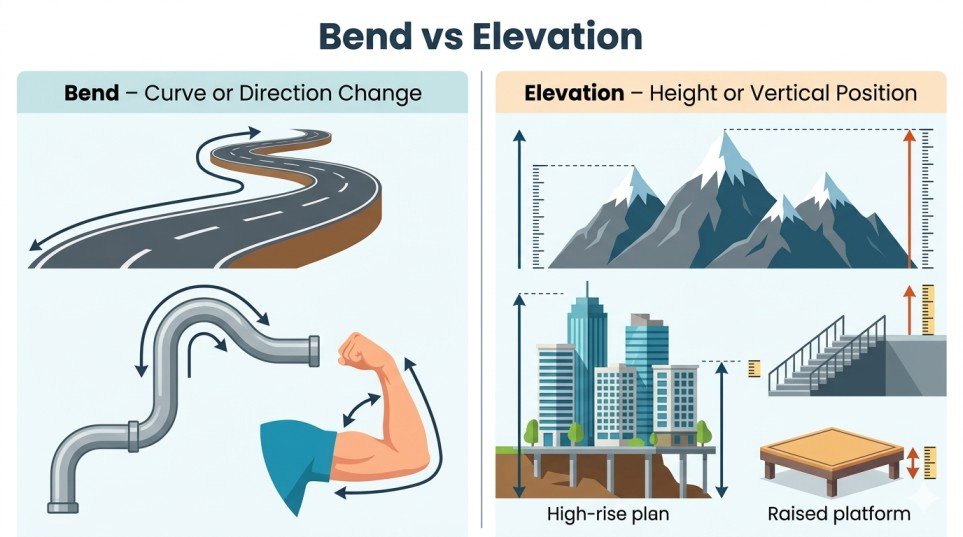
Quick Ans: The difference between bend or elevation depends on movement and position. A bend refers to a curve, angle, or change in direction, while elevation refers to height or vertical position above a certain level. Although both terms appear in construction, geography, fitness, and anatomy, they describe very different concepts.
Many people search for bend or elevation because the two terms appear in different fields and sometimes create confusion. You may hear them in engineering, road design, fitness training, anatomy, architecture, or geography.
However, the meanings are not the same.
A bend usually describes a curve or flex in shape or direction. Elevation, on the other hand, refers to height or upward position. For example, a road bend changes direction, while road elevation changes height.
The confusion often happens because both terms describe physical movement or positioning. Yet one focuses on direction and curvature, while the other focuses on vertical distance.
Understanding the difference between bend or elevation is important in many real world situations. Architects use these concepts in building design. Fitness trainers use them when teaching body movement. Engineers apply them in road and bridge construction.
This complete guide explains both terms clearly. You will learn definitions, uses, comparisons, advantages, common mistakes, examples, exercises, and practical applications.
Quick Answer: Bend or Elevation
The easiest way to understand bend or elevation is to focus on movement versus height.
| Feature | Bend | Elevation |
|---|---|---|
| Meaning | Curve or flex | Height or vertical position |
| Focus | Direction change | Upward level |
| Common Use | Roads, joints, pipes | Geography, buildings, maps |
| Motion Type | Curving movement | Vertical movement |
| Example | Bent knee | Elevated platform |
In short, a bend changes direction, while elevation changes height.
What Is a Bend?
A bend is a curve, turn, or flex in an object, structure, or body part. It changes the direction or shape of something.
Bends appear in many areas such as:
- Roads
- Pipes
- Rivers
- Human joints
- Metal structures
For example, when you bend your elbow, the arm changes angle. Similarly, a road bend changes driving direction.
Common Types of Bends
Several forms of bends exist:
- Sharp bend
- Smooth curve
- Right angle bend
- U shaped bend
- Pipe bend
Each type changes movement or direction differently.
How Bends Work
A bend occurs when force changes the shape or path of something.
For example:
- Pressure is applied
- Direction changes
- The object curves or flexes
As a result, the structure no longer remains straight.
Everyday Examples of Bends
You encounter bends daily.
Common examples include:
- Curved roads
- Bent straws
- Elbow movement
- River turns
- Folded wires
Because bends are everywhere, the term appears in many industries.
What Is Elevation?
Elevation refers to height above a fixed point or surface. Most commonly, elevation measures height above sea level.
The term is widely used in:
- Geography
- Architecture
- Construction
- Fitness
- Engineering
For example, mountains have high elevation. Likewise, a raised stage has greater elevation than the surrounding floor.
Types of Elevation
Several forms of elevation exist depending on context:
- Ground elevation
- Building elevation
- Front elevation drawing
- Leg elevation in fitness
- Elevation above sea level
Each type focuses on vertical position.
How Elevation Works
Elevation measures upward distance from a base level.
The process generally involves:
- Selecting a reference point
- Measuring vertical height
- Comparing positions
Because of this, elevation is important in mapping and design.
Everyday Examples of Elevation
You can observe elevation in many situations:
- Hills and mountains
- Raised platforms
- Stairs
- High floors in buildings
- Elevated highways
Elevation affects visibility, climate, and structure design.
Key Differences Between Bend or Elevation
Direction vs Height
The biggest difference between bend or elevation is focus.
A bend changes direction or shape. Elevation changes vertical position.
Movement Style
Bending involves curving or flexing. Elevation involves moving upward or measuring height.
Common Applications
Bends appear in roads, pipes, and body joints. Elevation appears in maps, buildings, and landscape measurements.
Visual Appearance
A bend creates a curve. Elevation creates height difference.
These distinctions make the terms useful in different industries.
Advantages and Disadvantages
Bend Advantages
Bends provide several benefits:
- Allow flexible movement
- Improve directional flow
- Help structures fit spaces
- Reduce sharp impacts in piping systems
Bend Disadvantages
Some drawbacks also exist:
- Weak points may develop
- Sharp bends reduce efficiency
- Excessive bending can cause damage
Elevation Advantages
Elevation offers important benefits:
- Better visibility
- Improved drainage
- Protection from flooding
- Enhanced airflow
Elevation Disadvantages
Higher elevation may also create challenges:
- Difficult accessibility
- Increased construction cost
- Weather exposure
Therefore, both bend and elevation have practical strengths and limitations.
Real World Examples
Road Construction
Road engineers use bends to change driving direction safely. At the same time, elevation changes help roads cross hills and valleys.
Fitness Training
Exercise instructors teach knee bends and arm bends. Meanwhile, leg elevation exercises improve blood circulation.
Architecture
Architects design curved staircases with bends. They also create elevation drawings to show building height and appearance.
Plumbing Systems
Pipe bends redirect water flow. Elevated water tanks use height to create pressure.
These examples show how bend or elevation serve completely different purposes.
Regional and Global Usage
Geography
Elevation is extremely important in geography because it measures mountain and land height.
Transportation
Road bends appear worldwide to improve traffic movement and safety.
Construction Industry
Both concepts are essential in construction. Builders use bends in materials and elevation in design planning.
Medical and Fitness Fields
Doctors discuss body bending and limb elevation during treatment and therapy.
As a result, bend or elevation terminology appears globally across many professions.
Related Concepts and Comparisons
Bend vs Curve
A curve is usually smoother and more gradual. A bend may refer to any directional change.
Elevation vs Altitude
Elevation measures height from sea level on land. Altitude usually describes height in the air.
Bend vs Elevation in Roads
| Feature | Bend | Elevation |
|---|---|---|
| Purpose | Change direction | Change height |
| Example | Curved turn | Uphill road |
| Focus | Horizontal path | Vertical level |
| Effect | Steering control | Climbing or descending |
Understanding related terms improves comprehension of bend or elevation.
Common Mistakes About Bend or Elevation
Confusing Curves With Height
Some people think elevated roads are bends. In reality, elevation relates to height, not direction.
Using Bend for Vertical Movement
A raised structure is elevated, not bent.
Ignoring Measurement Standards
Elevation requires reference points like sea level. Without proper reference, measurements become inaccurate.
Over Bending Materials
Excessive bending can weaken metal, plastic, or pipes.
Avoiding these mistakes improves communication and technical accuracy.
Beginner to Advanced Learning Tips
Beginner Level
Start by identifying simple examples around you such as bent paper clips or elevated stairs.
Intermediate Level
Study how roads use bends and elevation together for safety and efficiency.
Advanced Level
Learn engineering concepts related to:
- Structural bending stress
- Elevation mapping
- Architectural elevation drawings
- Terrain modeling
These topics provide deeper understanding of practical applications.
Step By Step Comparison Scenario
Imagine a mountain road project.
If engineers create a bend:
- The road changes direction
- Drivers turn left or right
- Curved sections improve navigation
If engineers create elevation:
- The road moves uphill
- Height increases above sea level
- Vehicles climb or descend slopes
Although both affect road design, each serves a different purpose.
Exercises With Answers
Exercise 1
Which term refers to height above a surface?
Answer: Elevation.
Exercise 2
Which term describes a curve or change in direction?
Answer: Bend.
Exercise 3
What does a road bend primarily change?
Answer: Direction.
Exercise 4
What does mountain elevation measure?
Answer: Height above sea level.
Exercise 5
True or False: Elevation always means bending.
Answer: False.
When Should You Use Bend or Elevation?
Use bend when describing:
- Curves
- Flexing movement
- Direction changes
- Angles in structures
Use elevation when discussing:
- Height
- Vertical position
- Raised surfaces
- Sea level measurements
Choosing the correct term improves clarity and technical accuracy.
FAQs About Bend or Elevation
What is the main difference between bend or elevation?
A bend changes direction or shape, while elevation refers to height or vertical position.
Does bend mean upward movement?
Not necessarily. Bend usually refers to curving or flexing rather than moving upward.
What does elevation measure?
Elevation measures vertical height above a reference level such as sea level.
Can roads have both bend and elevation?
Yes. Roads often curve and rise or fall at the same time.
Is a bent pipe elevated?
Not always. A pipe can bend without changing height.
Why is elevation important in geography?
Elevation affects climate, drainage, and land measurement.
What is a body bend exercise?
It is a movement where joints flex or curve during exercise.
What is leg elevation in fitness?
Leg elevation involves raising the legs above body level for exercise or recovery.
Can elevation improve flood protection?
Yes. Elevated buildings are often safer from flooding.
Are bend and curve the same thing?
They are similar, but bend often describes sharper directional changes.
Conclusion
Understanding bend or elevation is important in engineering, fitness, geography, construction, and daily life. Although the terms sometimes appear together, they describe different concepts.
A bend changes direction or shape through curving or flexing. Elevation, however, refers to height or upward position relative to a reference point.
Roads, buildings, exercises, and landscapes all use these concepts in unique ways. Engineers rely on bends for movement and design flexibility. Architects use elevation for planning height and structure appearance.
Choosing the correct term improves communication and technical understanding. When discussing curves, angles, or flexing, use bend. When discussing vertical height or raised position, use elevation.
By understanding the differences between bend or elevation, you can communicate more clearly in both professional and everyday situations.
Discover More:-
- Cake or Death Meaning: Origin, Humor, and Popular Usage Explained
- Counseling or Counselling: Differences, Meaning, and Correct Usage Guide

Lisa Thompson is a USA-based content writer and language specialist focused on grammar, writing improvement and digital publishing.
She holds a degree in English Language and Communication and has professional experience in educational and web content creation.
As the author of Gramtivo.Com, she aims to help readers improve their writing skills through clear and practical guidance.