
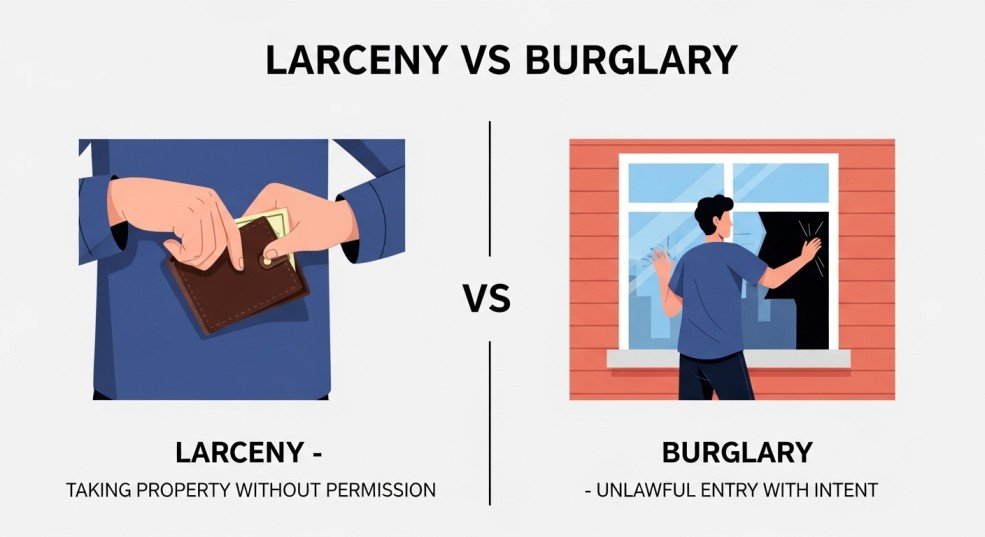
Quick Ans: The main difference between larceny vs burglary is intent and action. Larceny involves taking someone else’s property without permission, while burglary involves entering a building or structure with the intent to commit a crime inside. Although both are theft related crimes, they are legally distinct.
Many people search for larceny vs burglary because the terms seem similar. Both involve crime. Both often relate to theft and appear in legal cases and news reports.
However, they are not the same.
Larceny focuses on stealing property. Burglary focuses on unlawful entry with criminal intent. Because of this difference, the legal consequences and definitions vary.
Confusion usually happens when someone assumes burglary always means stealing. In reality, burglary can occur even if nothing is taken. The key factor is entering a place with intent to commit a crime.
Understanding larceny vs burglary is important for students, legal professionals, and anyone interested in criminal law. It also helps people better understand legal rights and responsibilities.
This guide explains the differences in simple terms. You will learn definitions, examples, advantages and disadvantages of legal classifications, common mistakes, and practical exercises.
Quick Answer: Larceny vs Burglary
To understand larceny vs burglary, focus on the core legal definitions.
| Feature | Larceny | Burglary |
|---|---|---|
| Definition | Taking property unlawfully | Entering a structure with intent to commit a crime |
| Requires Entry | No | Yes |
| Requires Theft | Yes | Not always |
| Focus | Property theft | Illegal entry and intent |
| Example | Stealing a phone | Breaking into a house |
In simple terms, larceny is stealing, while burglary is unlawful entry with intent.
What Is Larceny?
Larceny is the unlawful taking of someone else’s property with the intent to permanently deprive them of it.
This definition focuses on the act of taking property.
Key Elements of Larceny
Several elements must be present:
- Property belongs to another person
- Taking occurs without permission
- Intent exists to keep the property permanently
If any of these elements are missing, the crime may not qualify as larceny.
Examples of Larceny
Common real world examples include:
- Stealing a wallet from a table
- Taking a bicycle without permission
- Shoplifting items from a store
- Picking someone’s pocket
In each case, the focus remains on the act of stealing.
Types of Larceny
Larceny can be classified into different types:
- Petty larceny for low value items
- Grand larceny for high value property
- Shoplifting as a specific form of larceny
These classifications affect penalties and legal consequences.
What Is Burglary?
Burglary involves entering a building or structure without permission with the intent to commit a crime inside.
Unlike larceny, burglary does not require theft to occur.
Key Elements of Burglary
To qualify as burglary, certain conditions must exist:
- Unlawful entry into a structure
- Intent to commit a crime
- The structure can be a house, store, or building
The crime can involve theft, but it may also involve other offenses.
Examples of Burglary
Real world examples include:
- Breaking into a house to steal valuables
- Entering a store after closing hours to commit vandalism
- Sneaking into an office with intent to commit fraud
Even if nothing is stolen, the crime still counts as burglary.
Types of Burglary
Burglary laws often include categories such as:
- Residential burglary
- Commercial burglary
- Aggravated burglary involving weapons or danger
These categories affect how serious the crime is considered.
Key Differences Between Larceny vs Burglary
Nature of the Crime
The most important difference in larceny vs burglary is the nature of the offense. Larceny focuses on taking property. Burglary focuses on unlawful entry with intent.
Requirement of Entry
Larceny does not require entering a building. Burglary always involves entry into a structure.
Requirement of Theft
Larceny requires actual theft. Burglary does not require theft to be completed.
Legal Focus
Larceny laws focus on property rights. Burglary laws focus on security and protection of spaces.
Advantages and Disadvantages
Larceny Advantages (Legal Perspective)
From a legal standpoint, classification helps:
- Clearly define theft crimes
- Assign penalties based on value
- Simplify prosecution of property crimes
Larceny Disadvantages
However, limitations include:
- May not cover entry related crimes
- Focuses only on property loss
- Can overlap with other offenses
Advantages of Burglary
Burglary classification provides benefits such as:
- Protecting homes and buildings
- Addressing intent before crime completion
- Covering a wider range of criminal behavior
Disadvantages of Burglary
Some challenges include:
- Proving intent can be difficult
- Entry definitions vary by law
- May overlap with trespassing laws
Thus, both categories serve important but different roles in criminal law.
Real World Examples
Example 1: Larceny
A person takes a phone left on a café table and leaves. This situation is larceny because property is taken without permission.
Example 2: Burglary
A person breaks into a house at night intending to steal. Even if nothing is taken, the act is burglary.
Example 3: Both Crimes
A person enters a house illegally and steals jewelry. This situation includes both burglary and larceny.
These examples highlight how larceny vs burglary can overlap but remain distinct.
Regional and Legal Variations
Different Legal Systems
Definitions of larceny and burglary can vary by country. Some legal systems use different terms or combine offenses.
Modern Legal Changes
In some regions, larceny has been replaced with broader terms like theft. Burglary definitions may also expand to include vehicles or other structures.
Importance of Local Law
Always refer to local legal codes when analyzing larceny vs burglary. Laws differ across jurisdictions.
Related Concepts and Comparisons
Larceny vs Theft
Theft is a broader term that includes larceny. Many modern laws use theft instead of larceny.
Burglary vs Robbery
Robbery involves taking property through force or threat. Burglary focuses on unlawful entry.
Larceny vs Burglary vs Robbery
| Crime | Entry Required | Theft Required | Force Involved |
|---|---|---|---|
| Larceny | No | Yes | No |
| Burglary | Yes | No | No |
| Robbery | No | Yes | Yes |
Understanding these comparisons helps clarify legal terminology.
Common Mistakes About Larceny vs Burglary
Assuming Burglary Always Means Theft
Burglary does not require theft. Intent alone is enough.
Confusing Theft With Robbery
Robbery involves force or threat, unlike larceny.
Ignoring Intent in Burglary
Intent is essential. Without intent to commit a crime, burglary may not apply.
Overlooking Legal Differences
Different regions define crimes differently. Always check local laws.
Avoiding these mistakes improves understanding of larceny vs burglary.
Beginner to Advanced Legal Understanding
Beginner Level
Focus on basic definitions. Larceny means stealing. Burglary means unlawful entry with intent.
Intermediate Level
Learn elements required to prove each crime. Understand how courts evaluate evidence.
Advanced Level
Study legal variations, case law, and jurisdiction differences. Analyze how charges are combined in complex cases.
Step By Step Scenario Comparison
Consider two situations.
If someone commits larceny:
- Finds unattended property
- Takes it without permission
- Keeps it permanently
If someone commits burglary:
- Enters a building unlawfully
- Plans to commit a crime
- May or may not complete the crime
These steps show how larceny vs burglary differ in action and intent.
Exercises With Answers
Exercise 1
Which crime requires taking property?
Answer: Larceny.
Exercise 2
Which crime requires unlawful entry?
Answer: Burglary.
Exercise 3
Can burglary occur without theft?
Answer: Yes.
Exercise 4
Which crime focuses on property loss?
Answer: Larceny.
Exercise 5
True or False: Larceny requires entering a building.
Answer: False.
When Should You Use Larceny vs Burglary?
Use larceny when:
- Property is taken without permission
- No unlawful entry occurs
- Focus is on theft
Use burglary when:
- A structure is entered unlawfully
- Intent to commit a crime exists
- Theft may or may not occur
Understanding the difference ensures correct legal classification.
FAQs About Larceny vs Burglary
What is the main difference between larceny vs burglary?
Larceny involves stealing property, while burglary involves unlawful entry with intent to commit a crime.
Can burglary happen without stealing anything?
Yes. In the larceny vs burglary comparison, burglary only requires intent, not actual theft.
Is larceny the same as theft?
Larceny is a type of theft, but modern laws often use the broader term theft.
What is an example of burglary?
Breaking into a house with intent to steal is a common example.
What is an example of larceny?
Taking someone’s wallet without permission is larceny.
Which crime is more serious, burglary or larceny?
Burglary is often more serious because it involves unlawful entry and potential danger.
Does burglary require breaking a door?
No. Any unlawful entry can qualify, even without forced entry.
Can someone be charged with both crimes?
Yes. If a person enters unlawfully and steals, both charges may apply.
Is shoplifting considered larceny?
Yes. Shoplifting is a form of larceny.
Why is intent important in burglary?
Intent defines the crime. Without intent to commit a crime, burglary may not be proven.
Conclusion
Understanding larceny vs burglary is essential for recognizing how criminal law defines different offenses. Although both relate to unlawful behavior, they focus on different actions.
Larceny involves taking property without permission. Burglary involves entering a structure with intent to commit a crime. Because of this distinction, the legal consequences and requirements differ.
The key takeaway is simple. Larceny is about theft. Burglary is about unlawful entry and intent.
In real situations, both crimes can occur together. However, they remain separate legal charges.
Learning these differences improves legal awareness and helps avoid confusion. Whether you are studying law or simply want to understand legal terms, knowing the difference between larceny vs burglary is valuable.
Discover More:-
- Cassava vs Yuca: Key Differences, Uses, and Cooking Guide
- Nashville vs Austin: Differences, Cost, Lifestyle, and Which City Is Better

Lisa Thompson is a USA-based content writer and language specialist focused on grammar, writing improvement and digital publishing.
She holds a degree in English Language and Communication and has professional experience in educational and web content creation.
As the author of Gramtivo.Com, she aims to help readers improve their writing skills through clear and practical guidance.