
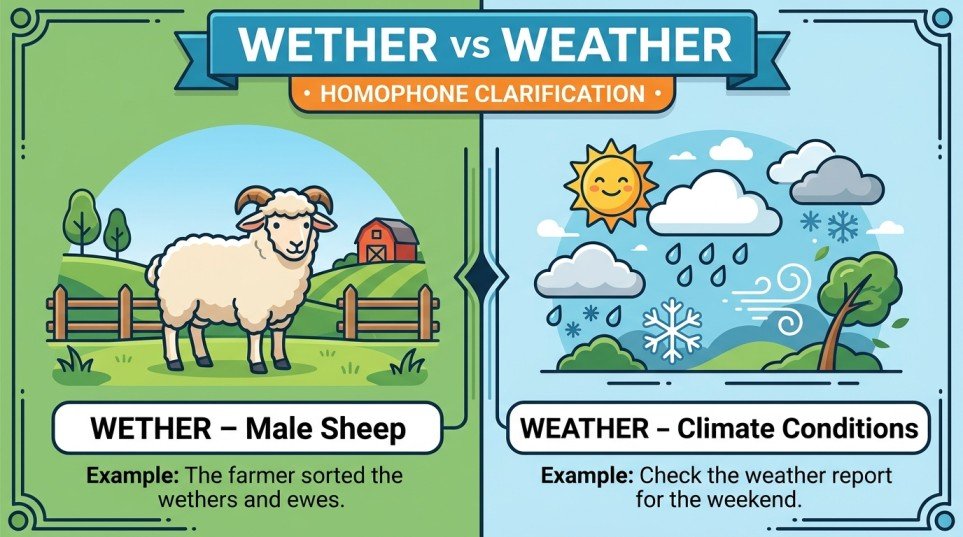
Quick Ans: The difference between wether or weather is simple but important. “Weather” refers to climate conditions like rain, sunshine, wind, or snow, while “wether” is a noun used for a castrated male sheep. Although the words sound similar, they have completely different meanings and uses.
Many English learners confuse wether or weather because the words sound almost identical. Their spelling differs by only one letter. However, their meanings are completely unrelated.
“Weather” is a very common word used in daily conversation. People talk about weather forecasts, storms, temperature, and seasons almost every day. In contrast, “wether” is a much less common term mostly used in farming and animal care.
Because the pronunciation is similar, writers sometimes accidentally choose the wrong spelling. Spell check tools may not always catch the mistake since both words are technically correct English words.
Understanding the difference between wether or weather helps improve spelling, grammar, and communication. It also prevents embarrassing writing mistakes in school, business, and online conversations.
This guide explains each word clearly with examples, comparisons, exercises, and practical tips. By the end, you will confidently know when to use “wether” and when to use “weather.”
Quick Answer: Wether or Weather
Here is the easiest way to understand wether or weather.
| Word | Meaning | Example |
|---|---|---|
| Wether | A castrated male sheep | The farmer sold the wether. |
| Weather | Climate conditions | The weather is sunny today. |
In simple terms:
- Weather relates to climate and temperature.
- Wether refers to a sheep.
What Does Weather Mean?
The word weather describes atmospheric conditions outside. It includes temperature, rain, wind, humidity, snow, and storms.
People use “weather” in daily speech very often.
Common Weather Conditions
Examples include:
- Sunny weather
- Rainy weather
- Windy weather
- Snowy weather
- Humid weather
Because weather changes frequently, it affects travel, farming, sports, and daily activities.
Examples of Weather in Sentences
Here are some examples:
- The weather is beautiful today.
- Bad weather delayed the flight.
- We checked the weather forecast before traveling.
- Cold weather can damage plants.
These examples show how common the word is in everyday communication.
Weather as a Verb
Interestingly, “weather” can also act as a verb.
For example:
- The old house weathered the storm.
- Strong paint helps wood weather outdoor conditions.
In this form, the word means to survive or resist damage over time.
What Does Wether Mean?
The word wether is much less common. It refers to a castrated male sheep, usually raised for wool or meat production.
Farmers and livestock experts mainly use this term.
Why Farmers Use Wethers
Wethers are often easier to manage than uncastrated male sheep because they are calmer and less aggressive.
As a result, farmers may raise them for:
- Wool production
- Meat farming
- Grazing control
Examples of Wether in Sentences
Here are some correct examples:
- The wether grazed near the fence.
- Farmers separated the wether from the younger lambs.
- That wether produces high quality wool.
Outside agricultural contexts, most people rarely use this word.
Key Differences Between Wether or Weather
Meaning
The biggest difference between wether or weather is meaning.
- Weather relates to climate conditions.
- Wether refers to a male sheep.
Frequency of Use
“Weather” appears constantly in conversations and writing. “Wether” is uncommon outside farming communities.
Part of Speech
“Weather” functions as both a noun and a verb. “Wether” works only as a noun.
Context
You will usually see:
- Weather in forecasts and daily conversation
- Wether in agriculture or farming discussions
Pronunciation Comparison
One reason people confuse wether or weather is pronunciation.
Both words are pronounced almost the same:
- Wether: WETH er
- Weather: WETH er
Because English contains many homophones, spelling mistakes happen easily.
Advantages and Disadvantages of Each Word
Advantages of Using “Weather” Correctly
- Improves communication clarity
- Helps in everyday conversations
- Essential for writing and speaking
- Common in education and media
Disadvantages of Misusing “Weather”
- Creates spelling errors
- Confuses readers
- Weakens professional writing
Advantages of Knowing “Wether”
- Expands vocabulary
- Helps in agricultural studies
- Useful in farming discussions
Disadvantages of Misusing “Wether”
- Makes sentences confusing
- Changes sentence meaning completely
- Appears unprofessional in formal writing
Therefore, understanding wether or weather improves writing accuracy.
Real World Examples
Weather in Daily Life
Weather affects many activities such as:
- Travel planning
- Outdoor sports
- Farming
- School schedules
- Flights and transportation
For example, heavy weather conditions can cancel flights or delay events.
Wether in Farming
Farmers may discuss wethers when managing livestock.
For example:
- A wether may be raised for wool production.
- Ranchers may separate wethers from breeding sheep.
These examples show how different the two words really are.
Regional and Global Usage
Weather Worldwide
The word “weather” is universal in English speaking countries. News channels, apps, and websites constantly discuss weather conditions.
Wether in Agricultural Communities
“Wether” appears mainly in farming regions where sheep farming is common.
Countries with strong sheep industries include:
- Australia
- New Zealand
- United Kingdom
- United States
Even in these places, ordinary conversation still uses “weather” much more often.
Related Concepts and Comparisons
Weather vs Climate
People often confuse weather and climate.
| Term | Meaning |
|---|---|
| Weather | Short term atmospheric conditions |
| Climate | Long term weather patterns |
For example:
- Rain today is weather.
- Desert heat patterns are climate.
Wether vs Ram
Both words relate to sheep, but they are not identical.
| Word | Meaning |
|---|---|
| Wether | Castrated male sheep |
| Ram | Uncastrated male sheep |
Understanding related terms makes the wether or weather distinction easier.
Common Mistakes About Wether or Weather
Using “Wether” Instead of “Weather”
Many people accidentally write:
- Incorrect: The wether is sunny.
- Correct: The weather is sunny.
Because both words sound alike, this mistake is common.
Assuming “Wether” Is a Misspelling
Some people believe “wether” is not a real word. However, it is a valid English noun.
Forgetting Context
Context helps determine the correct spelling.
If the topic involves:
- Rain
- Temperature
- Forecasts
- Seasons
Then the correct word is “weather.”
If the topic involves sheep farming, “wether” may be correct.
Beginner to Advanced Learning Tips
Beginner Level
Remember this simple clue:
- Weather contains “ea” like “earth” and sky conditions.
Intermediate Level
Practice writing example sentences using both words correctly.
Advanced Level
Study homophones and confusing English word pairs such as:
- Their vs there
- Affect vs effect
- Stationary vs stationery
This practice improves overall grammar skills.
Step By Step Memory Trick
Here is a simple memory method for wether or weather.
For Weather
- Weather contains “ea.”
- Think of “earth and atmosphere.”
- Weather relates to climate.
For Wether
- Wether contains no “a.”
- Think of animals and farming terms.
These tricks make spelling easier to remember.
Exercises With Answers
Exercise 1
Which word relates to climate conditions?
Answer: Weather.
Exercise 2
Which word refers to a male sheep?
Answer: Wether.
Exercise 3
Choose the correct sentence:
A. The weather is rainy today.
B. The wether is rainy today.
Answer: A.
Exercise 4
True or False: “Wether” is not a real English word.
Answer: False.
Exercise 5
Which word appears more often in daily conversation?
Answer: Weather.
When Should You Use Wether or Weather?
Use weather when discussing:
- Temperature
- Rain
- Wind
- Forecasts
- Climate conditions
Use wether when discussing:
- Sheep farming
- Livestock
- Wool production
Context always determines the correct spelling.
FAQs About Wether or Weather
What is the main difference between wether or weather?
Weather refers to climate conditions, while wether means a castrated male sheep.
Is wether a real word?
Yes. Wether is a legitimate English noun used mainly in farming.
Why do people confuse wether or weather?
The words sound almost identical, which causes spelling confusion.
Which word is more common, wether or weather?
Weather is far more common in everyday English.
Can weather be used as a verb?
Yes. Weather can mean surviving or resisting difficult conditions.
Do weather and climate mean the same thing?
No. Weather describes short term conditions, while climate describes long term patterns.
How can I remember the spelling of weather?
Remember that weather contains “ea,” similar to “earth” and atmosphere conditions.
Where is the word wether commonly used?
Wether is mainly used in agriculture and sheep farming.
Is “the wether is nice today” correct?
No. The correct sentence is “the weather is nice today.”
Are wether and weather homophones?
Yes. They sound alike but have different meanings and spellings.
Conclusion
Understanding wether or weather is important for clear communication and correct spelling. Although the words sound nearly identical, their meanings are completely different.
Weather relates to atmospheric conditions such as rain, sunshine, wind, and temperature. It appears constantly in daily conversation, news reports, and forecasts.
Wether, on the other hand, refers to a castrated male sheep used in farming and agriculture. The word is much less common and usually appears only in livestock discussions.
Because pronunciation is similar, many people accidentally confuse the spellings. However, remembering the context makes the correct choice easier.
If the topic involves climate or forecasts, use “weather.” If the discussion focuses on sheep farming, use “wether.”
With practice and repetition, the difference between wether or weather becomes simple and easy to remember.
Discover More:-

Jennifer Collins is a professional grammar expert and language educator at gramtivo.com, specializing in English grammar, writing skills, and language improvement. She holds a Master’s degree in English Language and Literature from a recognized university in the United States. With years of teaching and content development experience, she is dedicated to helping learners improve their communication skills with clear and practical guidance.