
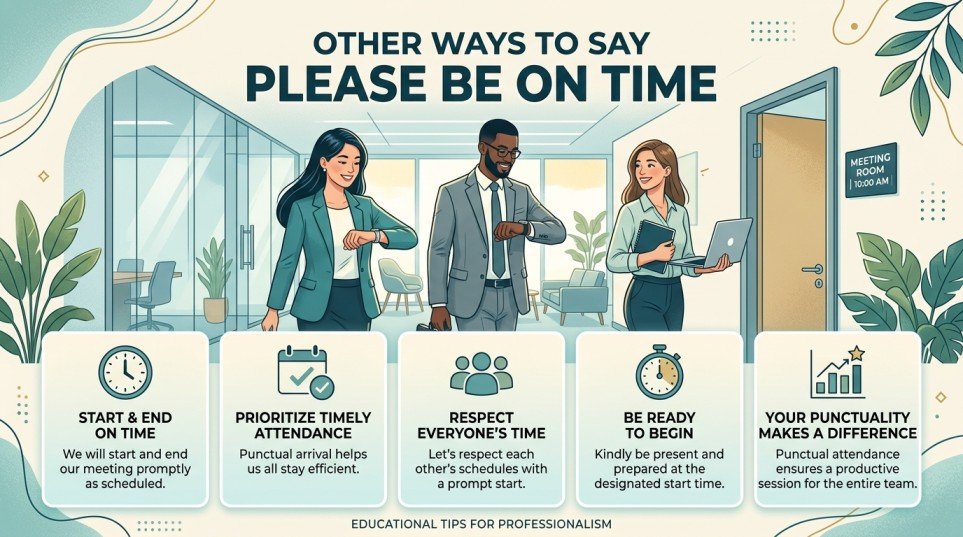
Quick Answer: Instead of saying please be on time, you can say: please arrive promptly, don’t be late, be punctual, make sure you arrive on time, please arrive as scheduled.
The phrase “please be on time” is commonly used when asking someone to arrive or complete something punctually. It’s direct, polite, and useful in both professional and personal communication.
However, repeating the same phrase can make your English sound repetitive. Native speakers often use different expressions depending on tone, urgency, and context.
Learning alternatives to “please be on time” helps you sound more natural and fluent. It also improves your communication skills in meetings, invitations, workplace situations, and everyday conversations. These phrases can even help you express excitement in English while still sounding polite and professional.
Quick Categories Section
Formal alternatives to “please be on time”
- Please arrive promptly
- Kindly be punctual
- Please ensure timely arrival
- Arrive at the scheduled time
Pro Tip: Use these in formal emails, business meetings, and official invitations.
Casual alternatives
- Don’t be late
- Be there on time
- Try to make it on time
- Show up on time
Pro Tip: Perfect for friends, family, and casual plans.
Professional alternatives
- Please arrive as scheduled
- Kindly arrive promptly
- Timeliness would be appreciated
- Please be punctual for the meeting
Pro Tip: Keep your wording polite and respectful in workplace communication.
Informal expressions
- Don’t keep us waiting
- Be there sharp
- Make it on time
- Don’t show up late
Pro Tip: Avoid these in formal or professional settings.
“Professional English often depends on tone, not just vocabulary.”
Common Mistakes
- Sounding too demanding
Example: “Be on time.” without “please” may sound rude. - Using slang in professional communication
Example: “Don’t show up late” in a business email sounds harsh. - Repeating the same phrase constantly
Example: Using “please be on time” in every reminder message. - Ignoring tone and urgency
Example: Casual wording during an important meeting invitation. - Being too indirect
Example: “Try to come early maybe” sounds unclear.
What Does “Please Be on Time” Mean?
It means asking someone politely to arrive or complete something at the expected time.
Grammatically, it’s an imperative sentence softened by the word “please.”
Example Sentence:
Please be on time for tomorrow’s meeting.
When to Use “Please Be on Time”
- Before meetings or appointments
- For events and invitations
- In workplace communication
- During school or class situations
- In spoken and written English
Spoken vs Written: Common in both
Formal vs Informal: Neutral but slightly direct
Is It Professional or Polite to Say “Please Be on Time”?
Polite? ✔️ Yes
Professional? ✔️ Yes
Business Example:
“Please be on time for the client presentation tomorrow morning.”
Pros and Cons of Using “Please Be on Time”
Pros
- Clear and direct
- Easy to understand
- Professional in many contexts
- Widely used
Cons
- Can sound repetitive
- Slightly strict in casual settings
- Limited emotional tone
- May sound demanding if overused
“Small wording changes can make requests sound more polite and professional.”
Other Ways to Say “Please Be on Time” (With Examples)
These alternatives will help you sound more fluent, confident, and natural in different situations.
Use them according to tone, audience, and context.
1. Phrase: Please arrive promptly
Meaning: Arrive without delay.
Explanation: Formal and professional alternative.
Example Sentence: Please arrive promptly for the interview.
Best Use: business meetings
Worst Use: casual hangouts
Tone: professional, polite
Context Variability: professional / written
2. Phrase: Kindly be punctual
Meaning: Arrive at the correct time.
Explanation: Very formal and respectful.
Example Sentence: Kindly be punctual for the ceremony.
Best Use: formal events
Worst Use: casual text
Tone: formal, respectful
Context Variability: professional / formal
3. Phrase: Don’t be late
Meaning: Arrive on time.
Explanation: Direct and common expression.
Example Sentence: Don’t be late for dinner tonight.
Best Use: casual talk
Worst Use: formal email
Tone: direct, casual
Context Variability: casual / spoken
4. Phrase: Please arrive as scheduled
Meaning: Follow the planned timing.
Explanation: Professional scheduling phrase.
Example Sentence: Please arrive as scheduled for the appointment.
Best Use: workplace
Worst Use: friendly chat
Tone: professional, neutral
Context Variability: professional
5. Phrase: Make sure you arrive on time
Meaning: Ensure punctual arrival.
Explanation: Friendly but clear reminder.
Example Sentence: Make sure you arrive on time tomorrow.
Best Use: reminders
Worst Use: legal writing
Tone: friendly, clear
Context Variability: casual / professional
“The right tone can make even direct requests sound friendly.”
6. Phrase: Please don’t keep us waiting
Meaning: Arrive without delay.
Explanation: Informal but expressive.
Example Sentence: Please don’t keep us waiting tonight.
Best Use: friendly events
Worst Use: formal meeting
Tone: informal, playful
Context Variability: casual
7. Phrase: Be there on time
Meaning: Arrive punctually.
Explanation: Casual and straightforward.
Example Sentence: Be there on time for the movie.
Best Use: casual plans
Worst Use: formal invitations
Tone: casual, direct
Context Variability: spoken
8. Phrase: Timeliness would be appreciated
Meaning: Being punctual is important.
Explanation: Polite professional wording.
Example Sentence: Timeliness would be appreciated during the conference.
Best Use: formal emails
Worst Use: casual speech
Tone: professional, formal
Context Variability: written
9. Phrase: Please be punctual
Meaning: Arrive at the expected time.
Explanation: Clear and professional phrase.
Example Sentence: Please be punctual for your shift.
Best Use: workplace
Worst Use: casual parties
Tone: professional, direct
Context Variability: professional
10. Phrase: Show up on time
Meaning: Arrive at the correct time.
Explanation: Informal spoken expression.
Example Sentence: Just show up on time tomorrow.
Best Use: casual talk
Worst Use: business email
Tone: informal, friendly
Context Variability: casual
11. Phrase: Please don’t arrive late
Meaning: Avoid late arrival.
Explanation: Polite but direct.
Example Sentence: Please don’t arrive late for the event.
Best Use: invitations
Worst Use: playful contexts
Tone: polite, clear
Context Variability: professional / casual
12. Phrase: Arrive at the scheduled time
Meaning: Follow the planned timing exactly.
Explanation: Formal scheduling phrase.
Example Sentence: Please arrive at the scheduled time.
Best Use: appointments
Worst Use: casual texting
Tone: formal, professional
Context Variability: professional
13. Phrase: Be here sharp
Meaning: Arrive exactly on time.
Explanation: Informal but strong reminder.
Example Sentence: Be here sharp at 8 a.m.
Best Use: spoken reminders
Worst Use: formal writing
Tone: informal, firm
Context Variability: spoken
14. Phrase: We’d appreciate your punctuality
Meaning: Punctual arrival is valued.
Explanation: Soft professional wording.
Example Sentence: We’d appreciate your punctuality during the session.
Best Use: workplace
Worst Use: casual plans
Tone: polite, professional
Context Variability: professional
15. Phrase: Please make every effort to be on time
Meaning: Try hard to arrive punctually.
Explanation: Polite but serious request.
Example Sentence: Please make every effort to be on time tomorrow.
Best Use: important meetings
Worst Use: relaxed gatherings
Tone: respectful, serious
Context Variability: professional
“Fluent English speakers adapt their tone depending on the situation.”
16. Phrase: Don’t keep everyone waiting
Meaning: Arrive without delay.
Explanation: Informal reminder.
Example Sentence: Don’t keep everyone waiting tonight.
Best Use: social events
Worst Use: formal writing
Tone: casual, playful
Context Variability: casual
17. Phrase: Please arrive on schedule
Meaning: Follow the planned timetable.
Explanation: Professional scheduling phrase.
Example Sentence: Please arrive on schedule for registration.
Best Use: workplace
Worst Use: casual conversations
Tone: professional, neutral
Context Variability: professional
18. Phrase: Make it on time
Meaning: Arrive before or at the expected time.
Explanation: Casual encouragement.
Example Sentence: Try to make it on time tonight.
Best Use: friends
Worst Use: formal email
Tone: casual, friendly
Context Variability: spoken
19. Phrase: Kindly arrive before the start time
Meaning: Arrive before activities begin.
Explanation: Formal and polite wording.
Example Sentence: Kindly arrive before the start time.
Best Use: ceremonies
Worst Use: casual chats
Tone: formal, respectful
Context Variability: professional
20. Phrase: Please don’t delay
Meaning: Avoid being late.
Explanation: Short and direct request.
Example Sentence: Please don’t delay tomorrow morning.
Best Use: urgent situations
Worst Use: casual invitations
Tone: firm, polite
Context Variability: professional
21. Phrase: We’ll start right on time
Meaning: The event begins exactly as scheduled.
Explanation: Indirect reminder to arrive punctually.
Example Sentence: We’ll start right on time at 9 a.m.
Best Use: meetings
Worst Use: playful contexts
Tone: professional, clear
Context Variability: workplace
22. Phrase: Please plan to arrive early
Meaning: Arrive before the scheduled time.
Explanation: Helpful for important events.
Example Sentence: Please plan to arrive early for check-in.
Best Use: travel/events
Worst Use: casual meetups
Tone: polite, practical
Context Variability: professional
23. Phrase: Don’t miss the start
Meaning: Arrive before things begin.
Explanation: Friendly reminder.
Example Sentence: Don’t miss the start of the show.
Best Use: entertainment
Worst Use: formal email
Tone: casual, encouraging
Context Variability: spoken
24. Phrase: Your prompt arrival would be appreciated
Meaning: Quick and punctual arrival is valued.
Explanation: Very professional wording.
Example Sentence: Your prompt arrival would be appreciated.
Best Use: business events
Worst Use: casual talk
Tone: formal, professional
Context Variability: written
25. Phrase: Please be here promptly
Meaning: Arrive quickly and on time.
Explanation: Slightly formal request.
Example Sentence: Please be here promptly tomorrow morning.
Best Use: appointments
Worst Use: informal jokes
Tone: polite, direct
Context Variability: professional
26. Phrase: Let’s begin on time
Meaning: Start punctually together.
Explanation: Team-oriented reminder.
Example Sentence: Let’s begin on time for the workshop.
Best Use: group settings
Worst Use: strict warnings
Tone: collaborative, professional
Context Variability: workplace
27. Phrase: Please respect the schedule
Meaning: Follow planned timing.
Explanation: Formal and firm wording.
Example Sentence: Please respect the schedule during the conference.
Best Use: organized events
Worst Use: friendly gatherings
Tone: formal, serious
Context Variability: professional
28. Phrase: Try to be there promptly
Meaning: Make an effort to arrive on time.
Explanation: Softer and more flexible wording.
Example Sentence: Try to be there promptly tonight.
Best Use: casual reminders
Worst Use: strict deadlines
Tone: friendly, polite
Context Variability: casual
29. Phrase: Please don’t run late
Meaning: Avoid arriving late.
Explanation: Casual but polite reminder.
Example Sentence: Please don’t run late tomorrow.
Best Use: spoken English
Worst Use: official documents
Tone: casual, warm
Context Variability: spoken
30. Phrase: Be ready on time
Meaning: Prepare and arrive punctually.
Explanation: Useful for meetings and events.
Example Sentence: Be ready on time for the presentation.
Best Use: teamwork
Worst Use: relaxed chats
Tone: clear, practical
Context Variability: professional / spoken
“Polite timing requests sound better when the tone matches the situation.”
Mini Quiz / Self-Check
1. Which phrase is most professional?
A. Don’t be late
B. Kindly be punctual
C. Be there sharp
Answer: B
2. Which phrase is most informal?
A. Show up on time
B. Your prompt arrival would be appreciated
C. Kindly arrive before the start time
Answer: A
3. Which phrase works best in a business email?
A. Don’t keep us waiting
B. Please arrive as scheduled
C. Make it on time
Answer: B
Comparison Table: Top Alternatives
| Phrase | Tone | Best Use |
|---|---|---|
| Please arrive promptly | Professional | Meetings |
| Kindly be punctual | Formal | Events |
| Don’t be late | Casual | Friends |
| Please arrive as scheduled | Professional | Workplace |
| Make sure you arrive on time | Neutral | Reminders |
| Please be punctual | Professional | Office |
| Show up on time | Informal | Casual talk |
| Timeliness would be appreciated | Formal | Emails |
| We’ll start right on time | Professional | Meetings |
| Please be here promptly | Neutral | Appointments |
FAQs
1. What are the best alternatives to “please be on time”?
Good alternatives include please arrive promptly, kindly be punctual, and make sure you arrive on time.
2. Is “please be on time” professional?
Yes, it is both polite and professional in many situations.
3. What is a softer way to say “please be on time”?
You can say timeliness would be appreciated or try to be there promptly.
4. Can informal expressions in English be used at work?
Only in relaxed workplace environments; formal phrases are usually better.
5. Why learn other ways to say “please be on time”?
It improves fluency, tone flexibility, and professional communication skills.
Conclusion
Learning other ways to say “please be on time” helps you communicate more naturally and professionally. Different phrases allow you to sound polite, friendly, or formal depending on the situation.
Practice using these alternatives daily. Over time, your English will sound more fluent, polished, and confident.
CTA: Which phrase will you start using today? Try replacing your usual expression with a more natural alternative.
Discover More:-
- Other Ways to Say Please Take Your Time (30+ Examples)
- Other Ways to Say I Appreciate It (30+ Examples)

Lisa Thompson is a USA-based content writer and language specialist focused on grammar, writing improvement and digital publishing.
She holds a degree in English Language and Communication and has professional experience in educational and web content creation.
As the author of Gramtivo.Com, she aims to help readers improve their writing skills through clear and practical guidance.