
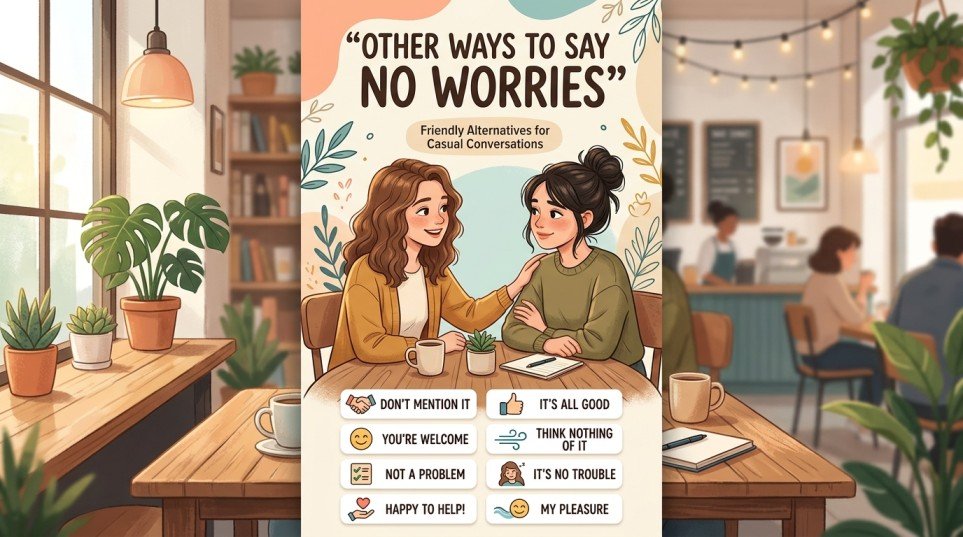
Quick Answer: Instead of no worries, you can say: no problem, it’s okay, don’t mention it, all good, think nothing of it.
The phrase “no worries” is widely used in English to reassure someone that everything is fine. It’s friendly, casual, and very common in everyday conversations.
However, overusing it can make your speech sound repetitive or too informal—especially in professional settings.
Learning alternatives to “no worries” helps you sound more natural and flexible. It also improves your ability to adjust tone based on context and even helps you express excitement in English or reassurance more effectively.
Quick Categories Section
Formal alternatives to “no worries”
- It is no trouble at all
- Please do not be concerned
- No inconvenience whatsoever
- Think nothing of it
Pro Tip: Use these in formal writing or professional conversations.
Casual alternatives
- It’s okay
- No problem
- All good
- You’re fine
Pro Tip: These are perfect for daily conversations and friendly chats.
Professional alternatives
- That’s perfectly fine
- No issue at all
- It’s not a problem
- Please don’t worry
Pro Tip: Keep your tone neutral and polite in workplace communication.
Informal expressions
- No big deal
- Don’t sweat it
- We’re good
- It’s nothing
Pro Tip: Avoid these in formal emails or serious discussions.
“Using the right variation makes your English sound more natural and confident.”
Common Mistakes
- Using “no worries” in formal emails
Example: “No worries” in a client email sounds too casual. - Overusing the phrase
Example: Saying it repeatedly reduces its impact. - Using it in serious situations
Example: “No worries” after a major mistake sounds inappropriate. - Ignoring tone differences
Example: Choosing casual phrases in professional settings. - Sounding dismissive
Example: Saying it quickly without warmth may seem careless.
What Does “No Worries” Mean?
It means there is no problem or reason to be concerned.
Grammatically, it is an informal expression used to reassure someone.
Example Sentence:
No worries, everything is under control.
When to Use “No Worries”
- When responding to an apology
- When someone thanks you
- In casual conversations
- To reassure others
Spoken vs Written: Mostly spoken
Formal vs Informal: Informal
Is It Professional or Polite to Say “No Worries”?
Polite? ✔️ Yes
Professional? ❌ No (in most cases)
Business Example:
“Thank you for your message. There’s no issue at all.”
Pros and Cons of Using “No Worries”
Pros
- Simple and natural
- Friendly tone
- Very common
- Easy to use
Cons
- Too informal for work
- Overused
- Limited tone flexibility
- Not suitable for formal writing
“Professional communication requires tone awareness, not just vocabulary.”
Other Ways to Say “No Worries” (With Examples)
These alternatives will help you sound more fluent, confident, and natural in different situations.
Use them based on tone, audience, and context.
1. Phrase: No problem
Meaning: There is no issue.
Explanation: Most common alternative.
Example Sentence: No problem, happy to help.
Best Use: general use
Worst Use: formal letter
Tone: neutral, friendly
Context Variability: casual / spoken
2. Phrase: It’s okay
Meaning: Everything is fine.
Explanation: Simple reassurance.
Example Sentence: It’s okay, don’t worry.
Best Use: everyday use
Worst Use: formal writing
Tone: kind, neutral
Context Variability: casual / spoken
3. Phrase: Don’t mention it
Meaning: No thanks or apology needed.
Explanation: Polite and slightly formal.
Example Sentence: Don’t mention it, really.
Best Use: polite reply
Worst Use: serious issue
Tone: polite, calm
Context Variability: casual / professional
4. Phrase: All good
Meaning: Everything is fine.
Explanation: Informal and relaxed.
Example Sentence: All good, no issues.
Best Use: casual talk
Worst Use: workplace email
Tone: informal, relaxed
Context Variability: casual
5. Phrase: You’re welcome
Meaning: A polite reply to thanks.
Explanation: Formal alternative in some contexts.
Example Sentence: You’re welcome, anytime.
Best Use: polite reply
Worst Use: apology response
Tone: polite, neutral
Context Variability: professional
“Fluency improves when you replace common phrases with smarter alternatives.”
6. Phrase: It’s not a problem
Meaning: There is no issue.
Explanation: Professional tone.
Example Sentence: It’s not a problem at all.
Best Use: workplace
Worst Use: slang
Tone: neutral, professional
Context Variability: professional
7. Phrase: No issue at all
Meaning: Absolutely no problem.
Explanation: Strong reassurance.
Example Sentence: There’s no issue at all.
Best Use: work setting
Worst Use: casual slang
Tone: professional, calm
Context Variability: professional
8. Phrase: Don’t worry about it
Meaning: No need to be concerned.
Explanation: Friendly reassurance.
Example Sentence: Don’t worry about it, really.
Best Use: casual talk
Worst Use: formal writing
Tone: warm, casual
Context Variability: casual
9. Phrase: It’s nothing
Meaning: The issue is insignificant.
Explanation: Downplays concern.
Example Sentence: It’s nothing, really.
Best Use: reassurance
Worst Use: formal writing
Tone: humble, calm
Context Variability: casual
10. Phrase: Think nothing of it
Meaning: It’s unimportant.
Explanation: Slightly formal.
Example Sentence: Think nothing of it.
Best Use: polite reply
Worst Use: slang
Tone: formal, refined
Context Variability: professional
11. Phrase: No big deal
Meaning: The issue is minor.
Explanation: Casual reassurance.
Example Sentence: It’s no big deal.
Best Use: casual
Worst Use: serious context
Tone: relaxed, informal
Context Variability: casual
12. Phrase: That’s perfectly fine
Meaning: Completely acceptable.
Explanation: Professional tone.
Example Sentence: That’s perfectly fine with me.
Best Use: workplace
Worst Use: slang
Tone: professional, calm
Context Variability: professional
13. Phrase: You’re fine
Meaning: Everything is okay.
Explanation: Direct reassurance.
Example Sentence: You’re fine, don’t worry.
Best Use: quick reply
Worst Use: formal writing
Tone: direct, casual
Context Variability: spoken
14. Phrase: It’s all good
Meaning: Everything is fine.
Explanation: Informal variation.
Example Sentence: It’s all good, no stress.
Best Use: casual
Worst Use: formal email
Tone: informal, relaxed
Context Variability: casual
15. Phrase: No trouble at all
Meaning: No inconvenience.
Explanation: Polite and professional.
Example Sentence: It’s no trouble at all.
Best Use: workplace
Worst Use: slang
Tone: polite, professional
Context Variability: professional
16. Phrase: Don’t sweat it
Meaning: Don’t stress.
Explanation: Informal and friendly.
Example Sentence: Don’t sweat it, really.
Best Use: casual
Worst Use: formal setting
Tone: informal, relaxed
Context Variability: casual
17. Phrase: We’re good
Meaning: Everything is fine between us.
Explanation: Casual reassurance.
Example Sentence: We’re good, no worries.
Best Use: casual
Worst Use: professional email
Tone: informal, friendly
Context Variability: casual
18. Phrase: No harm done
Meaning: Nothing bad happened.
Explanation: Reassures after small mistakes.
Example Sentence: No harm done at all.
Best Use: minor issues
Worst Use: serious problems
Tone: reassuring, calm
Context Variability: casual
19. Phrase: It’s quite alright
Meaning: Acceptable situation.
Explanation: Slightly formal.
Example Sentence: It’s quite alright.
Best Use: polite reply
Worst Use: slang
Tone: formal, calm
Context Variability: professional
20. Phrase: No inconvenience at all
Meaning: No disruption occurred.
Explanation: Formal tone.
Example Sentence: There was no inconvenience at all.
Best Use: business context
Worst Use: casual chat
Tone: formal, professional
Context Variability: professional
“Confidence in English comes from choosing the right phrase for the right moment.”
21. Phrase: It’s absolutely fine
Meaning: Completely acceptable.
Explanation: Emphasizes reassurance.
Example Sentence: It’s absolutely fine.
Best Use: general use
Worst Use: strict formal writing
Tone: calm, reassuring
Context Variability: casual / professional
22. Phrase: No need to worry
Meaning: There is no concern.
Explanation: Gentle reassurance.
Example Sentence: There’s no need to worry.
Best Use: reassurance
Worst Use: urgent situations
Tone: caring, calm
Context Variability: casual
23. Phrase: It’s no issue
Meaning: There is no problem.
Explanation: Short and professional.
Example Sentence: It’s no issue at all.
Best Use: workplace
Worst Use: slang
Tone: neutral, professional
Context Variability: professional
24. Phrase: All sorted
Meaning: Everything is resolved.
Explanation: Common in British English.
Example Sentence: It’s all sorted now.
Best Use: casual
Worst Use: formal writing
Tone: informal, positive
Context Variability: casual
25. Phrase: No complaints here
Meaning: Everything is fine.
Explanation: Light and conversational.
Example Sentence: No complaints here.
Best Use: casual
Worst Use: formal context
Tone: relaxed, conversational
Context Variability: casual
26. Phrase: It’s totally fine
Meaning: Completely okay.
Explanation: Emphasizes reassurance.
Example Sentence: It’s totally fine, really.
Best Use: casual
Worst Use: formal writing
Tone: friendly, informal
Context Variability: casual
27. Phrase: Not a problem at all
Meaning: No issue whatsoever.
Explanation: Strong reassurance.
Example Sentence: Not a problem at all.
Best Use: workplace
Worst Use: slang
Tone: professional, friendly
Context Variability: professional
28. Phrase: Everything’s fine
Meaning: Nothing is wrong.
Explanation: Direct reassurance.
Example Sentence: Everything’s fine now.
Best Use: general use
Worst Use: formal writing
Tone: neutral, calm
Context Variability: casual
29. Phrase: No worries at all
Meaning: Strong version of reassurance.
Explanation: Emphasizes calmness.
Example Sentence: No worries at all, really.
Best Use: casual
Worst Use: formal context
Tone: relaxed, friendly
Context Variability: casual
30. Phrase: Happy to help
Meaning: You’re glad to assist.
Explanation: Positive and professional.
Example Sentence: Happy to help anytime.
Best Use: workplace
Worst Use: apology context
Tone: positive, professional
Context Variability: professional
“Fluent speakers adapt language instead of repeating the same phrase.”
Mini Quiz / Self-Check
1. Best phrase for professional email?
A. All good
B. No issue at all
C. Don’t sweat it
Answer: B
2. Most informal phrase?
A. It’s not a problem
B. Don’t sweat it
C. No inconvenience at all
Answer: B
3. Which is slightly formal?
A. Think nothing of it
B. We’re good
C. All good
Answer: A
Comparison Table: Top Alternatives
| Phrase | Tone | Best Use |
|---|---|---|
| No problem | Neutral | Everyday |
| It’s okay | Friendly | Daily talk |
| Don’t mention it | Polite | General |
| All good | Informal | Friends |
| No issue at all | Professional | Work |
| That’s perfectly fine | Professional | Emails |
| Don’t worry about it | Casual | Reassurance |
| No big deal | Informal | Minor issues |
| Think nothing of it | Formal | Polite replies |
| Not a problem at all | Professional | Workplace |
FAQs
1. What are the best alternatives to “no worries”?
Common options include no problem, it’s okay, and no issue at all.
2. Is “no worries” professional?
It is polite but too informal for most professional settings.
3. What should I say instead at work?
Use no issue at all or that’s perfectly fine.
4. Can I use informal expressions in English at work?
Only in relaxed environments; otherwise, avoid them.
5. Why learn alternatives to “no worries”?
It improves fluency, tone awareness, and communication skills.
See Also
- Other Ways to Say Thank You
- Professional English Phrases for Workplace Communication
Conclusion
Learning other ways to say “no worries” helps you communicate more effectively and naturally. It allows you to adjust tone based on context and sound more fluent.
Practice these alternatives daily. Over time, your English will become more flexible, confident, and professional.
CTA: Try replacing “no worries” with a new phrase today.
Discover More:-
- Other Ways to Say Talk to You Soon (30+ Examples)
- Other Ways to Say Hope to See You Soon (30+ Examples)

Robert Mitchell is a U.S.-based writer at Gramtivo.Com who focuses on grammar, writing improvement, and language-related content. He holds a degree in English and Linguistics from a U.S. university. His work aims to help readers enhance their writing skills with clear and practical guidance.