
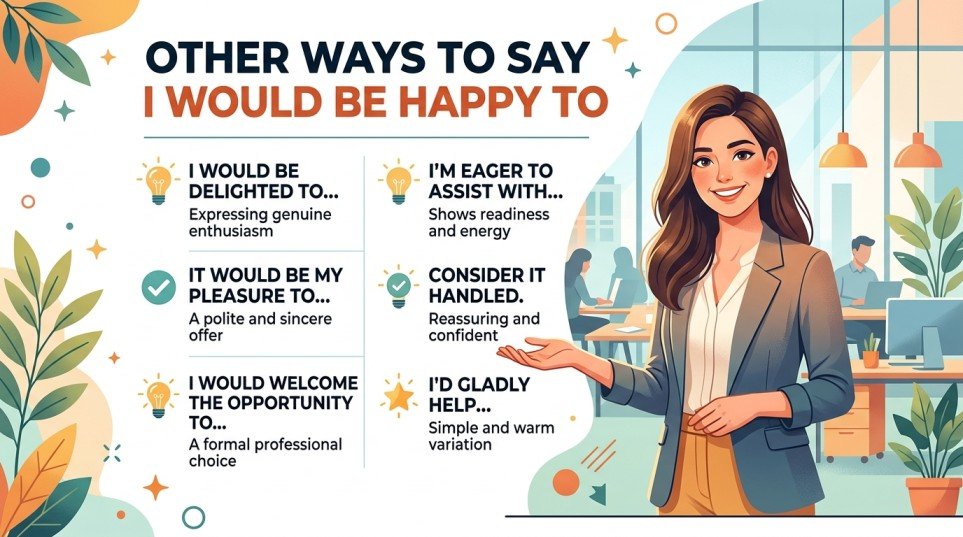
Quick Answer: Instead of saying I would be happy to, you can say: I’d be glad to, I’d love to, certainly, it would be my pleasure, absolutely.
The phrase “I would be happy to” is commonly used to politely agree to help, participate, or accept a request. It sounds warm, positive, and cooperative in both personal and professional communication.
Although the phrase is polite and natural, using it repeatedly can make your English sound repetitive. Native speakers often switch between several similar expressions depending on the tone and situation.
Learning alternatives to “I would be happy to” improves fluency and confidence. It also helps you sound more natural in emails, meetings, and conversations while allowing you to express excitement in English more effectively.
Quick Categories Section
Formal alternatives to “I would be happy to”
- It would be my pleasure
- I would be delighted to
- Certainly
- I would gladly assist
Pro Tip: Use these in professional emails, interviews, or formal discussions.
Casual alternatives
- I’d love to
- Sure thing
- Absolutely
- No problem
Pro Tip: These phrases sound natural in everyday conversations.
Professional alternatives
- I’d be glad to assist
- I’d be pleased to help
- Certainly, I can do that
- I’d be more than happy to
Pro Tip: Keep your tone positive yet polished in workplace communication.
Informal expressions
- Count me in
- Happy to help
- Sounds good
- You got it
Pro Tip: Informal expressions work best with friends or relaxed teams.
“Professional English becomes stronger when you vary your responses naturally.”
Common Mistakes
- Using overly casual phrases in formal settings
Example: Saying “You got it” in a client email. - Overusing one expression repeatedly
Example: Starting every reply with “I would be happy to.” - Sounding too enthusiastic in serious contexts
Example: “I’d love to!” during a formal negotiation. - Using vague responses
Example: Saying “sure” without sounding professional. - Ignoring tone and relationship
Example: Using stiff formal language with close friends.
What Does “I Would Be Happy To” Mean?
It means you are willing and pleased to do something for someone.
Grammatically, it is a polite conditional expression often used to accept requests or offer help.
Example Sentence:
I would be happy to help you with the project.
When to Use “I Would Be Happy To”
- When accepting a request politely
- When offering assistance
- In professional communication
- In customer service conversations
- In spoken and written English
Spoken vs Written: Common in both
Formal vs Informal: Neutral to professional
Is It Professional or Polite to Say “I Would Be Happy To”?
Polite? ✔️ Yes
Professional? ✔️ Yes
Business Example:
“I would be happy to schedule the meeting for next week.”
Pros and Cons of Using “I Would Be Happy To”
Pros
- Polite and professional
- Friendly tone
- Easy to understand
- Suitable for workplace communication
Cons
- Can sound repetitive
- Slightly formal in casual speech
- Lacks emotional variety
- Sometimes overly cautious
“Small changes in wording can instantly improve your communication style.”
Other Ways to Say “I Would Be Happy To” (With Examples)
These alternatives will help you sound more fluent, confident, and natural in different situations.
Use them according to tone, audience, and context.
1. Phrase: I’d be glad to
Meaning: You are pleased to help.
Explanation: Polite and professional alternative.
Example Sentence: I’d be glad to assist with the presentation.
Best Use: workplace
Worst Use: slang context
Tone: professional, warm
Context Variability: professional / written
2. Phrase: I’d love to
Meaning: You are enthusiastic about doing something.
Explanation: Friendly and expressive.
Example Sentence: I’d love to join you for dinner.
Best Use: casual talk
Worst Use: strict formal setting
Tone: cheerful, warm
Context Variability: casual / spoken
3. Phrase: Certainly
Meaning: Yes, definitely.
Explanation: Direct and professional response.
Example Sentence: Certainly, I can help with that.
Best Use: business context
Worst Use: emotional situations
Tone: formal, confident
Context Variability: professional
4. Phrase: It would be my pleasure
Meaning: Helping would bring satisfaction.
Explanation: Very polite and formal.
Example Sentence: It would be my pleasure to assist you.
Best Use: customer service
Worst Use: casual slang
Tone: formal, courteous
Context Variability: professional / written
5. Phrase: Absolutely
Meaning: Strong agreement or willingness.
Explanation: Energetic and confident.
Example Sentence: Absolutely, I can handle that task.
Best Use: quick response
Worst Use: legal writing
Tone: confident, positive
Context Variability: casual / professional
“Fluent English speakers adapt their tone instead of repeating the same phrase.”
6. Phrase: I’d be delighted to
Meaning: You are very pleased to do something.
Explanation: Formal and enthusiastic.
Example Sentence: I’d be delighted to attend the event.
Best Use: formal invitation
Worst Use: casual texting
Tone: formal, enthusiastic
Context Variability: professional
7. Phrase: No problem
Meaning: You are willing without difficulty.
Explanation: Casual and common expression.
Example Sentence: No problem, I can help you later.
Best Use: friendly talk
Worst Use: formal email
Tone: casual, relaxed
Context Variability: spoken
8. Phrase: Happy to help
Meaning: You are pleased to assist.
Explanation: Friendly and supportive.
Example Sentence: Happy to help anytime.
Best Use: customer support
Worst Use: highly formal writing
Tone: warm, helpful
Context Variability: casual / professional
9. Phrase: I’d be pleased to
Meaning: You would feel satisfaction helping.
Explanation: Professional and polished.
Example Sentence: I’d be pleased to discuss the proposal further.
Best Use: workplace
Worst Use: slang conversation
Tone: professional, polite
Context Variability: professional
10. Phrase: Sure thing
Meaning: Of course.
Explanation: Informal agreement.
Example Sentence: Sure thing, I’ll take care of it.
Best Use: casual conversation
Worst Use: professional meeting
Tone: casual, friendly
Context Variability: spoken
11. Phrase: Count me in
Meaning: You want to participate.
Explanation: Informal and enthusiastic.
Example Sentence: Count me in for the weekend trip.
Best Use: group plans
Worst Use: formal emails
Tone: energetic, informal
Context Variability: casual
12. Phrase: You got it
Meaning: Request accepted.
Explanation: Casual confirmation.
Example Sentence: You got it, I’ll send the file today.
Best Use: casual teamwork
Worst Use: executive email
Tone: relaxed, confident
Context Variability: spoken
13. Phrase: I’d be more than happy to
Meaning: Strong willingness to help.
Explanation: More expressive and warm.
Example Sentence: I’d be more than happy to answer your questions.
Best Use: professional communication
Worst Use: casual slang
Tone: warm, professional
Context Variability: professional
14. Phrase: Gladly
Meaning: Willingly and happily.
Explanation: Short but polished.
Example Sentence: I would gladly assist if needed.
Best Use: formal writing
Worst Use: casual texting
Tone: refined, polite
Context Variability: professional
15. Phrase: Sounds good
Meaning: Agreement with a suggestion.
Explanation: Casual approval.
Example Sentence: Sounds good, let’s do it tomorrow.
Best Use: casual plans
Worst Use: formal request
Tone: relaxed, friendly
Context Variability: casual
“Using varied expressions makes your English sound more natural and confident.”
16. Phrase: Of course
Meaning: Willing without hesitation.
Explanation: Common and flexible.
Example Sentence: Of course, I can help you.
Best Use: general use
Worst Use: legal documents
Tone: friendly, confident
Context Variability: casual / professional
17. Phrase: I’d gladly help
Meaning: Happy willingness to assist.
Explanation: Slightly formal and warm.
Example Sentence: I’d gladly help with the report.
Best Use: workplace
Worst Use: slang context
Tone: professional, supportive
Context Variability: professional
18. Phrase: I’m willing to
Meaning: You agree to do something.
Explanation: Neutral and direct.
Example Sentence: I’m willing to take responsibility for it.
Best Use: serious discussion
Worst Use: emotional situations
Tone: neutral, direct
Context Variability: professional
19. Phrase: It’s my pleasure
Meaning: Helping is enjoyable.
Explanation: Very polite and service-oriented.
Example Sentence: It’s my pleasure to assist you today.
Best Use: customer service
Worst Use: casual slang
Tone: polite, formal
Context Variability: professional
20. Phrase: I can certainly do that
Meaning: Strong willingness and ability.
Explanation: Professional confirmation.
Example Sentence: I can certainly do that for you.
Best Use: workplace
Worst Use: casual texting
Tone: professional, confident
Context Variability: professional
21. Phrase: I’m happy to help
Meaning: You feel good about assisting.
Explanation: Warm and common expression.
Example Sentence: I’m happy to help whenever needed.
Best Use: general communication
Worst Use: overly formal writing
Tone: friendly, supportive
Context Variability: casual / professional
22. Phrase: Consider it done
Meaning: You will complete the task.
Explanation: Confident and proactive.
Example Sentence: Consider it done by tomorrow morning.
Best Use: teamwork
Worst Use: formal legal context
Tone: confident, direct
Context Variability: professional / spoken
23. Phrase: I’d enjoy that
Meaning: You would take pleasure in it.
Explanation: Positive and conversational.
Example Sentence: I’d enjoy working on that project.
Best Use: collaborative work
Worst Use: strict formal context
Tone: positive, conversational
Context Variability: casual / professional
24. Phrase: I’m available to help
Meaning: You are ready to assist.
Explanation: Practical and professional.
Example Sentence: I’m available to help this afternoon.
Best Use: workplace
Worst Use: emotional support
Tone: professional, helpful
Context Variability: professional
25. Phrase: I’d appreciate the opportunity
Meaning: You value the chance to participate.
Explanation: Formal and respectful.
Example Sentence: I’d appreciate the opportunity to contribute.
Best Use: interviews
Worst Use: casual chats
Tone: formal, respectful
Context Variability: professional
26. Phrase: I’d welcome the chance
Meaning: You are open and positive about it.
Explanation: Professional and optimistic.
Example Sentence: I’d welcome the chance to discuss this further.
Best Use: networking
Worst Use: slang context
Tone: professional, positive
Context Variability: professional
27. Phrase: Definitely
Meaning: Strong agreement.
Explanation: Short and confident.
Example Sentence: Definitely, I can do that.
Best Use: quick reply
Worst Use: formal writing
Tone: confident, casual
Context Variability: spoken
28. Phrase: I’d be honored to
Meaning: You feel privileged to do something.
Explanation: Formal and respectful.
Example Sentence: I’d be honored to speak at the event.
Best Use: formal invitation
Worst Use: casual requests
Tone: respectful, formal
Context Variability: professional
29. Phrase: I’m more than willing
Meaning: Very willing to help.
Explanation: Emphasizes readiness.
Example Sentence: I’m more than willing to assist.
Best Use: workplace
Worst Use: slang conversation
Tone: professional, supportive
Context Variability: professional
30. Phrase: I can help with that
Meaning: You are able and willing to assist.
Explanation: Direct and practical.
Example Sentence: I can help with that right away.
Best Use: customer support
Worst Use: emotional context
Tone: practical, helpful
Context Variability: casual / professional
“Confident communication comes from choosing the right phrase for the situation.”
Mini Quiz / Self-Check
1. Best phrase for a professional email?
A. Sure thing
B. I’d be pleased to
C. You got it
Answer: B
2. Which phrase is the most informal?
A. It would be my pleasure
B. Sure thing
C. I’d appreciate the opportunity
Answer: B
3. Which phrase sounds most formal?
A. I’d be honored to
B. Sounds good
C. No problem
Answer: A
Comparison Table: Top Alternatives
| Phrase | Tone | Best Use |
|---|---|---|
| I’d be glad to | Professional | Workplace |
| I’d love to | Casual | Friends |
| Certainly | Formal | Business |
| It would be my pleasure | Formal | Customer service |
| Absolutely | Positive | Quick replies |
| Happy to help | Friendly | General use |
| I’d be pleased to | Professional | Emails |
| Of course | Flexible | Everyday use |
| Consider it done | Confident | Teamwork |
| I’d be honored to | Respectful | Formal events |
FAQs
1. What are the best alternatives to “I would be happy to”?
Popular choices include I’d be glad to, absolutely, and it would be my pleasure.
2. Is “I would be happy to” professional?
Yes, it is polite and professional for workplace communication.
3. What can I say instead in casual conversations?
Use phrases like sure thing, I’d love to, or no problem.
4. Which alternative sounds the most formal?
It would be my pleasure and I’d be honored to sound highly formal.
5. Why learn alternatives to “I would be happy to”?
It improves fluency, tone variety, and communication confidence.
Conclusion
Learning different other ways to say “I would be happy to” helps you communicate more naturally and professionally. It also allows you to adjust your tone depending on the situation and audience.
Practice these alternatives regularly to build stronger fluency and confidence. Over time, your English will sound more polished, expressive, and natural.
CTA: Which alternative will you start using today?
Discover More:-
- Other Ways to Say Thank You for Your Concern (30+ Examples)
- Other Ways to Say Please Take Your Time (30+ Examples)

Robert Mitchell is a U.S.-based writer at Gramtivo.Com who focuses on grammar, writing improvement, and language-related content. He holds a degree in English and Linguistics from a U.S. university. His work aims to help readers enhance their writing skills with clear and practical guidance.