
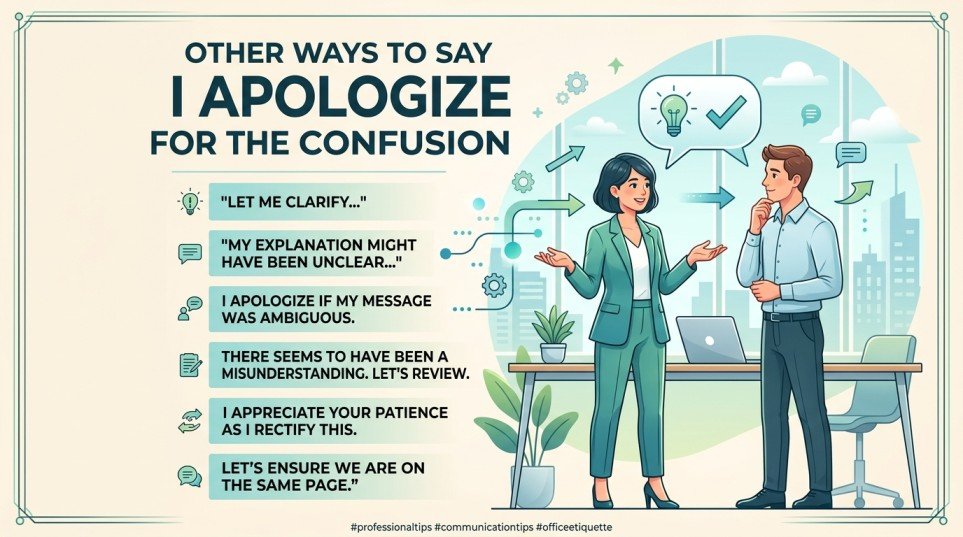
Quick Answer: Instead of saying I apologize for the confusion, you can say: sorry for the misunderstanding, I regret the mix-up, thank you for your patience, pardon the confusion, sorry for any inconvenience.
The phrase “I apologize for the confusion” is commonly used when clarifying misunderstandings, correcting mistakes, or addressing unclear communication. It sounds polite and professional, especially in emails and customer service situations.
However, repeating the same expression can make your communication feel robotic or repetitive. Native speakers often use different alternatives depending on tone, audience, and formality.
Learning alternatives to “I apologize for the confusion” helps you sound more natural, polished, and confident. It also improves your professional communication skills and helps you express excitement in English and empathy more effectively in conversations.
Quick Categories Section
Formal alternatives to “I apologize for the confusion”
- Please accept my apologies for the misunderstanding
- I regret any confusion caused
- Pardon the misunderstanding
- I sincerely apologize for the mix-up
Pro Tip: Use these in official emails, workplace communication, or customer support responses.
Casual alternatives
- Sorry about the mix-up
- My bad
- Sorry for the misunderstanding
- Didn’t mean to confuse you
Pro Tip: Keep these for friendly or informal conversations.
Professional alternatives
- Thank you for your patience
- I appreciate your understanding
- Sorry for any inconvenience caused
- Let me clarify that for you
Pro Tip: Professional phrases should focus on solutions, not just apologies.
Informal expressions
- Oops, wrong info
- Sorry, that came out wrong
- I mixed things up
- That’s on me
Pro Tip: Avoid overly casual expressions in business communication.
“Professional communication becomes stronger when you vary your wording naturally.”
Common Mistakes
- Over-apologizing
Example: Saying “I deeply apologize” for a small misunderstanding. - Using vague language
Example: “Sorry for everything” sounds unclear. - Sounding robotic
Example: Repeating “I apologize for the confusion” in every email. - Ignoring the solution
Example: Apologizing without clarifying the issue. - Using informal phrases professionally
Example: “My bad” in a client email.
What Does “I Apologize for the Confusion” Mean?
It means you are expressing regret for causing misunderstanding or unclear communication.
Grammatically, it is a formal apology statement using the verb apologize.
Example Sentence:
I apologize for the confusion regarding the meeting schedule.
When to Use “I Apologize for the Confusion”
- When correcting unclear information
- In customer service responses
- During professional communication
- After misunderstandings or mistakes
Spoken vs Written: More common in writing
Formal vs Informal: Mostly formal and professional
Is It Professional or Polite to Say “I Apologize for the Confusion”?
Polite? ✔️ Yes
Professional? ✔️ Yes
Business Example:
“I apologize for the confusion regarding your order details.”
Pros and Cons of Using “I Apologize for the Confusion”
Pros
- Professional tone
- Clear and respectful
- Common in workplace communication
- Easy to understand
Cons
- Can sound repetitive
- Slightly formal for casual talk
- May feel robotic if overused
- Lacks emotional warmth sometimes
“The best apologies are clear, concise, and solution-focused.”
Other Ways to Say “I Apologize for the Confusion” (With Examples)
These alternatives will help you sound more fluent, confident, and natural in different situations.
Use them according to tone, audience, and context.
1. Phrase: Sorry for the misunderstanding
Meaning: Apologizing for unclear communication.
Explanation: Softer and more conversational.
Example Sentence: Sorry for the misunderstanding earlier.
Best Use: general use
Worst Use: legal writing
Tone: polite, friendly
Context Variability: casual / professional
2. Phrase: I regret the mix-up
Meaning: Expressing regret for confusion.
Explanation: Slightly formal and professional.
Example Sentence: I regret the mix-up with your appointment.
Best Use: workplace
Worst Use: casual slang
Tone: formal, professional
Context Variability: professional / written
3. Phrase: Pardon the confusion
Meaning: Asking forgiveness for misunderstanding.
Explanation: Polite and concise.
Example Sentence: Pardon the confusion regarding the update.
Best Use: customer service
Worst Use: close friends
Tone: formal, polite
Context Variability: professional
4. Phrase: Sorry for any inconvenience
Meaning: Apologizing for disruption or trouble.
Explanation: Common in business communication.
Example Sentence: Sorry for any inconvenience caused.
Best Use: workplace
Worst Use: casual chat
Tone: professional, respectful
Context Variability: professional / written
5. Phrase: Thank you for your patience
Meaning: Appreciating understanding during confusion.
Explanation: Focuses on gratitude instead of blame.
Example Sentence: Thank you for your patience while we resolved the issue.
Best Use: customer support
Worst Use: personal argument
Tone: professional, appreciative
Context Variability: professional
“Modern professional English often replaces direct apologies with appreciation.”
6. Phrase: I appreciate your understanding
Meaning: Thanking someone for being patient.
Explanation: Positive and professional wording.
Example Sentence: I appreciate your understanding in this matter.
Best Use: business communication
Worst Use: casual texting
Tone: polite, professional
Context Variability: professional
7. Phrase: Sorry, that wasn’t clear
Meaning: Admitting unclear communication.
Explanation: Simple and direct.
Example Sentence: Sorry, that wasn’t clear in my last email.
Best Use: quick clarification
Worst Use: formal reports
Tone: casual, honest
Context Variability: spoken / written
8. Phrase: Let me clarify that
Meaning: Correcting confusion immediately.
Explanation: Solution-focused phrase.
Example Sentence: Let me clarify that for you.
Best Use: workplace
Worst Use: emotional argument
Tone: professional, helpful
Context Variability: professional
9. Phrase: I may have caused some confusion
Meaning: Acknowledging possible misunderstanding.
Explanation: Softer responsibility.
Example Sentence: I may have caused some confusion earlier.
Best Use: polite discussion
Worst Use: serious mistakes
Tone: careful, polite
Context Variability: professional
10. Phrase: Sorry for the mix-up
Meaning: Apologizing for a mistake or confusion.
Explanation: Common informal alternative.
Example Sentence: Sorry for the mix-up with the schedule.
Best Use: casual workplace
Worst Use: legal context
Tone: friendly, neutral
Context Variability: casual / professional
11. Phrase: My apologies for the misunderstanding
Meaning: Formal apology for confusion.
Explanation: Professional and respectful.
Example Sentence: My apologies for the misunderstanding.
Best Use: formal email
Worst Use: casual texting
Tone: formal, polite
Context Variability: professional
12. Phrase: I’m sorry if that was unclear
Meaning: Apologizing for lack of clarity.
Explanation: Gentle and conversational.
Example Sentence: I’m sorry if that was unclear before.
Best Use: clarification
Worst Use: strict formal writing
Tone: warm, polite
Context Variability: spoken / written
13. Phrase: That was my mistake
Meaning: Taking responsibility.
Explanation: Honest and direct.
Example Sentence: That was my mistake, sorry about that.
Best Use: workplace
Worst Use: legal situations
Tone: accountable, sincere
Context Variability: casual / professional
14. Phrase: I misspoke earlier
Meaning: Admitting incorrect wording.
Explanation: Useful in spoken communication.
Example Sentence: I misspoke earlier about the deadline.
Best Use: presentations
Worst Use: casual slang
Tone: professional, direct
Context Variability: spoken
15. Phrase: Sorry, I mixed things up
Meaning: Admitting confusion or error.
Explanation: Informal and natural.
Example Sentence: Sorry, I mixed things up earlier.
Best Use: friendly talk
Worst Use: professional report
Tone: casual, honest
Context Variability: casual
“Clear communication matters more than perfect communication.”
16. Phrase: Please excuse the misunderstanding
Meaning: Asking forgiveness politely.
Explanation: Formal alternative.
Example Sentence: Please excuse the misunderstanding regarding the invoice.
Best Use: formal business
Worst Use: casual conversation
Tone: formal, respectful
Context Variability: professional
17. Phrase: I sincerely apologize for the mix-up
Meaning: Strong formal apology.
Explanation: Emphasizes sincerity.
Example Sentence: I sincerely apologize for the mix-up in communication.
Best Use: serious workplace issue
Worst Use: minor casual mistakes
Tone: sincere, professional
Context Variability: professional
18. Phrase: Sorry for the unclear message
Meaning: Apologizing for vague wording.
Explanation: Specific and direct.
Example Sentence: Sorry for the unclear message earlier.
Best Use: emails
Worst Use: legal writing
Tone: neutral, polite
Context Variability: professional / spoken
19. Phrase: I should have explained that better
Meaning: Accepting responsibility for poor explanation.
Explanation: Humble and constructive.
Example Sentence: I should have explained that better.
Best Use: workplace discussions
Worst Use: formal legal context
Tone: thoughtful, sincere
Context Variability: spoken / professional
20. Phrase: I apologize for the misunderstanding
Meaning: Formal apology for confusion.
Explanation: Direct and professional.
Example Sentence: I apologize for the misunderstanding about the timeline.
Best Use: business communication
Worst Use: casual texting
Tone: professional, respectful
Context Variability: professional
21. Phrase: Sorry for the confusion earlier
Meaning: Apologizing for previous misunderstanding.
Explanation: Slightly more conversational.
Example Sentence: Sorry for the confusion earlier today.
Best Use: quick correction
Worst Use: legal writing
Tone: friendly, polite
Context Variability: casual / professional
22. Phrase: That came out wrong
Meaning: Admitting poor wording.
Explanation: Casual spoken expression.
Example Sentence: Sorry, that came out wrong.
Best Use: spoken conversation
Worst Use: formal email
Tone: casual, honest
Context Variability: spoken
23. Phrase: I didn’t explain that clearly
Meaning: Admitting unclear explanation.
Explanation: Direct and accountable.
Example Sentence: I didn’t explain that clearly before.
Best Use: teaching or work
Worst Use: legal context
Tone: sincere, professional
Context Variability: professional / spoken
24. Phrase: I understand the confusion
Meaning: Acknowledging misunderstanding.
Explanation: Empathetic approach.
Example Sentence: I understand the confusion regarding the instructions.
Best Use: customer service
Worst Use: personal argument
Tone: understanding, calm
Context Variability: professional
25. Phrase: Sorry for the miscommunication
Meaning: Apologizing for communication error.
Explanation: Common professional phrase.
Example Sentence: Sorry for the miscommunication earlier.
Best Use: workplace
Worst Use: casual joking
Tone: professional, neutral
Context Variability: professional
26. Phrase: I take responsibility for the confusion
Meaning: Accepting accountability.
Explanation: Strong professional wording.
Example Sentence: I take responsibility for the confusion caused.
Best Use: leadership roles
Worst Use: casual chat
Tone: accountable, professional
Context Variability: professional
27. Phrase: That information was incorrect
Meaning: Correcting wrong details.
Explanation: Straightforward clarification.
Example Sentence: That information was incorrect, and I apologize.
Best Use: workplace correction
Worst Use: emotional situations
Tone: direct, professional
Context Variability: professional
28. Phrase: I apologize for any misunderstanding
Meaning: Formal apology for confusion.
Explanation: Broad and professional wording.
Example Sentence: I apologize for any misunderstanding this caused.
Best Use: formal communication
Worst Use: casual conversation
Tone: respectful, formal
Context Variability: professional
29. Phrase: Sorry, I gave the wrong impression
Meaning: Admitting unintended misunderstanding.
Explanation: Useful in conversations.
Example Sentence: Sorry, I gave the wrong impression earlier.
Best Use: spoken communication
Worst Use: legal documents
Tone: sincere, conversational
Context Variability: spoken
30. Phrase: Thanks for pointing that out
Meaning: Appreciating correction instead of over-apologizing.
Explanation: Positive and professional response.
Example Sentence: Thanks for pointing that out; let me correct it.
Best Use: workplace feedback
Worst Use: serious disputes
Tone: appreciative, professional
Context Variability: professional
“Confident communication balances apology with clarity and solutions.”
Mini Quiz / Self-Check
1. Which phrase is most professional?
A. My bad
B. I sincerely apologize for the mix-up
C. Oops, wrong info
Answer: B
2. Which phrase focuses on appreciation instead of apology?
A. Sorry for the misunderstanding
B. Thank you for your patience
C. I mixed things up
Answer: B
3. Which expression is too casual for client emails?
A. My bad
B. I regret the mix-up
C. I appreciate your understanding
Answer: A
Comparison Table: Top Alternatives
| Phrase | Tone | Best Use |
|---|---|---|
| Sorry for the misunderstanding | Neutral | General use |
| I regret the mix-up | Formal | Workplace |
| Pardon the confusion | Professional | Customer service |
| Sorry for any inconvenience | Professional | Business |
| Thank you for your patience | Appreciative | Support emails |
| I appreciate your understanding | Professional | Workplace |
| Let me clarify that | Helpful | Clarifications |
| My apologies for the misunderstanding | Formal | Emails |
| Sorry for the miscommunication | Neutral | Office communication |
| I take responsibility for the confusion | Accountable | Leadership |
FAQs
1. What are the best alternatives to “I apologize for the confusion”?
Popular alternatives include sorry for the misunderstanding, thank you for your patience, and I regret the mix-up.
2. Is “I apologize for the confusion” professional?
Yes, it is a professional and polite phrase commonly used in workplace communication.
3. What phrase sounds more positive than apologetic?
“Thank you for your patience” sounds more positive and solution-focused.
4. Can I use informal expressions in professional English?
Avoid overly casual phrases like my bad in formal business communication.
5. Why learn other ways to say “I apologize for the confusion”?
It improves fluency, professionalism, and communication variety.
Conclusion
Learning different other ways to say “I apologize for the confusion” helps you sound more natural, professional, and emotionally intelligent in communication. It also allows you to adjust tone depending on the audience and situation.
Practice these expressions regularly and focus on clarity as much as politeness. Strong communication comes from choosing the right words with the right tone.
CTA: Which phrase fits your communication style best? Start using a new one today.
Discover More:-

Jennifer Collins is a professional grammar expert and language educator at gramtivo.com, specializing in English grammar, writing skills, and language improvement. She holds a Master’s degree in English Language and Literature from a recognized university in the United States. With years of teaching and content development experience, she is dedicated to helping learners improve their communication skills with clear and practical guidance.