
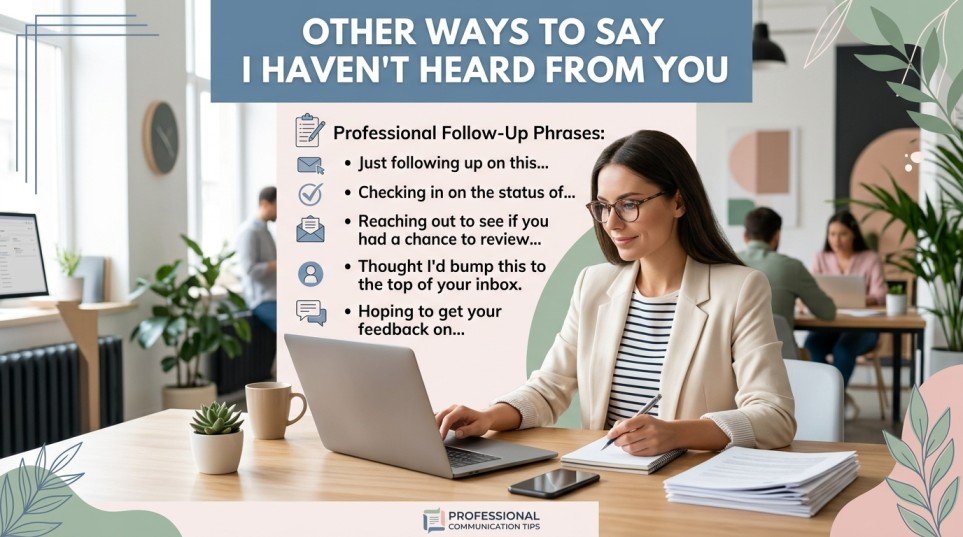
Quick Answer: Instead of saying I haven’t heard from you, you can use: I haven’t received a response, I’m following up, I haven’t gotten your reply, I was wondering if you saw my message, I wanted to check in.
The phrase “I haven’t heard from you” is commonly used when you are waiting for a response from someone. It can be used in personal conversations, professional emails, and follow-up messages.
While the phrase is clear and widely understood, using it repeatedly can make your communication sound repetitive. Different situations require different levels of politeness, professionalism, and urgency.
Learning alternatives to “I haven’t heard from you” helps you sound more natural and adaptable. It also improves your written and spoken communication, especially when using professional reaction phrases and informal expressions in English.
Quick Categories Section
Formal alternatives to “I haven’t heard from you”
- I have not yet received a response
- I am awaiting your reply
- I have yet to hear back from you
- I would appreciate an update
Pro Tip: These phrases work best in business emails and formal correspondence.
Casual alternatives
- Haven’t heard back from you
- Just checking in
- Did you get my message?
- What’s up?
Pro Tip: Keep the tone friendly and conversational.
Professional alternatives
- I wanted to follow up
- I’m checking on the status
- I’m reaching out regarding my previous message
- I’m looking forward to your response
Pro Tip: Professional follow-ups should remain polite and concise.
Informal expressions
- Haven’t gotten a reply yet
- You’ve gone quiet
- Haven’t seen a response
- Just touching base
Pro Tip: Use these only with people you know well.
“Following up professionally is a skill that strengthens communication and relationships.”
Common Mistakes
- Sounding impatient Example: “Why haven’t you replied yet?”
- Using an overly demanding tone Example: “You need to answer me immediately.”
- Following up too frequently Example: Sending multiple messages in one day.
- Being too vague Example: “Any news?” without context.
- Using casual language in professional emails Example: “Hey, what happened to my message?”
What Does “I Haven’t Heard From You” Mean?
The phrase means you have not received a response, update, or communication from someone.
It is commonly used when following up on previous messages, requests, or conversations.
Example Sentence:
I haven’t heard from you regarding the project proposal.
When to Use “I Haven’t Heard From You”
- Following up on an email
- Waiting for feedback
- Checking on a request
- Looking for an update
- Reconnecting after silence
Spoken vs Written: Common in both formats
Formal vs Informal: Neutral, depending on context
Is It Professional or Polite to Say “I Haven’t Heard From You”?
Polite? ✔️ Yes
Professional? ✔️ Yes, when phrased politely
Business Example:
“I haven’t heard from you regarding the meeting schedule, so I wanted to follow up.”
Pros and Cons of Using “I Haven’t Heard From You”
Pros
- Clear and direct
- Easy to understand
- Works in many situations
- Suitable for follow-ups
Cons
- Can sound repetitive
- May feel impatient
- Lacks variety
- Sometimes sounds blunt
“The best follow-up messages are polite, clear, and respectful of the other person’s time.”
Other Ways to Say “I Haven’t Heard From You” (With Examples)
These alternatives will help you sound more fluent, confident, and natural in different situations.
Use them according to tone, context, and audience for more effective communication.
1. Phrase: I wanted to follow up
Meaning: Checking on a previous communication.
Explanation: One of the most professional alternatives.
Example Sentence: I wanted to follow up regarding my earlier email.
Best Use: business emails
Worst Use: urgent complaints
Tone: professional, polite
Context Variability: professional / written
2. Phrase: I haven’t received a response yet
Meaning: No reply has been received.
Explanation: Clear and formal.
Example Sentence: I haven’t received a response yet and wanted to check in.
Best Use: formal communication
Worst Use: casual texting
Tone: formal, neutral
Context Variability: professional / written
3. Phrase: I’m checking in
Meaning: Requesting an update.
Explanation: Friendly and versatile.
Example Sentence: I’m checking in to see if there are any updates.
Best Use: general follow-ups
Worst Use: serious disputes
Tone: friendly, professional
Context Variability: casual / professional
4. Phrase: I was wondering if you saw my message
Meaning: Asking whether the message was received.
Explanation: Soft and polite.
Example Sentence: I was wondering if you saw my message from last week.
Best Use: polite reminders
Worst Use: urgent deadlines
Tone: courteous, gentle
Context Variability: casual / professional
5. Phrase: I haven’t gotten your reply
Meaning: No response has arrived.
Explanation: Casual alternative.
Example Sentence: I haven’t gotten your reply yet.
Best Use: personal communication
Worst Use: formal reports
Tone: casual, direct
Context Variability: casual / spoken
“A polite follow-up often gets better results than a demanding message.”
6. Phrase: I’m reaching out again
Meaning: Contacting someone another time.
Explanation: Professional follow-up phrase.
Example Sentence: I’m reaching out again regarding the proposal.
Best Use: workplace communication
Worst Use: casual texting
Tone: professional, polite
Context Variability: professional
7. Phrase: I have yet to hear back from you
Meaning: No response has been received so far.
Explanation: Formal and professional.
Example Sentence: I have yet to hear back from you concerning the application.
Best Use: formal emails
Worst Use: friendly chats
Tone: formal, professional
Context Variability: professional / written
8. Phrase: Just checking in
Meaning: Looking for an update.
Explanation: Common and friendly.
Example Sentence: Just checking in to see how things are going.
Best Use: friendly follow-ups
Worst Use: legal matters
Tone: casual, warm
Context Variability: casual / professional
9. Phrase: I’m following up on my previous message
Meaning: Referring to earlier communication.
Explanation: Very professional.
Example Sentence: I’m following up on my previous message about the meeting.
Best Use: business emails
Worst Use: casual texts
Tone: professional, formal
Context Variability: professional
10. Phrase: I’m still awaiting your response
Meaning: Waiting for a reply.
Explanation: Formal and respectful.
Example Sentence: I’m still awaiting your response regarding the contract.
Best Use: business correspondence
Worst Use: close friends
Tone: formal, professional
Context Variability: professional / written
11. Phrase: I wanted to touch base
Meaning: Reconnect or check status.
Explanation: Popular workplace phrase.
Example Sentence: I wanted to touch base regarding our discussion.
Best Use: office communication
Worst Use: highly formal documents
Tone: professional, friendly
Context Variability: professional
12. Phrase: I’m looking forward to your reply
Meaning: Expecting a response.
Explanation: Polite and positive.
Example Sentence: I’m looking forward to your reply.
Best Use: professional emails
Worst Use: urgent demands
Tone: polite, professional
Context Variability: written
13. Phrase: I wanted to check on the status
Meaning: Asking for progress information.
Explanation: Useful for projects and requests.
Example Sentence: I wanted to check on the status of my application.
Best Use: professional inquiries
Worst Use: personal chats
Tone: professional, neutral
Context Variability: professional
14. Phrase: I haven’t seen a response yet
Meaning: No reply has appeared.
Explanation: Casual but clear.
Example Sentence: I haven’t seen a response yet, so I thought I’d ask.
Best Use: casual follow-ups
Worst Use: formal letters
Tone: neutral, friendly
Context Variability: casual
15. Phrase: Did you get my message?
Meaning: Confirming message delivery.
Explanation: Direct but common.
Example Sentence: Did you get my message from yesterday?
Best Use: personal communication
Worst Use: executive emails
Tone: direct, casual
Context Variability: spoken / casual
“Professional communication often depends on choosing the right follow-up phrase.”
16. Phrase: I’m seeking an update
Meaning: Requesting current information.
Explanation: Formal and professional.
Example Sentence: I’m seeking an update regarding the project timeline.
Best Use: business communication
Worst Use: casual texting
Tone: formal, professional
Context Variability: professional
17. Phrase: I have not yet received your feedback
Meaning: Feedback is still pending.
Explanation: Common in workplace communication.
Example Sentence: I have not yet received your feedback on the proposal.
Best Use: workplace
Worst Use: personal chats
Tone: professional, polite
Context Variability: professional
18. Phrase: I’m waiting to hear from you
Meaning: Expecting communication.
Explanation: Simple and natural.
Example Sentence: I’m waiting to hear from you about the next steps.
Best Use: general use
Worst Use: formal reports
Tone: neutral, friendly
Context Variability: casual / professional
19. Phrase: I haven’t received an update
Meaning: No new information has arrived.
Explanation: Suitable for projects and requests.
Example Sentence: I haven’t received an update on the matter.
Best Use: work situations
Worst Use: social conversations
Tone: professional, neutral
Context Variability: professional
20. Phrase: I wanted to reconnect
Meaning: Restart communication.
Explanation: Useful after a long gap.
Example Sentence: I wanted to reconnect regarding our earlier discussion.
Best Use: networking
Worst Use: urgent requests
Tone: warm, professional
Context Variability: professional
21. Phrase: I haven’t heard back yet
Meaning: No response so far.
Explanation: Casual variation.
Example Sentence: I haven’t heard back yet, so I thought I’d follow up.
Best Use: everyday communication
Worst Use: formal reports
Tone: casual, neutral
Context Variability: casual / professional
22. Phrase: I’m circling back
Meaning: Returning to a previous topic.
Explanation: Popular business phrase.
Example Sentence: I’m circling back regarding our last conversation.
Best Use: workplace
Worst Use: casual texts
Tone: professional, modern
Context Variability: professional
23. Phrase: I wanted to see if there were any updates
Meaning: Requesting new information.
Explanation: Soft and polite.
Example Sentence: I wanted to see if there were any updates on the project.
Best Use: professional communication
Worst Use: urgent complaints
Tone: polite, professional
Context Variability: professional
24. Phrase: I’m writing to follow up
Meaning: Sending a follow-up message.
Explanation: Formal email wording.
Example Sentence: I’m writing to follow up on my previous inquiry.
Best Use: business emails
Worst Use: casual chats
Tone: formal, professional
Context Variability: written
25. Phrase: I haven’t gotten any update
Meaning: No new information received.
Explanation: Casual variation.
Example Sentence: I haven’t gotten any update from you yet.
Best Use: informal communication
Worst Use: formal correspondence
Tone: casual, direct
Context Variability: casual
26. Phrase: I’m checking on the progress
Meaning: Asking about advancement.
Explanation: Useful for projects.
Example Sentence: I’m checking on the progress of the assignment.
Best Use: workplace
Worst Use: social chats
Tone: professional, neutral
Context Variability: professional
27. Phrase: I’d appreciate an update
Meaning: Politely requesting information.
Explanation: Formal and respectful.
Example Sentence: I’d appreciate an update when convenient.
Best Use: business communication
Worst Use: casual texting
Tone: professional, courteous
Context Variability: professional
28. Phrase: I’m reaching out for an update
Meaning: Contacting someone to get information.
Explanation: Professional and clear.
Example Sentence: I’m reaching out for an update on the application.
Best Use: workplace
Worst Use: friendly chats
Tone: professional, neutral
Context Variability: professional
29. Phrase: You’ve been quiet lately
Meaning: Communication has stopped.
Explanation: Informal and conversational.
Example Sentence: You’ve been quiet lately. How have you been?
Best Use: friends
Worst Use: business emails
Tone: casual, friendly
Context Variability: casual
30. Phrase: I was hoping to hear from you
Meaning: Expecting a response.
Explanation: Polite and slightly personal.
Example Sentence: I was hoping to hear from you regarding the opportunity.
Best Use: polite follow-ups
Worst Use: urgent demands
Tone: warm, professional
Context Variability: professional / personal
“Effective follow-ups are polite reminders, not pressure tactics.”
Mini Quiz / Self-Check
1. Which phrase is most professional for an email?
A. You’ve been quiet lately
B. I’m following up on my previous message
C. Did you get my message?
Answer: B
2. Which phrase is best for a friend?
A. I have yet to hear back from you
B. I’m seeking an update
C. Did you get my message?
Answer: C
3. Which phrase sounds the most formal?
A. Just checking in
B. I’m still awaiting your response
C. Haven’t heard back yet
Answer: B
4. Which phrase is suitable for networking?
A. I wanted to reconnect
B. You’ve been quiet lately
C. Haven’t gotten a reply
Answer: A
Comparison Table: Top Alternatives
| Phrase | Tone | Best Use |
|---|---|---|
| I wanted to follow up | Professional | Business emails |
| I’m checking in | Friendly | General follow-ups |
| I have yet to hear back from you | Formal | Workplace |
| I’m following up on my previous message | Professional | Email communication |
| I’m still awaiting your response | Formal | Business correspondence |
| I wanted to touch base | Professional | Workplace |
| I’m looking forward to your reply | Polite | Professional emails |
| I’d appreciate an update | Courteous | Business communication |
| I was hoping to hear from you | Warm | Follow-ups |
| Did you get my message? | Casual | Personal communication |
FAQs
1. What are the best alternatives to “I haven’t heard from you”?
Some of the best options include I wanted to follow up, I’m checking in, and I have yet to hear back from you.
2. Is “I haven’t heard from you” professional?
Yes. It can be professional when used politely and with the appropriate context.
3. What should I say instead in a business email?
Use phrases like I’m following up on my previous message or I’d appreciate an update.
4. How do I follow up without sounding rude?
Choose polite wording, keep the message brief, and avoid sounding demanding.
5. Why should I learn alternatives to “I haven’t heard from you”?
Using different expressions improves fluency, professionalism, and communication effectiveness.
Conclusion
Learning other ways to say “I haven’t heard from you” helps you communicate more effectively in personal and professional situations. Different alternatives allow you to sound polite, professional, friendly, or formal depending on the context.
Practice these phrases regularly and pay attention to tone. Over time, you’ll become more confident in writing follow-up emails, sending messages, and maintaining professional relationships.
CTA: Which of these follow-up phrases do you use most often? Try a new one in your next message.
Discover More:-
- Other Ways to Say Thank You for Taking Care of This (30+ Examples)
- Other Ways to Say Please Let Me Know What You Think (30+ Examples)

Jennifer Collins is a professional grammar expert and language educator at gramtivo.com, specializing in English grammar, writing skills, and language improvement. She holds a Master’s degree in English Language and Literature from a recognized university in the United States. With years of teaching and content development experience, she is dedicated to helping learners improve their communication skills with clear and practical guidance.