
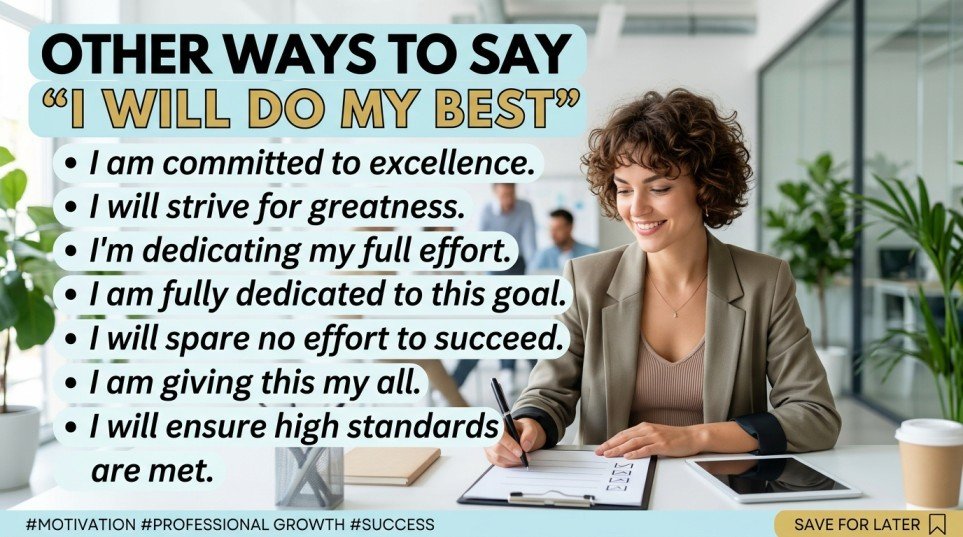
Quick Answer: Instead of saying I will do my best, you can say I’ll give it my all, I’ll do everything I can, I’ll put in my best effort, I’ll make it happen, I’ll give it my full attention.
The phrase “I will do my best” is commonly used to express commitment, effort, and determination. It reassures others that you intend to work hard and achieve the best possible outcome.
While this phrase is clear and widely accepted, using it repeatedly can make your communication sound repetitive. Native speakers often choose different expressions depending on the situation, relationship, and level of professionalism.
Learning alternatives to “I will do my best” helps you sound more fluent and confident. It also allows you to communicate effort and dedication more naturally in both personal and professional situations. Expanding your vocabulary with other ways to say “I will do my best” can significantly improve your spoken and written English.
Quick Categories Section
Formal alternatives to “I will do my best”
- I will make every effort
- I will do everything possible
- I will give it my utmost attention
- I will strive to achieve that
Pro Tip: Use these phrases in professional emails, interviews, and formal discussions.
Casual alternatives
- I’ll give it my all
- I’ll try my hardest
- I’ll do everything I can
- I’ll give it a shot
Pro Tip: These expressions work well with friends, family, and everyday conversations.
Professional alternatives
- I will make it a priority
- I will put forth my best effort
- I am committed to achieving this
- I will work diligently on it
Pro Tip: Professional alternatives sound confident without making unrealistic promises.
Informal expressions
- I’ll give it everything I’ve got
- I’m on it
- I’ll make it happen
- Leave it with me
Pro Tip: Informal expressions are best reserved for casual settings.
“The right phrase can make your commitment sound stronger and more professional.”
Common Mistakes
- Making unrealistic promises
Example: “I guarantee it will be finished tomorrow.”
- Using overly casual phrases in business settings
Example: “I’ll give it a shot” in a formal proposal.
- Sounding uncertain
Example: “I guess I’ll try.”
- Repeating the same phrase too often
Example: Using “I’ll do my best” in every email.
- Choosing a phrase that doesn’t match the situation
Example: “I’ll make it happen” when the outcome isn’t fully under your control.
What Does “I Will Do My Best” Mean?
The phrase means you will put forth maximum effort to achieve a desired result or complete a task successfully.
Grammatically, it is a future-tense statement expressing commitment and intention.
Example Sentence:
I will do my best to complete the project before the deadline.
When to Use “I Will Do My Best”
- When accepting responsibility
- When responding to requests
- During interviews
- In customer service situations
- When offering support
- In personal and professional conversations
Spoken vs Written: Common in both forms
Formal vs Informal: Neutral and versatile
Is It Professional or Polite to Say “I Will Do My Best”?
Polite? ✔️ Yes
Professional? ✔️ Usually
While it is polite and acceptable, some workplaces prefer stronger action-oriented phrases.
Business Example:
“I will do my best to resolve this issue as quickly as possible.”
Pros and Cons of Using “I Will Do My Best”
Pros
- Clear and easy to understand
- Shows commitment
- Polite and respectful
- Suitable for many situations
Cons
- Can sound repetitive
- Sometimes lacks confidence
- May appear vague
- Less impactful than stronger alternatives
“Strong communication balances confidence with realistic expectations.”
Other Ways to Say “I Will Do My Best” (With Examples)
These alternatives will help you sound more fluent, confident, and natural in different situations.
Use them according to tone, context, and audience to express commitment, determination, and responsibility.
1. Phrase: I’ll give it my all
Meaning: I will put in maximum effort.
Explanation: A strong and motivational expression.
Example Sentence: I’ll give it my all and see what I can achieve.
Best Use: motivation, teamwork
Worst Use: legal discussions
Tone: determined, positive
Context Variability: casual / spoken
2. Phrase: I’ll do everything I can
Meaning: I will use all available resources and effort.
Explanation: Shows commitment without guaranteeing results.
Example Sentence: I’ll do everything I can to help you.
Best Use: support situations
Worst Use: guaranteed outcomes
Tone: sincere, supportive
Context Variability: casual / professional
3. Phrase: I’ll put in my best effort
Meaning: I will work as hard as possible.
Explanation: Professional and straightforward.
Example Sentence: I’ll put in my best effort to meet the deadline.
Best Use: workplace
Worst Use: casual jokes
Tone: professional, responsible
Context Variability: professional / written
4. Phrase: I’ll make it happen
Meaning: I will work toward achieving the goal.
Explanation: Confident and proactive.
Example Sentence: Leave it with me; I’ll make it happen.
Best Use: leadership
Worst Use: uncertain projects
Tone: confident, proactive
Context Variability: casual / professional
5. Phrase: I’ll give it my full attention
Meaning: I will focus completely on it.
Explanation: Emphasizes concentration and care.
Example Sentence: I’ll give it my full attention this afternoon.
Best Use: work tasks
Worst Use: casual chat
Tone: professional, attentive
Context Variability: professional
“Confidence grows when your language clearly reflects your effort.”
6. Phrase: I’ll try my hardest
Meaning: I will make the strongest effort possible.
Explanation: Common and easy to understand.
Example Sentence: I’ll try my hardest to finish on time.
Best Use: personal goals
Worst Use: formal reports
Tone: sincere, determined
Context Variability: casual / spoken
7. Phrase: I’ll make every effort
Meaning: I will do everything reasonably possible.
Explanation: Formal and professional.
Example Sentence: I’ll make every effort to address your concerns.
Best Use: business communication
Worst Use: casual banter
Tone: professional, respectful
Context Variability: professional / written
8. Phrase: I’ll work hard on it
Meaning: I will dedicate significant effort.
Explanation: Direct and natural.
Example Sentence: I’ll work hard on it this week.
Best Use: everyday use
Worst Use: formal proposals
Tone: straightforward, positive
Context Variability: casual / professional
9. Phrase: I’ll put my heart into it
Meaning: I will work with passion and dedication.
Explanation: Emotional and expressive.
Example Sentence: I’ll put my heart into this project.
Best Use: creative work
Worst Use: technical reports
Tone: heartfelt, enthusiastic
Context Variability: spoken
10. Phrase: I’ll do everything possible
Meaning: I will take every reasonable action.
Explanation: Strong commitment.
Example Sentence: I’ll do everything possible to assist you.
Best Use: customer service
Worst Use: casual humor
Tone: supportive, professional
Context Variability: professional
11. Phrase: I’m committed to this
Meaning: I am fully dedicated to achieving the goal.
Explanation: Demonstrates responsibility.
Example Sentence: I’m committed to this and will see it through.
Best Use: workplace
Worst Use: temporary tasks
Tone: serious, professional
Context Variability: professional
12. Phrase: I’ll do my utmost
Meaning: I will make the greatest possible effort.
Explanation: Formal and traditional.
Example Sentence: I’ll do my utmost to ensure success.
Best Use: formal communication
Worst Use: casual conversations
Tone: formal, respectful
Context Variability: professional
13. Phrase: I’ll give it everything I’ve got
Meaning: I will use all my energy and effort.
Explanation: Powerful and motivational.
Example Sentence: I’ll give it everything I’ve got.
Best Use: challenges
Worst Use: formal writing
Tone: energetic, determined
Context Variability: casual
14. Phrase: I’ll do what I can
Meaning: I will help within my abilities.
Explanation: Honest and realistic.
Example Sentence: I’ll do what I can to help.
Best Use: assistance
Worst Use: leadership announcements
Tone: sincere, modest
Context Variability: casual / professional
15. Phrase: I’ll take care of it
Meaning: I will handle the task personally.
Explanation: Shows responsibility.
Example Sentence: Don’t worry, I’ll take care of it.
Best Use: task management
Worst Use: uncertain situations
Tone: confident, reassuring
Context Variability: casual / professional
“The most effective promises focus on effort, not guarantees.”
16. Phrase: I’ll put forth my best effort
Meaning: I will contribute maximum effort.
Explanation: Professional variation.
Example Sentence: I’ll put forth my best effort throughout the project.
Best Use: workplace
Worst Use: casual chat
Tone: professional, formal
Context Variability: professional
17. Phrase: I’ll strive to achieve it
Meaning: I will work diligently toward success.
Explanation: Formal and goal-oriented.
Example Sentence: I’ll strive to achieve the desired outcome.
Best Use: business settings
Worst Use: friendly conversations
Tone: ambitious, professional
Context Variability: professional
18. Phrase: I’ll dedicate myself to it
Meaning: I will fully commit myself.
Explanation: Shows strong dedication.
Example Sentence: I’ll dedicate myself to completing this task.
Best Use: long-term projects
Worst Use: quick favors
Tone: committed, serious
Context Variability: professional
19. Phrase: I’ll focus on making it work
Meaning: I will concentrate on achieving success.
Explanation: Practical and solution-oriented.
Example Sentence: I’ll focus on making it work.
Best Use: problem-solving
Worst Use: casual jokes
Tone: positive, practical
Context Variability: professional
20. Phrase: I’ll do all I can
Meaning: I will help as much as possible.
Explanation: Simple and sincere.
Example Sentence: I’ll do all I can to support you.
Best Use: support situations
Worst Use: promises requiring certainty
Tone: caring, helpful
Context Variability: casual / professional
21. Phrase: I’m on it
Meaning: I have started working on it.
Explanation: Short and confident.
Example Sentence: Thanks for letting me know. I’m on it.
Best Use: workplace chats
Worst Use: formal documents
Tone: proactive, confident
Context Variability: casual / professional
22. Phrase: Leave it with me
Meaning: I will handle the matter.
Explanation: Common in professional English.
Example Sentence: Leave it with me; I’ll look into it.
Best Use: customer service
Worst Use: official reports
Tone: reassuring, helpful
Context Variability: professional
23. Phrase: I’ll do my utmost best
Meaning: I will make the greatest effort possible.
Explanation: Emphasizes determination.
Example Sentence: I’ll do my utmost best to help.
Best Use: supportive situations
Worst Use: highly formal writing
Tone: determined, sincere
Context Variability: spoken
24. Phrase: I’ll tackle it right away
Meaning: I will begin immediately.
Explanation: Shows urgency and action.
Example Sentence: I’ll tackle it right away.
Best Use: workplace tasks
Worst Use: long-term planning
Tone: proactive, energetic
Context Variability: professional
25. Phrase: I’ll give it serious attention
Meaning: I will consider it carefully.
Explanation: Focuses on thoughtfulness.
Example Sentence: I’ll give it serious attention this week.
Best Use: important issues
Worst Use: casual conversations
Tone: professional, thoughtful
Context Variability: professional
26. Phrase: I’ll work diligently on it
Meaning: I will work carefully and consistently.
Explanation: Strong professional phrase.
Example Sentence: I’ll work diligently on it until completion.
Best Use: business communication
Worst Use: casual speech
Tone: professional, dedicated
Context Variability: professional
27. Phrase: I’ll put my best foot forward
Meaning: I will make my best effort and impression.
Explanation: Common idiomatic expression.
Example Sentence: I’ll put my best foot forward during the presentation.
Best Use: interviews
Worst Use: technical documents
Tone: confident, positive
Context Variability: spoken / professional
28. Phrase: I’ll see what I can do
Meaning: I will try to help.
Explanation: Useful when success is uncertain.
Example Sentence: I’ll see what I can do about it.
Best Use: assistance
Worst Use: guaranteed commitments
Tone: helpful, realistic
Context Variability: casual / professional
29. Phrase: I’ll give it my maximum effort
Meaning: I will work as hard as possible.
Explanation: Strong expression of dedication.
Example Sentence: I’ll give it my maximum effort.
Best Use: challenging goals
Worst Use: casual chats
Tone: determined, serious
Context Variability: professional
30. Phrase: You can count on me
Meaning: You can rely on my effort and support.
Explanation: Builds trust and confidence.
Example Sentence: You can count on me to get this done.
Best Use: teamwork
Worst Use: situations outside your control
Tone: reliable, supportive
Context Variability: casual / professional
“The most professional alternatives communicate effort without overpromising results.”
Mini Quiz / Self-Check
1. Which phrase is most professional?
A. I’m on it
B. I’ll make every effort
C. I’ll give it a shot
Answer: B
2. Which phrase is best when success is uncertain?
A. I’ll see what I can do
B. I’ll make it happen
C. I guarantee it
Answer: A
3. Which phrase sounds most confident?
A. I guess I’ll try
B. I’ll give it my all
C. Maybe I can help
Answer: B
Comparison Table: Top Alternatives
| Phrase | Tone | Best Use |
|---|---|---|
| I’ll give it my all | Motivational | Challenges |
| I’ll do everything I can | Supportive | Helping others |
| I’ll put in my best effort | Professional | Workplace |
| I’ll make every effort | Formal | Business emails |
| I’m committed to this | Professional | Projects |
| I’ll work diligently on it | Professional | Work tasks |
| I’ll give it my full attention | Attentive | Important work |
| I’ll see what I can do | Realistic | Assistance |
| You can count on me | Reliable | Teamwork |
| I’ll take care of it | Confident | Task ownership |
FAQs
1. What are the best alternatives to “I will do my best”?
Popular options include I’ll give it my all, I’ll make every effort, and I’ll do everything I can.
2. Is “I will do my best” professional?
Yes, but stronger professional alternatives may sound more confident in workplace communication.
3. What can I say instead of “I will do my best” in an email?
Try I will make every effort or I will work diligently on it.
4. Which alternative sounds most confident?
I’ll make it happen and You can count on me often sound the most confident.
5. Why learn other ways to say “I will do my best”?
It improves fluency, vocabulary, tone awareness, and professional communication skills.
Conclusion
Learning other ways to say “I will do my best” allows you to communicate commitment, responsibility, and determination more effectively. Different situations require different tones, and having multiple alternatives helps you sound more natural and confident.
Practice these phrases regularly and pay attention to context. The more variety you use, the more fluent and professional your English will become.
CTA: Which of these alternatives will you start using today?
Discover More:-
- Other Ways to Say At Your Earliest Convenience (30+ Examples)
- Other Ways to Say Please Let Me Know Your Availability (30+ Examples)

Robert Mitchell is a U.S.-based writer at Gramtivo.Com who focuses on grammar, writing improvement, and language-related content. He holds a degree in English and Linguistics from a U.S. university. His work aims to help readers enhance their writing skills with clear and practical guidance.