
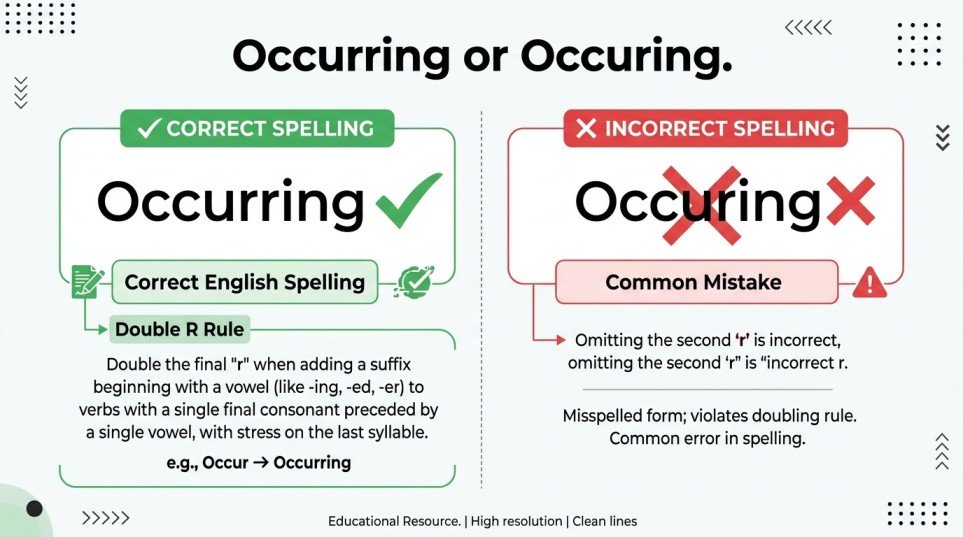
Quick Ans: The correct spelling is occurring with two “r” letters. The spelling occuring is incorrect in standard English because the final consonant must double before adding “ing.” Understanding the difference helps improve grammar, spelling, and professional writing accuracy.
Many English learners and even native speakers confuse occurring or occuring. The words look almost identical. However, only one spelling is correct.
This mistake happens because English spelling rules can feel confusing. Some verbs double the final consonant before adding “ing,” while others do not. As a result, writers often wonder whether to use one “r” or two.
The correct spelling is occurring. The incorrect version is occuring.
Understanding this rule matters in school, business writing, emails, and professional communication. A small spelling mistake can make writing look less polished. Therefore, learning the correct form improves both confidence and accuracy.
In this guide, you will learn the difference between occurring or occuring, spelling rules, grammar explanations, examples, common mistakes, exercises, and practical writing tips. By the end, you will know exactly when and why to use occurring correctly.
Quick Answer: Occurring or Occuring
The correct spelling is occurring.
| Word | Correct or Incorrect |
|---|---|
| Occurring | Correct |
| Occuring | Incorrect |
The verb occur doubles the final “r” before adding “ing.”
Therefore:
- Occur + ing = occurring
- Not occuring
What Does “Occurring” Mean?
The word occurring comes from the verb occur. It means:
- Happening
- Taking place
- Existing at a certain time
Simple Examples
- A meeting is occurring right now.
- The problem is occurring frequently.
- Heavy rain is occurring across the city.
In each sentence, the word describes something happening in the present.
Why “Occurring” Is Correct
The confusion in occurring or occuring comes from English spelling rules.
The Doubling Rule
When a verb:
- Ends with a vowel followed by a consonant
- Has stress on the final syllable
the final consonant usually doubles before adding “ing.”
The word occur follows this rule.
Breakdown:
- Occur
- Final consonant = r
- Add “ing”
- Double the r
Result:
- Occurring
Because of this grammar rule, occuring becomes incorrect.
Understanding the Spelling Rule
Words That Double the Final Consonant
Here are similar examples:
| Base Word | Correct Form |
|---|---|
| Run | Running |
| Begin | Beginning |
| Admit | Admitting |
| Occur | Occurring |
Each word doubles the final consonant before adding “ing.”
Words That Do Not Double
Not every word follows this pattern.
| Base Word | Correct Form |
|---|---|
| Read | Reading |
| Visit | Visiting |
| Open | Opening |
These words do not need consonant doubling.
Therefore, understanding stress and syllables helps avoid spelling mistakes.
Common Examples of “Occurring”
In Everyday Conversation
People use occurring in daily speech and writing.
Examples:
- The event is occurring tomorrow.
- Changes are occurring quickly.
- An error is occurring in the software.
In Academic Writing
Teachers and researchers frequently use the word.
Examples:
- Climate changes are occurring worldwide.
- The reaction is occurring at low temperatures.
In Business Communication
Professional writing often includes the term.
Examples:
- Delays are occurring during shipping.
- Technical issues are occurring on the website.
Because the word appears in many situations, correct spelling becomes important.
Key Differences Between Occurring or Occuring
Spelling Accuracy
The biggest difference is correctness.
- Occurring = correct
- Occuring = incorrect
Grammar Compliance
The spelling occurring follows standard English grammar rules. The spelling occuring breaks the consonant doubling rule.
Professional Appearance
Correct spelling improves:
- Academic writing
- Job applications
- Emails
- Reports
Meanwhile, spelling mistakes can reduce credibility.
Advantages of Using Correct Spelling
Better Communication
Correct spelling makes writing easier to understand.
Improved Professionalism
Proper grammar creates a stronger impression in workplaces and schools.
Higher Writing Confidence
Knowing grammar rules helps writers feel more confident.
Better Search Engine Accuracy
Correct spelling improves online searches and digital communication.
For these reasons, learning the correct form of occurring matters.
Real World Examples
Student Writing
A student writes:
- “The experiment is occurring today.”
This sentence is correct.
Workplace Email
An employee writes:
- “Technical issues are occurring during login.”
Again, the spelling is correct.
Incorrect Example
Someone writes:
- “The event is occuring tomorrow.”
This version contains a spelling mistake.
Real world examples make the rule easier to remember.
Regional and Global Usage
American English
American English uses occurring with double “r.”
British English
British English also uses occurring with double “r.”
Global English Learning
English learners worldwide commonly confuse occurring or occuring because consonant doubling rules differ between languages.
However, standard English grammar always prefers occurring.
Related Concepts and Comparisons
Occurring vs Happening
Both words describe events taking place.
Examples:
- The meeting is occurring now.
- The meeting is happening now.
“Happening” sounds more casual, while “occurring” sounds more formal.
Occurred vs Occurring
| Word | Meaning |
|---|---|
| Occurred | Happened in the past |
| Occurring | Happening now |
Examples:
- The accident occurred yesterday.
- The accident is occurring now.
Occur vs Occurring
“Occur” is the base verb. “Occurring” is the present participle form.
Understanding these forms helps improve grammar accuracy.
Common Mistakes About Occurring or Occuring
Forgetting the Double “R”
The most common mistake is writing:
- Occuring ❌
Instead of:
- Occurring ✅
Ignoring Stress Rules
People often forget that stressed final syllables usually require consonant doubling.
Relying Only on Pronunciation
Both spellings sound similar when spoken. Because of this, writers sometimes choose the wrong version.
Typing Too Quickly
Fast typing often causes spelling errors. Proofreading helps catch these mistakes.
Avoiding these problems improves writing quality.
Beginner to Advanced Grammar Tips
Beginner Level
Remember this simple formula:
- Occur + ing = occurring
Intermediate Level
Learn the consonant doubling rule for verbs ending in vowel plus consonant patterns.
Advanced Level
Study syllable stress and verb formation patterns in English grammar.
For example:
- Refer → referring
- Transfer → transferring
- Occur → occurring
These patterns strengthen overall spelling skills.
Step By Step Spelling Breakdown
Let us spell the word correctly step by step.
Step 1
Start with the base verb:
- Occur
Step 2
Identify the final consonant:
- r
Step 3
Add “ing”
Because the final syllable is stressed, double the consonant.
Step 4
Final result:
- Occurring
This process explains why occuring is incorrect.
Exercises With Answers
Exercise 1
Which spelling is correct?
- Occuring
- Occurring
Answer: Occurring.
Exercise 2
Complete the sentence:
“Changes are ______ rapidly.”
Answer: occurring.
Exercise 3
True or False: “Occuring” is standard English spelling.
Answer: False.
Exercise 4
Which grammar rule applies to occurring?
Answer: Final consonant doubling rule.
Exercise 5
Choose the correct sentence:
- Problems are occuring daily.
- Problems are occurring daily.
Answer: Problems are occurring daily.
When Should You Use “Occurring”?
Use occurring when describing something happening right now or repeatedly happening over time.
Examples include:
- Events occurring today
- Errors occurring in software
- Changes occurring in nature
Always remember that the correct spelling uses two “r” letters.
FAQs About Occurring or Occuring
Which spelling is correct: occurring or occuring?
The correct spelling is occurring with two “r” letters.
Why is “occuring” incorrect?
It breaks the English consonant doubling rule used before adding “ing.”
Does American English use occurring or occuring?
American English uses occurring.
Does British English spell occurring differently?
No. British English also uses occurring with double “r.”
Why does occurring double the “r”?
The verb “occur” ends with a stressed vowel plus consonant pattern, which requires consonant doubling.
Is occurring a verb or adjective?
It is usually the present participle form of the verb occur.
Can occurring describe repeated events?
Yes. It can describe events happening repeatedly or continuously.
What is the past tense of occur?
The past tense is occurred.
How can I remember the correct spelling of occurring?
Remember that occur becomes occurring by doubling the final “r.”
Is occuring ever acceptable in English?
No. Standard English grammar considers occuring incorrect.
Conclusion
Understanding occurring or occuring is important for accurate English writing. Although the two spellings look similar, only occurring is correct.
The correct form follows the English consonant doubling rule. Since “occur” ends with a stressed vowel plus consonant pattern, the final “r” doubles before adding “ing.”
Using correct spelling improves professional communication, academic writing, and everyday grammar. Small spelling mistakes may seem minor, but they can affect clarity and credibility.
Fortunately, remembering the rule is simple:
- Occur + ing = occurring
Practice using the word in sentences, proofread carefully, and pay attention to similar spelling patterns. With repetition, the correct spelling becomes natural.
Now that you understand the difference between occurring or occuring, you can write confidently and avoid this common English mistake.
Discover More:-
- Slushy or Slushie: Differences, Meaning, and Correct Usage Guide
- Outter or Outer: Correct Spelling, Meaning, and Grammar Guide

Lisa Thompson is a USA-based content writer and language specialist focused on grammar, writing improvement and digital publishing.
She holds a degree in English Language and Communication and has professional experience in educational and web content creation.
As the author of Gramtivo.Com, she aims to help readers improve their writing skills through clear and practical guidance.