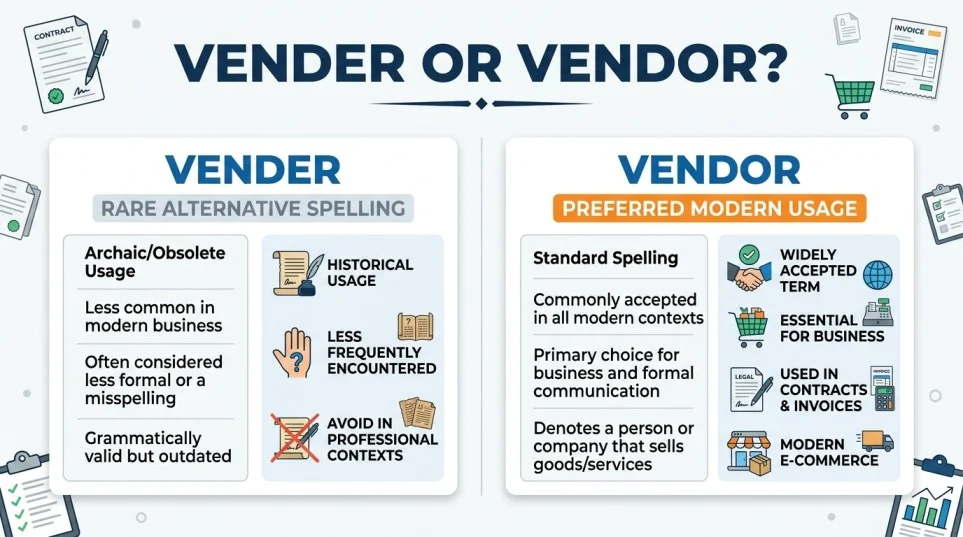
Quick Ans: The correct word in most modern English writing is vendor. While vender is also a legitimate English word, it is much less common and is considered a variant spelling. In business, commerce, technology, and professional communication, vendor is the preferred and widely accepted form.
Many people search for vender or vendor because the two words look almost identical. At first glance, they appear interchangeable. Both refer to a person or company that sells goods or services.
However, there is an important difference.
One spelling is used far more often in modern English. The other exists in dictionaries but appears much less frequently in professional writing.
This confusion often arises when writing business emails, contracts, invoices, website content, or academic papers. A small spelling mistake can make a document appear less professional.
Understanding the difference between vender or vendor helps writers communicate clearly and confidently. It also prevents errors in business communication, legal documents, and online content.
In this comprehensive guide, you will learn the meaning of each word, usage rules, advantages and disadvantages of each spelling, real world examples, common mistakes, exercises, related grammar concepts, and frequently asked questions.
By the end, you will know exactly which spelling to use and when.
Quick Answer: Vender or Vendor
If you need a quick answer, use vendor.
| Word | Status | Usage Frequency |
|---|---|---|
| Vendor | Preferred modern spelling | Very common |
| Vender | Alternative spelling | Rare |
For most situations:
- Use vendor in business writing.
- Use vendor in contracts.
- Use vendor in software and technology industries.
- Use vendor in professional communication.
Although vender is technically correct, vendor is the standard choice.
What Does Vendor Mean?
A vendor is a person, business, or organization that sells products or services.
The word appears frequently in:
- Business contracts
- Procurement documents
- Technology industries
- Retail operations
- Government purchasing systems
Examples of Vendor in Sentences
- The company selected a new software vendor.
- Our vendor delivered the supplies on time.
- The event organizer contacted several food vendors.
- The vendor provided technical support after installation.
Because of its widespread use, most dictionaries list vendor as the primary spelling.
Common Types of Vendors
Vendors can operate in many industries:
- Software vendors
- Food vendors
- Equipment vendors
- Retail vendors
- Service vendors
- Wholesale vendors
As a result, the word has become a standard business term worldwide.
What Does Vender Mean?
A vender is also a person who sells goods or services.
Historically, the word developed from the verb “vend,” which means to sell.
Although dictionaries recognize vender, modern English speakers rarely use it.
Examples of Vender in Sentences
- The vender sold handmade crafts at the market.
- A local vender supplied fresh vegetables.
These examples are grammatically correct. Nevertheless, many readers may assume the spelling is a mistake because vendor is much more familiar.
Why Vender Is Less Common
Several factors contributed to the dominance of vendor:
- Business organizations standardized the spelling.
- Legal documents commonly adopted vendor.
- Technology companies preferred vendor.
- Educational materials typically teach vendor.
Consequently, vendor became the accepted standard.
Key Differences Between Vender or Vendor
Popularity
The biggest difference between vender or vendor is usage frequency.
Vendor appears in business documents, websites, contracts, and professional communication.
Vender appears much less often.
Professional Acceptance
Most organizations recognize vendor as the standard spelling.
Professional writers almost always choose vendor.
Reader Expectations
Modern readers expect to see vendor.
Using vender may create confusion because many people think it is a spelling error.
Search Engine Usage
Online searches overwhelmingly favor vendor.
Therefore, websites and businesses generally use vendor for better clarity and consistency.
Comparison Table: Vender vs Vendor
| Feature | Vender | Vendor |
|---|---|---|
| Dictionary Word | Yes | Yes |
| Modern Usage | Rare | Very common |
| Business Writing | Uncommon | Standard |
| Legal Documents | Rare | Preferred |
| Technology Industry | Rare | Standard |
| SEO Friendliness | Lower | Higher |
This comparison clearly shows why vendor is the preferred option.
Advantages and Disadvantages
Advantages of Using Vendor
- Widely recognized
- Professional appearance
- Common in business writing
- Preferred in legal documents
- Better for SEO and online content
Disadvantages of Using Vendor
- Very few disadvantages exist
- Some historical texts may use different spellings
Advantages of Using Vender
- Technically correct
- Recognized by dictionaries
- Historically valid spelling
Disadvantages of Using Vender
- Rarely used today
- Can confuse readers
- May appear incorrect
- Less common in professional communication
Because of these factors, most writers choose vendor.
Real World Examples
Business Contracts
A contract may state:
“The vendor shall provide services according to the agreed terms.”
Most legal professionals use vendor rather than vender.
Technology Industry
Software companies frequently use terms such as:
- Software vendor
- Cloud vendor
- Hardware vendor
Technology documentation almost never uses vender.
Event Planning
An event organizer may work with:
- Food vendors
- Equipment vendors
- Entertainment vendors
Again, vendor remains the preferred spelling.
Government Procurement
Government purchasing systems often refer to approved vendors and vendor registration programs.
As a result, vendor dominates official documentation.
Regional and Global Usage
United States
American English strongly favors vendor.
Business organizations, schools, and government agencies use this spelling consistently.
United Kingdom
British English also prefers vendor.
Although vender appears occasionally, vendor remains the standard form.
International Business
Global companies overwhelmingly use vendor in contracts and procurement processes.
Therefore, vendor has become the international standard.
Common Uses of Vendor in Different Industries
Technology
Technology companies often refer to:
- Software vendors
- Cloud vendors
- Security vendors
- Hardware vendors
Retail
Retail businesses work with:
- Product vendors
- Supply vendors
- Wholesale vendors
Healthcare
Healthcare organizations purchase products from:
- Medical equipment vendors
- Pharmaceutical vendors
- Technology vendors
Education
Schools and universities often contract with:
- Food service vendors
- Transportation vendors
- Software vendors
These examples show how widespread the term vendor has become.
Related Concepts and Comparisons
Vendor vs Seller
A seller is anyone who sells something.
A vendor usually refers to a business or professional supplier.
Vendor vs Supplier
Suppliers provide goods to businesses.
Vendors often sell products directly or through commercial agreements.
Vendor vs Merchant
Merchants buy and resell products.
Vendors may manufacture, distribute, or sell products.
Vendor vs Contractor
A contractor performs work or services.
A vendor primarily provides products or services for purchase.
Understanding these related terms helps clarify the meaning of vendor.
Common Mistakes About Vender or Vendor
Assuming Vender Is Wrong
Many people believe vender is incorrect.
In reality, dictionaries recognize it as a valid spelling.
Using Vender in Professional Documents
Although technically correct, vender can appear unusual in business communication.
Choosing vendor helps avoid confusion.
Mixing Spellings
Some writers switch between vendor and vender in the same document.
Consistency is important.
Select one spelling and use it throughout.
Ignoring Audience Expectations
Readers expect to see vendor.
Using the preferred spelling improves readability and professionalism.
Beginner to Advanced Usage Tips
Beginner Level
Use vendor in all business and professional writing.
Intermediate Level
Learn related terms such as supplier, seller, and contractor.
Advanced Level
Understand industry specific vendor terminology, including:
- Preferred vendor
- Approved vendor
- Vendor management
- Vendor compliance
- Vendor relationship management
These terms appear frequently in corporate environments.
Step By Step Decision Guide
Suppose you need to write a business document.
Ask yourself these questions:
- Is this a professional document?
- Is the audience business related?
- Is clarity important?
- Is this for online publication?
If the answer is yes, use vendor.
In nearly every modern situation, vendor is the safest and most professional choice.
Exercises With Answers
Exercise 1
Which spelling is more common in modern business English?
Answer: Vendor.
Exercise 2
Which word is preferred in contracts?
Answer: Vendor.
Exercise 3
True or False: Vender is not a real word.
Answer: False.
Exercise 4
Which spelling appears more often in technology industries?
Answer: Vendor.
Exercise 5
Which spelling should most writers use?
Answer: Vendor.
When Should You Use Vendor Instead of Vender?
Use vendor when:
- Writing business emails
- Creating contracts
- Publishing website content
- Writing academic papers
- Producing marketing materials
- Creating procurement documents
Use vender only when:
- Following a specific historical source
- Referencing older texts
- Maintaining consistency with a particular style guide
For most situations, vendor remains the best choice.
FAQs About Vender or Vendor
Which is correct, vender or vendor?
Both are technically correct. However, vendor is the preferred spelling in modern English.
Is vender a real word?
Yes. Dictionaries recognize vender as a valid variant spelling.
Why is vendor more common than vender?
Business, legal, educational, and technology industries standardized the spelling vendor over time.
Should I use vendor in business writing?
Yes. Vendor is the accepted professional standard.
Do contracts use vendor or vender?
Most contracts use vendor because it is widely recognized and understood.
Is vendor used in technology industries?
Yes. Terms such as software vendor and cloud vendor are extremely common.
Can I use vender in academic writing?
You can, but vendor is usually the safer and more widely accepted choice.
Is there a meaning difference between vender and vendor?
No. Both words refer to someone who sells goods or services.
Which spelling is better for SEO?
Vendor is generally better because it receives significantly more searches and recognition.
Will people think vender is a mistake?
Many readers may assume it is an error because vendor is far more common.
Conclusion
The debate over vender or vendor is simpler than it first appears. Both words are recognized by dictionaries and carry the same basic meaning. Each refers to a person or company that sells goods or services.
Despite this similarity, vendor has become the clear standard in modern English. Businesses, government agencies, software companies, educational institutions, and legal professionals overwhelmingly use this spelling.
Choosing vendor improves professionalism, clarity, and consistency. Readers recognize it immediately, making communication smoother and more effective.
Although vender remains technically correct, its rarity often causes confusion. For that reason, most writers should avoid it unless a specific historical or stylistic reason exists.
When in doubt, use vendor. Doing so aligns your writing with current business standards and reader expectations.
Discover More:-
- Theragun vs Hypervolt: Detailed Comparison, Features, and Buying Guide
- Balcony vs Patio: Differences, Uses, and Outdoor Space Guide

Lisa Thompson is a USA-based content writer and language specialist focused on grammar, writing improvement and digital publishing.
She holds a degree in English Language and Communication and has professional experience in educational and web content creation.
As the author of Gramtivo.Com, she aims to help readers improve their writing skills through clear and practical guidance.