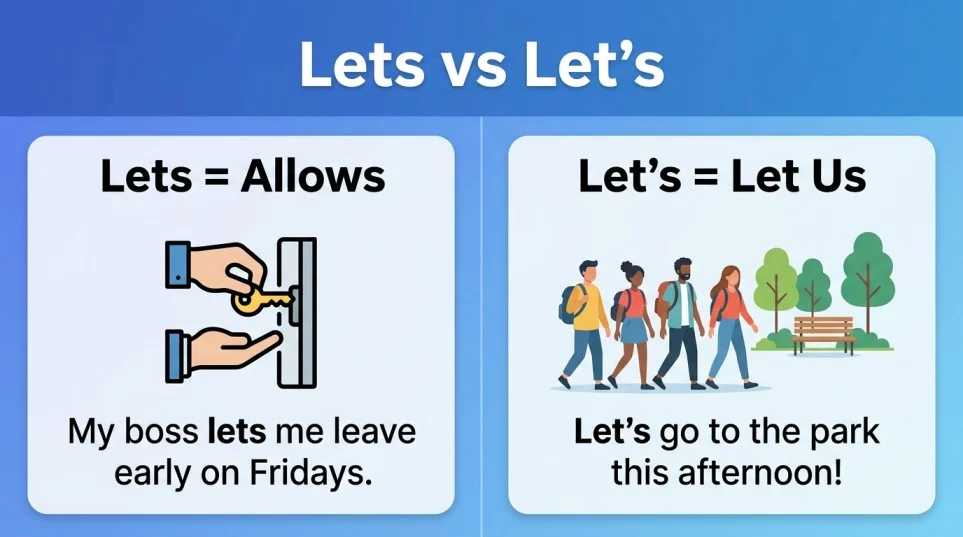
Quick Ans: The difference between lets or let’s is simple but important. Lets is a verb that means “allows” or “permits,” while let’s is a contraction of “let us.” Understanding when to use each form helps you avoid one of the most common grammar mistakes in English.
Many English learners and even native speakers get confused about lets or let’s. The words look almost identical. Only one apostrophe separates them. However, that small punctuation mark completely changes the meaning.
Grammar mistakes involving lets and let’s appear in emails, social media posts, business communication, and academic writing. As a result, understanding the difference is essential for clear communication.
For example, consider these two sentences:
- The teacher lets students leave early.
- Let’s leave early today.
Although the words look similar, they serve different purposes. One functions as a verb. The other acts as a contraction.
Learning the distinction is easier than many people think. Once you understand the rule, you can apply it confidently in everyday writing and speech.
This guide explains lets or let’s in detail. You will learn definitions, examples, advantages of correct usage, common mistakes, exercises, related grammar concepts, and frequently asked questions. By the end, you will know exactly which form to use in every situation.
Quick Answer: Lets or Let’s
The quickest way to understand lets or let’s is to remember this simple rule:
| Word | Meaning | Example |
|---|---|---|
| Lets | Allows or permits | She lets her dog run freely. |
| Let’s | Contraction of “let us” | Let’s go to the park. |
A useful test is to replace let’s with let us.
If the sentence still makes sense, use let’s.
For example:
- Let’s start now.
- Let us start now.
Both sentences work correctly.
However:
- The manager lets employees work remotely.
- The manager let us employees work remotely. ❌
Because the replacement does not work, the correct word is lets.
What Does “Lets” Mean?
Lets is the third person singular form of the verb let.
It means:
- Allows
- Permits
- Enables
The word usually appears when discussing what someone or something allows another person to do.
Examples of Lets
Consider these examples:
- The school lets students use tablets.
- My neighbor lets me borrow his tools.
- The software lets users create reports.
- She lets her children stay up late on weekends.
In each sentence, lets means “allows.”
How Lets Functions in a Sentence
The structure often looks like this:
Subject + lets + person + action
Examples:
- The coach lets players practice extra hours.
- The company lets employees work from home.
Because lets is a verb, it follows standard grammar rules for present tense verbs.
What Does “Let’s” Mean?
Let’s is a contraction of let us.
Writers and speakers use it when making suggestions, invitations, or proposals.
Examples of Let’s
Here are several examples:
- Let’s go for a walk.
- Let’s finish the project today.
- Let’s order pizza tonight.
- Let’s discuss the plan tomorrow.
Each sentence could also be written as:
- Let us go for a walk.
- Let us finish the project today.
The contraction simply sounds more natural in everyday English.
How Let’s Functions in a Sentence
The structure is usually:
Let’s + action
Examples include:
- Let’s begin.
- Let’s learn grammar.
- Let’s take a break.
Because it expresses a suggestion involving the speaker and listener, let’s is extremely common in conversation.
Key Differences Between Lets or Let’s
Meaning
The primary difference involves meaning.
Lets means allows.
Let’s means let us.
Grammar Function
Lets functions as a verb.
Let’s functions as a contraction.
Usage
Use lets when discussing permission.
Use let’s when making suggestions.
Example Comparison
| Sentence | Correct Word |
|---|---|
| The teacher ___ students ask questions. | Lets |
| ___ ask some questions. | Let’s |
| The app ___ users save files. | Lets |
| ___ save the file now. | Let’s |
Understanding this distinction makes choosing between lets or let’s much easier.
Advantages of Using Lets and Let’s Correctly
Better Professional Writing
Correct grammar improves emails, reports, and business communication.
Clearer Communication
Readers understand your meaning immediately when the correct form is used.
Improved Academic Performance
Students often lose marks because of punctuation mistakes.
Stronger Credibility
Accurate grammar creates a more professional impression.
Therefore, mastering lets or let’s contributes to stronger overall writing skills.
Disadvantages of Incorrect Usage
Reader Confusion
Using the wrong form may confuse readers.
Grammar Errors
Teachers and editors frequently mark this mistake.
Reduced Professionalism
Business documents with punctuation errors can appear careless.
Miscommunication
The intended meaning may become unclear.
For these reasons, it is worth learning the difference thoroughly.
Real World Examples
Workplace Communication
Correct:
- Let’s schedule a meeting tomorrow.
Incorrect:
- Lets schedule a meeting tomorrow.
School Writing
Correct:
- The teacher lets students use calculators.
Incorrect:
- The teacher let’s students use calculators.
Social Media Posts
Correct:
- Let’s celebrate our success.
Correct:
- My parents let me travel alone.
Both examples demonstrate how context determines the proper choice.
Regional and Global Usage
American English
American English uses both forms according to standard grammar rules.
British English
British English follows the same distinction.
International English
English learners worldwide often confuse lets or let’s because many languages do not use apostrophes in the same way.
Despite regional differences in vocabulary and spelling, the rule remains consistent everywhere.
Related Grammar Concepts
Its vs It’s
This pair creates confusion similar to lets or let’s.
Examples:
- Its color is blue.
- It’s raining outside.
Whose vs Who’s
Another common apostrophe issue:
- Whose book is this?
- Who’s coming tonight?
Your vs You’re
Many writers also struggle with:
- Your car is parked outside.
- You’re welcome.
Learning these related concepts strengthens overall grammar skills.
Common Mistakes About Lets or Let’s
Using Let’s for Permission
Incorrect:
- The manager let’s employees work remotely.
Correct:
- The manager lets employees work remotely.
Forgetting the Apostrophe
Incorrect:
- Lets go to the beach.
Correct:
- Let’s go to the beach.
Assuming Apostrophes Are Optional
Apostrophes change meaning. Therefore, leaving them out can create grammatical errors.
Relying Only on Sound
Both words sound almost identical. Consequently, listening alone does not help determine which form is correct.
Always check the sentence meaning.
Beginner to Advanced Learning Tips
Beginner Level
Memorize this rule:
- Lets = allows
- Let’s = let us
Intermediate Level
Practice replacing let’s with let us.
If the sentence still works, use let’s.
Advanced Level
Proofread carefully for apostrophe mistakes.
Additionally, study other commonly confused contractions.
Regular practice improves grammar accuracy over time.
Step By Step Usage Scenario
Imagine you are writing an email.
Sentence:
“_____ start the meeting now.”
Step 1: Ask whether the phrase means “let us.”
Step 2: Replace it with “let us.”
“Let us start the meeting now.”
Step 3: If the replacement works, use let’s.
Correct sentence:
“Let’s start the meeting now.”
Now consider:
“The manager _____ employees leave early.”
Replacing with “let us” does not make sense.
Therefore, the correct word is lets.
Exercises With Answers
Exercise 1
Choose the correct word:
_____ go shopping.
Answer: Let’s
Exercise 2
Choose the correct word:
The app _____ users customize settings.
Answer: Lets
Exercise 3
Choose the correct word:
_____ finish our homework.
Answer: Let’s
Exercise 4
Choose the correct word:
The coach _____ players stay after practice.
Answer: Lets
Exercise 5
True or False:
“Let’s” means “let us.”
Answer: True.
When Should You Use Lets or Let’s?
Use lets when:
- Describing permission
- Explaining what someone allows
- Writing present tense statements
Examples:
- The school lets students use laptops.
- The software lets users export data.
Use let’s when:
- Making suggestions
- Inviting someone to act
- Including yourself in the action
Examples:
- Let’s begin.
- Let’s eat lunch.
Remembering these situations makes choosing the correct form much easier.
FAQs About Lets or Let’s
What is the difference between lets or let’s?
Lets means “allows,” while let’s is a contraction of “let us.”
When should I use let’s?
Use let’s whenever you mean “let us” or when making a suggestion.
When should I use lets?
Use lets when describing permission or allowing someone to do something.
Is lets without an apostrophe correct?
Yes. Lets is correct when it means “allows” or “permits.”
Can I replace let’s with let us?
Yes. If the replacement works naturally, then let’s is correct.
Why do people confuse lets or let’s?
The words sound the same and differ by only one apostrophe.
Is let’s formal English?
Yes. Although it is a contraction, it is widely accepted in standard English.
Does lets always mean allows?
In most cases, yes. It usually refers to permitting or enabling an action.
Is the lets or let’s rule the same in American and British English?
Yes. Both varieties follow the same grammar rule.
What is the easiest way to remember lets or let’s?
Remember that the apostrophe in let’s replaces the missing letter in “us.”
Conclusion
Understanding lets or let’s is one of the simplest ways to improve your grammar. Although the difference is small, the meanings are completely different.
Lets is a verb that means allows or permits. Meanwhile, let’s is a contraction of “let us” and is used for suggestions or invitations.
A helpful strategy is the “let us” test. If replacing the word with “let us” makes sense, choose let’s. Otherwise, use lets.
Correct usage improves professional writing, academic work, and everyday communication. It also helps readers understand your message immediately.
With regular practice and careful proofreading, distinguishing between lets or let’s becomes automatic. Once you master this rule, you will avoid one of the most common punctuation mistakes in English.
Discover More:-
- Greatful or Grateful: Which Spelling Is Correct and Why?
- Ax or Axe: Which Spelling Is Correct? Complete Usage Guide

Lisa Thompson is a USA-based content writer and language specialist focused on grammar, writing improvement and digital publishing.
She holds a degree in English Language and Communication and has professional experience in educational and web content creation.
As the author of Gramtivo.Com, she aims to help readers improve their writing skills through clear and practical guidance.