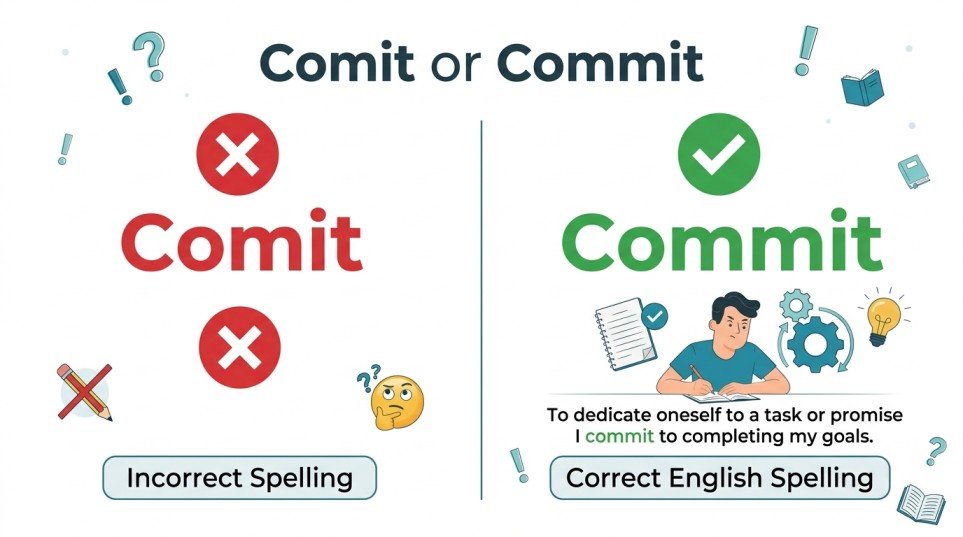
Quick Ans: The correct spelling is commit with two “m” letters. The word comit is a common misspelling and is not accepted in standard English. People often confuse the spelling because English double consonants can seem tricky during writing and typing.
Many writers search for comit or commit because the two words look very similar. One version appears shorter and simpler. The other includes a double consonant, which often creates confusion.
English spelling rules can be difficult. Some words use one consonant while others use two. As a result, spelling mistakes happen frequently in emails, essays, social media posts, and professional documents.
The confusion between comit or commit usually happens during fast typing. People may accidentally remove one “m” without noticing. Spell check tools sometimes catch the mistake, but not always.
Understanding the correct spelling matters because spelling errors can affect professionalism and clarity. In school, incorrect spelling may reduce grades. In business communication, mistakes can make writing appear careless.
This guide explains the difference between comit or commit in simple language. You will learn definitions, meanings, grammar rules, examples, common mistakes, exercises, and practical writing tips.
Quick Answer: Comit or Commit
The correct spelling is commit.
| Word | Correct or Incorrect | Meaning |
|---|---|---|
| Commit | Correct | To dedicate, carry out, or promise |
| Comit | Incorrect | Misspelling of commit |
Therefore, always use commit in formal and informal writing.
What Does Commit Mean?
The word commit is a verb in English. It has several meanings depending on context.
Common meanings include:
- To promise or dedicate yourself
- To carry out an action
- To place something officially
- To perform a crime or mistake
Examples of Commit in Sentences
Here are some simple examples:
- She decided to commit to daily exercise.
- The company will commit more money to research.
- He committed a serious mistake during the meeting.
- They committed to finishing the project on time.
Because the word has many uses, it appears frequently in everyday English.
Why Do People Write “Comit”?
The spelling comit usually happens because of typing or spelling confusion.
Several reasons explain the mistake:
- People forget the double “m”
- Fast typing removes one letter
- English spelling rules feel inconsistent
- Pronunciation does not strongly emphasize both “m” sounds
For example, many English learners assume shorter spellings are correct. However, English often uses double consonants in verbs like:
- Commit
- Submit
- Permit
As a result, “comit” becomes a common error.
Key Differences Between Comit or Commit
Spelling
The biggest difference is spelling accuracy.
- Commit is correct.
- Comit is incorrect.
Dictionary Recognition
English dictionaries recognize commit as a proper word. On the other hand, “comit” does not appear as a standard English verb.
Professional Usage
Professional writing always uses commit. Using “comit” may appear careless in formal communication.
Grammar Acceptance
Teachers, editors, and grammar tools accept commit. However, “comit” is treated as a spelling mistake.
Meaning and Usage of Commit
The word commit works in different situations. Understanding these meanings helps improve writing accuracy.
Commitment to Something
People often use commit when discussing dedication.
Examples:
- She committed to learning English.
- They committed to the new business plan.
Commit a Crime
The word also describes performing illegal actions.
Examples:
- The suspect committed theft.
- He committed fraud last year.
Commit in Technology
In programming and software development, commit has a technical meaning.
For example:
- Developers commit code changes to Git repositories.
- A commit saves project updates in version control systems.
Therefore, the word appears in both general and technical English.
Advantages of Using Correct Spelling
Better Professionalism
Correct spelling improves business communication.
Stronger Academic Writing
Teachers expect accurate grammar and spelling in assignments.
Improved Readability
Readers understand writing more easily when words are spelled correctly.
Better Search Engine Visibility
Correct spelling matters in SEO, blogging, and online publishing.
Because of these benefits, learning the correct form of commit is important.
Disadvantages of Misspelling Commit
Reduced Credibility
Frequent spelling mistakes can make writing appear unprofessional.
Confusion in Communication
Readers may pause or misunderstand incorrect words.
Lower Academic Scores
Spelling errors often reduce grades in school assignments.
Negative First Impressions
Employers and clients may notice spelling mistakes immediately.
Therefore, avoiding “comit” improves communication quality.
Real World Examples
In Business Emails
Correct:
- We commit to providing excellent customer service.
Incorrect:
- We comit to providing excellent customer service.
In School Assignments
Correct spelling helps students appear more careful and educated.
In Software Development
Programmers use the word commit daily.
Example:
- Please commit your code before leaving.
Using “comit” in technical writing would appear incorrect and unprofessional.
Regional and Global Usage
American English
American English uses commit with two “m” letters.
British English
British English also uses commit.
International English Learners
Many English learners struggle with double consonants. Consequently, “comit” becomes a frequent spelling mistake worldwide.
Despite regional differences in English, the spelling remains the same everywhere.
Related Concepts and Comparisons
Commit vs Submit
Both words use double consonants.
| Word | Meaning |
|---|---|
| Commit | Dedicate or carry out |
| Submit | Present or hand over |
Commit vs Promise
A promise is spoken or written assurance. Commit often suggests deeper dedication or action.
Commit vs Admit
Both words end with similar spelling patterns.
| Word | Meaning |
|---|---|
| Commit | Dedicate or perform |
| Admit | Accept or allow entry |
Learning related words helps reinforce spelling patterns.
Common Mistakes About Comit or Commit
Forgetting the Double “M”
This is the most common mistake.
Incorrect:
- I will comit to the project.
Correct:
- I will commit to the project.
Confusing Pronunciation With Spelling
The pronunciation does not strongly emphasize two “m” sounds. However, the spelling still requires them.
Typing Too Quickly
Fast typing often removes letters accidentally.
Ignoring Spell Check Warnings
Spell check tools usually flag “comit” as incorrect. Ignoring warnings can create avoidable errors.
Avoiding these mistakes improves writing accuracy.
Beginner to Advanced Spelling Tips
Beginner Level
Remember this simple phrase:
- “Commit needs double m for maximum effort.”
Intermediate Level
Practice writing sentences using commit daily.
Advanced Level
Study other double consonant verbs such as:
- Permit
- Submit
- Omit
Recognizing spelling patterns strengthens long term memory.
Step By Step Memory Trick
Here is an easy method for remembering the correct spelling.
- Start with “com”
- Add double “m”
- Finish with “it”
- Read the full word: commit
The double “m” is essential.
Exercises With Answers
Exercise 1
Which spelling is correct?
A. Comit
B. Commit
Answer: B. Commit.
Exercise 2
Fill in the blank:
She will ______ to the new schedule.
Answer: Commit.
Exercise 3
True or False: “Comit” is a correct English word.
Answer: False.
Exercise 4
Which sentence is correct?
A. They comit to quality service.
B. They commit to quality service.
Answer: B.
Exercise 5
How many “m” letters appear in commit?
Answer: Two.
When Should You Use Commit?
Use commit when discussing:
- Promises
- Dedication
- Responsibilities
- Actions
- Crimes
- Software version control
Never use “comit” in formal writing because it is incorrect.
FAQs About Comit or Commit
Is comit or commit correct?
The correct spelling is commit with two “m” letters.
Why do people spell commit as comit?
People often forget the double consonant during typing or writing.
Is comit a real English word?
No. “Comit” is considered a misspelling in standard English.
How do you remember the spelling of commit?
Remember that commit uses double “m” just like submit and permit.
What does commit mean?
Commit means to dedicate, promise, perform, or carry out something.
Is commit used in programming?
Yes. Developers use commit when saving code changes in version control systems like Git.
Can spell check detect comit?
Most spell check tools flag “comit” as incorrect.
Do British and American English spell commit differently?
No. Both use the spelling commit.
Is commit a verb or noun?
Commit is mainly used as a verb.
Why is correct spelling important in professional writing?
Correct spelling improves credibility, clarity, and professionalism.
Conclusion
Understanding comit or commit is simple once you learn the correct spelling rule. The correct form is always commit with two “m” letters. Meanwhile, “comit” is an incorrect spelling commonly caused by typing mistakes or confusion with English consonants.
Correct spelling matters in school, business, and online communication. Accurate writing improves professionalism and helps readers trust your message. In addition, proper spelling supports better academic performance and clearer communication.
The word commit appears in many situations, including promises, responsibilities, crimes, and software development. Because it is widely used, remembering the correct form is essential.
A helpful trick is to connect commit with other double consonant verbs like submit and permit. Practicing sentences regularly can also improve memory.
Now that you understand the difference between comit or commit, you can write confidently and avoid one of the most common English spelling mistakes.
Discover More:-
- Malignant or Benign: Key Differences, Symptoms, and Diagnosis Guide
- Right or Racist: Understanding the Difference Between Opinion and Racism

Robert Mitchell is a U.S.-based writer at Gramtivo.Com who focuses on grammar, writing improvement, and language-related content. He holds a degree in English and Linguistics from a U.S. university. His work aims to help readers enhance their writing skills with clear and practical guidance.