
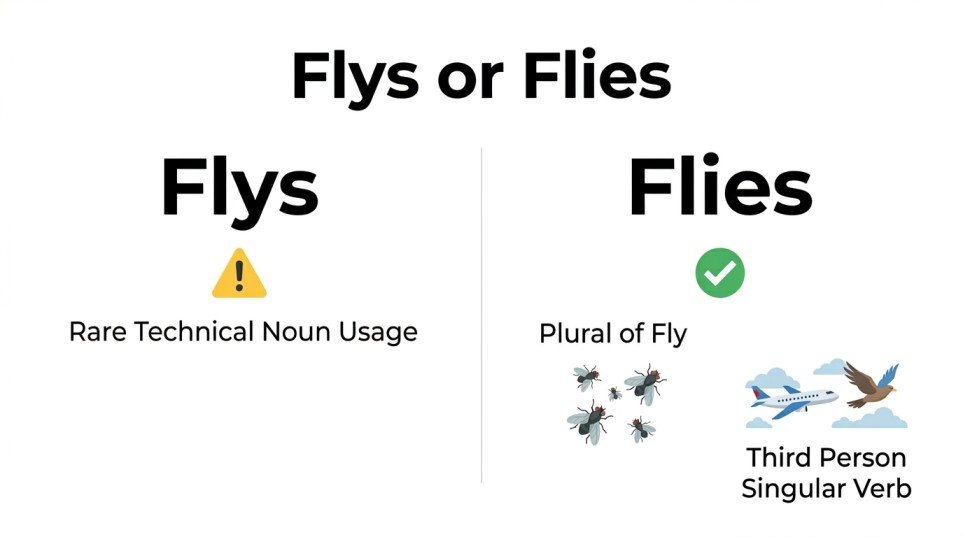
Quick Ans: The correct spelling depends on how the word is used. Flies is the standard plural form of fly and the third person singular form of the verb fly. Meanwhile, flys is rarely used in modern English and appears mainly as a noun in specific contexts, such as parts of tents or stage equipment.
Many English learners and native speakers get confused about flys or flies. The words look almost identical. Furthermore, both appear in dictionaries, which makes the situation even more confusing.
In most everyday situations, flies is the correct choice. You use it when talking about more than one fly insect. You also use it when describing someone or something that flies.
However, some people mistakenly write flys because they assume adding s is always the correct way to create a plural word. English spelling rules do not always work that way.
Understanding the difference between flys or flies is important for writing emails, academic papers, blog posts, and professional documents. Even a small spelling mistake can affect clarity and credibility.
This guide explains the meaning, grammar rules, examples, common mistakes, and practical exercises related to flys or flies. By the end, you will know exactly when to use each word.
Quick Answer: Flys or Flies
If you are wondering whether to use flys or flies, the answer is usually flies.
| Word | Correct Usage | Example |
|---|---|---|
| Flies | Plural of fly | The flies are buzzing around the room. |
| Flies | Third person singular verb | The bird flies south every winter. |
| Flys | Rare noun form | The tent flys were damaged during the storm. |
For most writers, flies is the correct choice.
What Does “Flies” Mean?
The word flies has two common uses in English.
Flies as a Plural Noun
When referring to more than one fly insect, the correct plural form is flies.
Examples:
- Several flies landed on the fruit.
- The flies were annoying during the picnic.
- Houseflies reproduce quickly.
Because fly ends with a consonant followed by y, the y changes to ies in the plural form.
Flies as a Verb
The word flies is also the third person singular form of the verb fly.
Examples:
- The airplane flies across the country daily.
- She flies to London every month.
- The eagle flies above the mountains.
In both cases, flies follows standard English grammar rules.
What Does “Flys” Mean?
The word flys exists, but it is uncommon.
In specialized situations, flys can refer to:
- Parts of tents
- Theater stage coverings
- Certain technical equipment
Most people never use this form in everyday writing.
Examples:
- The tent flys protected campers from rain.
- Workers repaired the damaged flys above the stage.
Because these uses are rare, many English speakers may never encounter them.
Why Is “Flies” Usually Correct?
The confusion surrounding flys or flies comes from English pluralization rules.
When a noun ends in a consonant followed by y, the standard rule is:
- Remove the y
- Add ies
Examples:
| Singular | Plural |
|---|---|
| Fly | Flies |
| Baby | Babies |
| City | Cities |
| Lady | Ladies |
| Country | Countries |
Therefore, fly becomes flies, not flys.
Similarly, verbs ending in y often change to ies in the third person singular.
Examples:
- Cry → Cries
- Try → Tries
- Fly → Flies
As a result, flies is correct in most situations.
Key Differences Between Flys or Flies
Meaning
Flies usually refers to insects or the verb form of fly.
Flys appears mainly in specialized technical contexts.
Frequency
You will encounter flies regularly in books, websites, and conversations.
By contrast, flys appears very rarely.
Grammar
Standard grammar rules support flies as the correct plural and verb form.
Meanwhile, flys functions only as a specialized noun.
Everyday Usage
Most writers should choose flies.
Only technical industries are likely to use flys.
Advantages and Disadvantages of Using Each Form
Advantages of Using “Flies”
- Grammatically correct in most situations
- Recognized by readers
- Accepted in academic writing
- Suitable for professional communication
Disadvantages of Using “Flies”
- Can be confused with the insect and verb meanings
Advantages of Using “Flys”
- Correct in specific technical contexts
- Useful for specialized industries
Disadvantages of Using “Flys”
- Rarely understood by general readers
- Often mistaken for a spelling error
- Inappropriate in most writing situations
Therefore, writers should generally use flies unless discussing specialized equipment or structures.
Real World Examples
Example in Everyday Conversation
Correct:
- Flies keep landing on my food.
Incorrect:
- Flys keep landing on my food.
Example in Business Writing
Correct:
- The company flies products worldwide.
Incorrect:
- The company flys products worldwide.
Example in Travel Writing
Correct:
- She flies internationally every month.
Incorrect:
- She flys internationally every month.
These examples show why flies is usually the correct choice.
Regional and Global Usage
American English
American English overwhelmingly uses flies in everyday communication.
British English
British English follows the same grammar rules. Therefore, flies remains the standard spelling.
International English
Across the English-speaking world, flies is considered correct for both plural nouns and third person singular verbs.
Consequently, the flys or flies distinction remains consistent globally.
Related Concepts and Comparisons
Fly vs Flies
| Word | Function |
|---|---|
| Fly | Singular noun or base verb |
| Flies | Plural noun or third person singular verb |
Examples:
- A fly landed on the table.
- Several flies landed on the table.
Cry vs Cries
English follows a similar spelling pattern.
Examples:
- She cries when sad.
- The baby cries loudly.
Try vs Tries
Another example follows the same rule.
Examples:
- He tries every day.
- She tries new recipes often.
Understanding these patterns helps clarify the flys or flies question.
Common Mistakes About Flys or Flies
Adding Only an “S”
Many learners assume every noun forms a plural by adding s.
Incorrect:
- Flys
Correct:
- Flies
Using “Flys” as a Verb
Some writers mistakenly use flys as the third person singular verb form.
Incorrect:
- The bird flys high.
Correct:
- The bird flies high.
Ignoring the Y to IES Rule
The most common mistake involves forgetting the spelling change.
Words ending in consonant plus y generally change to ies.
Overcorrecting Technical Terms
In rare technical contexts, flys may actually be correct. Therefore, context matters.
Beginner to Advanced Grammar Tips
Beginner Level
Remember one simple rule:
Consonant + y = ies
Examples:
- Fly → Flies
- Baby → Babies
Intermediate Level
Learn both noun and verb forms.
Examples:
- The flies are everywhere.
- The airplane flies daily.
Advanced Level
Understand specialized exceptions.
Certain technical industries use flys as a noun. Nevertheless, this usage remains uncommon.
Step By Step Grammar Scenario
Imagine you are writing a sentence.
You want to talk about several insects.
Step 1: Identify the singular noun.
- Fly
2: Apply the plural rule.
- Change y to ies
3: Write the plural form.
- Flies
Now imagine you are describing an airplane.
Step 1: Start with the verb fly.
2: Use third person singular.
3: Change y to ies.
Result:
- The airplane flies every day.
In both situations, flies is correct.
Exercises With Answers
Exercise 1
Which spelling is correct?
The bird ___ over the lake.
Answer: Flies.
Exercise 2
Choose the correct plural form.
Many ___ entered the kitchen.
Answer: Flies.
Exercise 3
True or False: “Flys” is the standard plural of fly.
Answer: False.
Exercise 4
Which sentence is correct?
A. The plane flys daily.
B. The plane flies daily.
Answer: B.
Exercise 5
What rule applies to fly when making it plural?
Answer: Change y to ies.
When Should You Use Flys or Flies?
Use flies when:
- Referring to multiple insects
- Using the verb fly in third person singular
- Writing professional content
- Creating academic documents
- Communicating in everyday English
Use flys only when:
- Referring to specialized technical nouns
- Writing about certain tent or theater components
For nearly all situations, flies is the correct choice.
FAQs About Flys or Flies
What is correct: flys or flies?
In most situations, flies is correct. It serves as both the plural noun and third person singular verb form of fly.
Is flys a real word?
Yes. However, it is a rare noun used in specialized technical contexts.
Why is the plural of fly spelled flies?
Because nouns ending in a consonant plus y typically change y to ies when forming the plural.
Do I write flys or flies for insects?
Use flies when referring to multiple insects.
Which is correct: the bird flys or the bird flies?
The correct sentence is “The bird flies.”
Is flies a noun or a verb?
It can be both. It functions as a plural noun and a third person singular verb.
Does British English use flys or flies?
British English uses flies in the same way as American English.
Can flys ever be correct?
Yes. Certain technical fields use flys as a noun, although the usage is uncommon.
Why do people confuse flys or flies?
Many people assume that adding s always creates a plural noun, which is not true in English.
What grammar rule helps remember flies?
The key rule is: consonant + y changes to ies.
Conclusion
The debate over flys or flies is easier to understand once you know the grammar rule. In standard English, flies is the correct plural form of fly. It is also the correct third person singular verb form.
Most writers should use flies when referring to insects or describing something that flies. This spelling follows common English rules and is accepted in academic, professional, and everyday communication.
Although flys is technically a real word, its usage is limited to specialized contexts such as theater equipment and tent components. Consequently, most readers will rarely encounter it.
Whenever you are unsure, remember the simple rule: words ending in a consonant plus y usually change to ies. Following this guideline will help you avoid mistakes and write with greater confidence.
Discover More:-
- Flyer or Flier: Which Spelling Is Correct and When to Use Each
- There or Their: Difference, Meaning, Examples, and Grammar Guide

Lisa Thompson is a USA-based content writer and language specialist focused on grammar, writing improvement and digital publishing.
She holds a degree in English Language and Communication and has professional experience in educational and web content creation.
As the author of Gramtivo.Com, she aims to help readers improve their writing skills through clear and practical guidance.