
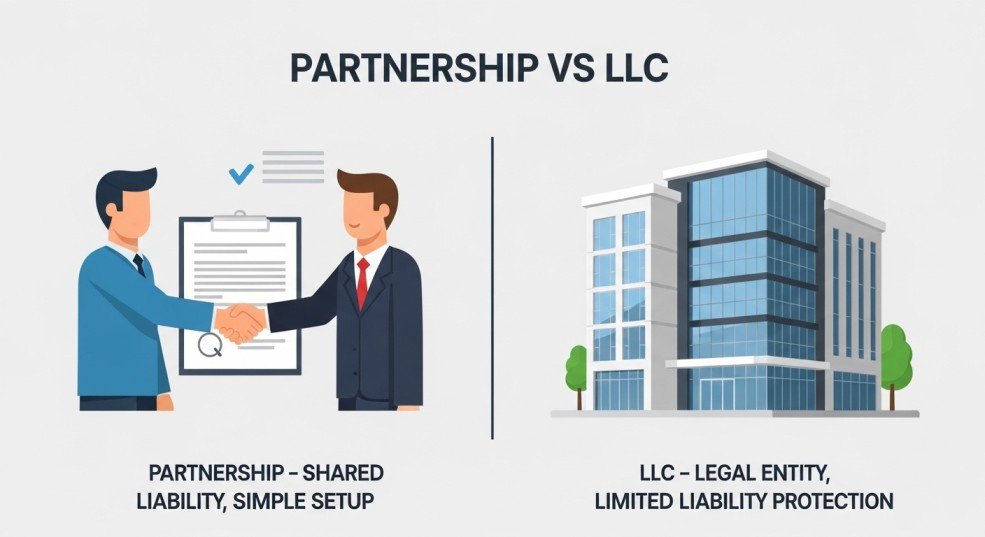
Quick Ans: The main difference between a partnership vs LLC is legal protection and structure. A partnership is a simple business owned by two or more people who share profits and liabilities. An LLC (Limited Liability Company) is a registered business structure that protects owners from personal liability while offering flexible taxation.
Many new business owners compare partnership vs LLC when starting a company. Both structures allow more than one person to run a business. Both are common for small and medium enterprises.
However, they are not the same.
A partnership is simple and easy to start. An LLC requires registration with the state but offers stronger legal protection. Because of this difference, each structure fits different business needs.
For example, friends starting a small service business may choose a partnership for simplicity. On the other hand, entrepreneurs with higher financial risk often prefer an LLC for protection.
Understanding partnership vs LLC helps you avoid legal issues, reduce taxes mistakes, and choose the right structure for long term success.
In this guide, you will learn definitions, advantages, disadvantages, comparisons, real world examples, common mistakes, and FAQs in simple language.
Quick Answer: Partnership vs LLC
To quickly understand partnership vs LLC, focus on liability and legal structure.
| Feature | Partnership | LLC |
|---|---|---|
| Legal Status | Unregistered agreement | Registered legal entity |
| Liability | Personal liability | Limited liability protection |
| Setup Cost | Low | Moderate |
| Taxation | Pass through taxation | Flexible taxation |
| Paperwork | Minimal | More formal |
In short, a partnership is simpler, while an LLC offers stronger protection.
What Is a Partnership?
A partnership is a business structure where two or more people agree to run a business together. Each partner shares profits, responsibilities, and liabilities.
Partnerships are common in:
- Small businesses
- Family businesses
- Professional services
- Freelance teams
Types of Partnerships
There are several types:
- General partnership
- Limited partnership
- Limited liability partnership (LLP in some regions)
Each type defines how responsibility is shared among partners.
How a Partnership Works
In a typical partnership:
- Two or more people agree to start a business
- They contribute money, skills, or resources
- Profits are shared based on agreement
- Losses are also shared
Because of this structure, trust plays a very important role.
Advantages of a Partnership
- Easy to start
- Low setup cost
- Simple management
- Shared responsibilities
Disadvantages of a Partnership
- Personal liability for debts
- Risk of disputes
- Limited legal protection
- Business continuity issues
What Is an LLC?
An LLC (Limited Liability Company) is a legal business structure registered with the government. It combines features of partnerships and corporations.
LLCs are popular in:
- Small and medium businesses
- Startups
- Online businesses
- Professional services
Key Features of an LLC
An LLC includes:
- Legal separation between owner and business
- Limited personal liability
- Flexible taxation options
- Formal registration process
How an LLC Works
In an LLC:
- Owners (called members) register the company
- The business becomes a separate legal entity
- Profits are distributed to members
- The company pays taxes depending on structure
Because of this separation, personal assets are usually protected.
Advantages of an LLC
- Limited personal liability
- Legal protection for owners
- Flexible tax options
- Professional business image
Disadvantages of an LLC
- Higher setup cost
- More paperwork
- Annual compliance requirements
- Registration process required
Key Differences Between Partnership vs LLC
Legal Protection
In a partnership, owners are personally responsible for debts. In contrast, an LLC protects personal assets.
Business Structure
A partnership is an agreement between individuals. An LLC is a legally registered entity.
Formation Process
Partnerships form automatically when people start doing business together. LLCs require official registration.
Tax Treatment
Both structures often use pass through taxation. However, LLCs may choose different tax options in some regions.
Liability Risk
The biggest difference in partnership vs LLC is risk exposure. Partnerships carry higher personal risk.
Advantages and Disadvantages
Partnership Advantages
- Simple setup process
- Low initial cost
- Flexible decision making
- Shared workload
Partnership Disadvantages
- Unlimited personal liability
- Partner conflicts possible
- No legal separation from business
- Difficult to transfer ownership
LLC Advantages
- Personal asset protection
- Professional structure
- Flexible taxation options
- Easier to attract investors
LLC Disadvantages
- Higher formation cost
- Ongoing compliance requirements
- More paperwork
- State registration needed
Real World Examples
Small Local Business
Two friends open a bakery without formal registration. This is a partnership. Both are responsible for profits and debts.
Startup Company
An entrepreneur registers an LLC for an online store. The business becomes a separate legal entity, protecting personal savings.
Professional Services
Lawyers or consultants may use partnerships or LLCs depending on risk level and legal rules.
These examples show how partnership vs LLC decisions depend on risk and business size.
Regional and Global Usage
United States
LLCs are very popular due to liability protection. Partnerships are common for small informal businesses.
Europe
Many countries use similar structures but may have different naming systems like LLPs.
Asia
Small businesses often start as partnerships due to simplicity, while growing firms convert to LLC-style structures.
Globally, partnership vs LLC choices depend on legal systems and business risk.
Related Concepts and Comparisons
Partnership vs Sole Proprietorship
A sole proprietorship has one owner. A partnership has multiple owners.
LLC vs Corporation
An LLC is simpler and more flexible. A corporation has stricter rules but may attract investors more easily.
LLP vs LLC
An LLP is a special partnership with limited liability protection, similar to LLC in some regions.
| Structure | Owners | Liability | Complexity |
|---|---|---|---|
| Partnership | 2+ | High | Low |
| LLC | 1+ | Low | Medium |
| Corporation | Many | Low | High |
Common Mistakes About Partnership vs LLC
Ignoring Liability Risk
Many people choose partnerships without understanding personal financial risk.
Not Signing Agreements
Partnerships without written agreements often lead to disputes.
Delaying LLC Registration
Some businesses operate too long without legal protection.
Mixing Personal and Business Funds
This creates legal and tax complications in both structures.
Avoiding these mistakes improves business stability.
Beginner to Advanced Business Tips
Beginner Level
Start with clear written agreements. Define roles and profit sharing early.
Intermediate Level
Track income and expenses separately. Consider formal registration if revenue grows.
Advanced Level
Consult legal and tax professionals. Evaluate switching from partnership to LLC as business expands.
Step By Step Decision Scenario
Imagine two people starting a business.
If they choose a partnership:
- Agree on roles
- Start business immediately
- Share profits directly
- Accept personal liability
If they choose an LLC:
- Register business legally
- Create operating agreement
- Open business bank account
- Separate personal assets
Although both work, the partnership vs LLC choice affects risk and legal protection.
Exercises With Answers
Exercise 1
Which structure offers limited liability?
Answer: LLC.
Exercise 2
Which structure is easier to start?
Answer: Partnership.
Exercise 3
In which structure are owners personally responsible for debts?
Answer: Partnership.
Exercise 4
Which structure requires official registration?
Answer: LLC.
Exercise 5
True or False: LLC and partnership are identical.
Answer: False.
When Should You Choose Partnership vs LLC?
Choose a partnership if you:
- Want a simple business setup
- Have low financial risk
- Trust your business partner
Choose an LLC if you:
- Want personal asset protection
- Plan to scale the business
- Expect financial or legal risks
Your decision should match business goals and risk level.
FAQs About Partnership vs LLC
What is the main difference between partnership vs LLC?
A partnership has no legal separation between owners and business, while an LLC provides limited liability protection.
Is an LLC better than a partnership?
In most cases, yes, because an LLC reduces personal financial risk.
Can a partnership become an LLC?
Yes. Many businesses convert from partnership to LLC as they grow.
Which is cheaper, partnership or LLC?
A partnership is cheaper because it requires no formal registration.
Do partnerships pay taxes separately?
No. Profits pass through to individual partners.
Does an LLC pay taxes?
It depends on the tax structure chosen by the owners.
Can one person form an LLC?
Yes. A single-member LLC is allowed in many regions.
What happens if a partnership fails?
Owners are personally responsible for debts and obligations.
Which is safer for business owners?
An LLC is generally safer due to liability protection.
Do LLCs need more paperwork?
Yes. LLCs require registration and ongoing compliance.
Conclusion
The comparison of partnership vs LLC comes down to simplicity versus protection. A partnership is easy to start and manage, making it suitable for small and informal businesses. However, it exposes owners to personal financial risk.
An LLC requires more setup and paperwork, but it offers strong legal protection and a professional structure. Because of this, it is often preferred for growing or high risk businesses.
Choosing between partnership vs LLC depends on your goals, risk tolerance, and future plans. If you want simplicity, a partnership may work. If you want safety and growth potential, an LLC is usually the better choice.
Understanding these differences helps you build a stronger and more secure business foundation.
Discover More:-
- Beaver vs Woodchuck: Key Differences, Habitat, Behavior, and Identification Guide
- Nashville vs Austin: Differences, Cost, Lifestyle, and Which City Is Better

Robert Mitchell is a U.S.-based writer at Gramtivo.Com who focuses on grammar, writing improvement, and language-related content. He holds a degree in English and Linguistics from a U.S. university. His work aims to help readers enhance their writing skills with clear and practical guidance.

Pingback: Veneers or Crowns: Differences, Benefits, and Which One to Choose
Pingback: Problemo or Problema: Differences, Meaning, and Correct Usage Guide
Pingback: Mole or Wart: Key Differences, Causes, Symptoms, and Treatment Guide
Pingback: Dysregulated vs Disregulated: Correct Spelling, Meaning, and Usage Guide