
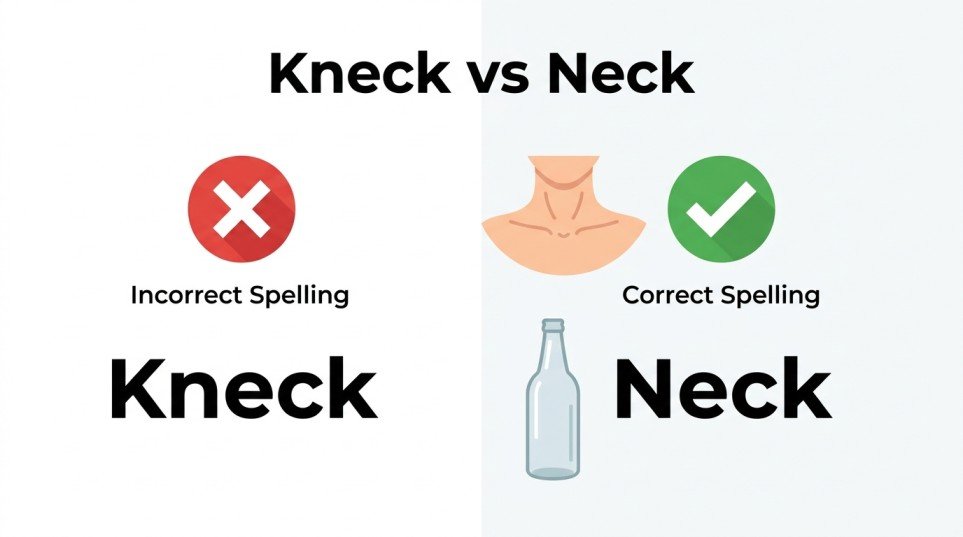
Quick Ans: The correct spelling is neck, not “kneck.” The word “kneck” is a common misspelling, while “neck” is the proper English word that refers to the part of the body connecting the head to the torso or similar narrow parts of objects.
Many people get confused about kneck or neck when writing or typing. Both forms may look similar at first glance. However, only one of them is correct.
The confusion often happens because English spelling can be tricky. Some words begin with silent letters, like “knee” or “knife.” Because of this pattern, people sometimes assume that “neck” should also begin with a “k.”
In reality, that is not true.
The correct spelling is “neck.” The form “kneck” does not exist in standard English. It is simply a spelling mistake that appears in informal writing or typing errors.
Understanding the difference between kneck or neck helps improve your writing accuracy. It also builds confidence in communication, whether you are writing emails, essays, or messages.
In this guide, you will learn definitions, examples, common mistakes, exercises, and practical tips. By the end, you will never confuse kneck or neck again.
Quick Answer: Kneck or Neck
To quickly understand kneck or neck, focus on correctness.
| Word | Correct or Incorrect | Meaning |
|---|---|---|
| Neck | Correct | Body part or narrow section |
| Kneck | Incorrect | Misspelling |
In simple terms, “neck” is correct, while “kneck” is wrong.
What Does “Neck” Mean?
The word neck refers to the part of the body that connects the head to the rest of the body. It also describes narrow parts of objects.
Common Meanings of Neck
The word “neck” can be used in several ways:
- The body part between the head and shoulders
- A narrow section of an object, such as a bottle
- A strip of land connecting two larger areas
- A part of clothing that surrounds the throat
Examples in Sentences
Here are simple examples:
- She wore a scarf around her neck.
- The bottle has a long neck.
- He felt pain in his neck after sleeping badly.
- The dress has a high neck design.
Because of its wide usage, “neck” is a very common English word.
Why “Kneck” Is Incorrect
The word “kneck” is not a real English word. It appears only as a mistake.
Why Do People Write “Kneck”?
Several reasons explain this confusion:
- English words like “knee” and “knife” start with silent “k”
- People assume a similar pattern applies
- Typing errors or autocorrect issues
- Lack of spelling awareness
However, “neck” does not follow that rule.
Key Point
Even though English has silent letters, not every word follows the same pattern. Therefore, adding a “k” to “neck” creates an incorrect form.
Key Differences Between Kneck or Neck
Spelling
“Neck” is the correct spelling. “Kneck” is incorrect.
Usage
“Neck” is used in writing and speech. “Kneck” should never be used.
Recognition
Dictionaries recognize “neck” as a valid word. “Kneck” does not appear in standard dictionaries.
Writing Accuracy
Using “neck” shows correct grammar. Using “kneck” may reduce credibility in writing.
Advantages of Using Correct Spelling
Improves Communication
Correct spelling makes your message clear and professional.
Builds Confidence
Knowing the right form helps you write without hesitation.
Avoids Misunderstanding
Incorrect words can confuse readers. Proper spelling prevents this issue.
Supports Learning
Using correct words strengthens vocabulary and language skills.
Disadvantages of Using “Kneck”
Looks Unprofessional
Misspelled words can reduce trust in your writing.
Causes Confusion
Readers may not understand what you mean.
Weakens Writing Quality
Frequent spelling mistakes lower the overall quality of content.
Affects Academic and Work Writing
Incorrect spelling may lead to lower grades or poor impressions.
Real World Examples
In School Writing
Students sometimes write “kneck” in essays. Teachers usually mark it as incorrect.
In Online Messages
Typing errors often lead to “kneck” in chats. However, correct spelling is still important in formal communication.
In Professional Emails
Using “neck” ensures clarity and professionalism. Mistakes like “kneck” should be avoided.
These examples show why understanding kneck or neck matters in everyday life.
Common Mistakes About Kneck or Neck
Adding a Silent “K”
Many learners assume that “neck” follows the same rule as “knee.” This assumption is incorrect.
Relying on Sound Alone
Both words may sound similar when spoken. However, spelling must follow standard rules.
Ignoring Spell Check
Sometimes, writers overlook spelling errors. Always review your work carefully.
Mixing Patterns
Not all English words follow the same pattern. Therefore, each word must be learned individually.
Related Concepts and Comparisons
Words With Silent “K”
Some English words begin with a silent “k,” such as:
- Knee
- Knife
- Knock
These words may cause confusion with “neck.”
Words Without Silent “K”
Many words do not include a silent “k,” including:
- Neck
- Net
- Nest
Understanding these differences helps avoid spelling errors.
Beginner to Advanced Learning Tips
Beginner Level
Practice writing the word “neck” in simple sentences.
Intermediate Level
Learn similar words and compare spelling patterns.
Advanced Level
Focus on spelling rules and exceptions in English. Build vocabulary through reading and writing.
Regular practice improves spelling accuracy over time.
Step By Step Learning Scenario
Imagine learning the correct spelling.
First, see the word “neck” in a sentence.
Next, write it several times.
Then, use it in your own sentences.
After that, compare it with similar words like “knee.”
Finally, test your understanding with exercises.
This method helps you remember the correct form.
Exercises With Answers
Exercise 1
Which word is correct: kneck or neck?
Answer: Neck.
Exercise 2
Is “kneck” a real English word?
Answer: No.
Exercise 3
Fill in the blank: She has pain in her ___.
Answer: Neck.
Exercise 4
True or False: “Kneck” is accepted in formal writing.
Answer: False.
Exercise 5
Which word refers to a narrow part of a bottle?
Answer: Neck.
When Should You Use “Neck”?
Use “neck” in all correct situations:
- Talking about body parts
- Describing objects
- Writing formal or informal content
- Academic or professional writing
Never use “kneck,” as it is incorrect.
FAQs About Kneck or Neck
Which is correct, kneck or neck?
The correct spelling is “neck.” The form “kneck” is incorrect.
Is “kneck” ever acceptable?
No. In the kneck or neck comparison, “kneck” is always wrong.
Why do people write “kneck”?
People confuse it with words that have a silent “k,” such as “knee.”
How can I remember the correct spelling?
Remember that “neck” starts with “n,” not “k.”
Is “neck” used in formal writing?
Yes. “Neck” is correct in both formal and informal writing.
Does “neck” have multiple meanings?
Yes. It refers to a body part and narrow sections of objects.
Can spell check catch “kneck”?
Most spell check tools will mark “kneck” as incorrect.
Is pronunciation different between kneck or neck?
No. They sound similar, which causes confusion.
Why does English have silent letters?
English developed from multiple languages, leading to irregular spelling patterns.
What is the best way to avoid this mistake?
Practice spelling and review your writing carefully.
Conclusion
Understanding kneck or neck is simple once you know the rule. The correct spelling is “neck,” while “kneck” is a common mistake.
Although English includes words with silent letters, not every word follows the same pattern. Therefore, assuming “neck” should start with a “k” leads to errors.
Using the correct spelling improves writing quality, clarity, and professionalism. It also helps build confidence in communication.
Whether you are writing an email, essay, or message, always use “neck.” Avoid “kneck” in all situations.
With practice and awareness, you can easily remember the correct form and avoid confusion in the future.
Discover More:-
- Strep or Tonsillitis: Key Differences, Symptoms, and Treatment Guide
- Coaches or Coach’s: Difference, Rules, and Easy Grammar Guide

Lisa Thompson is a USA-based content writer and language specialist focused on grammar, writing improvement and digital publishing.
She holds a degree in English Language and Communication and has professional experience in educational and web content creation.
As the author of Gramtivo.Com, she aims to help readers improve their writing skills through clear and practical guidance.