
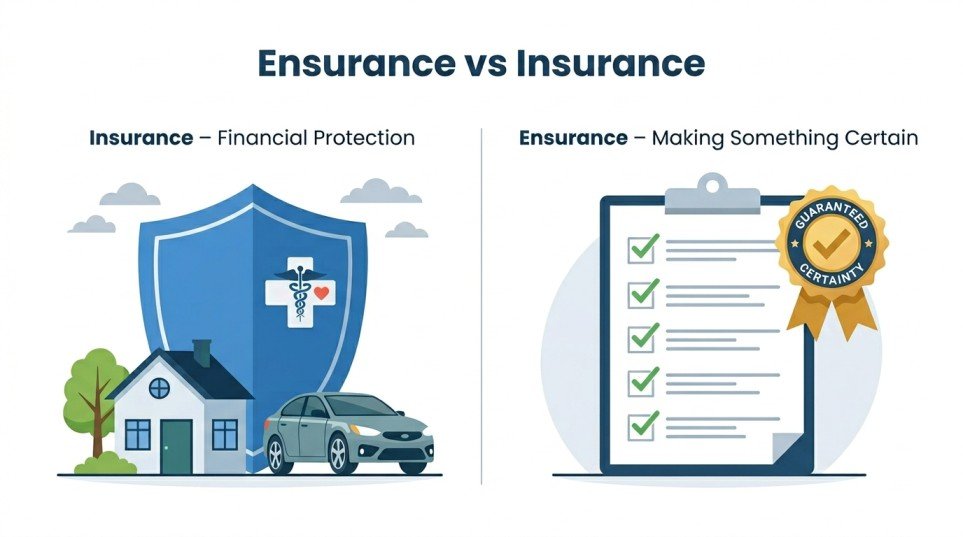
Quick Ans: The main difference between ensurance or insurance is usage and meaning. “Insurance” is the correct and widely accepted word for financial protection against loss, while “ensurance” is a rare term that refers to the act of making something certain. In modern English, most people should use “insurance” instead of “ensurance.”
Many people become confused about ensurance or insurance because the two words look and sound similar. At first glance, they may appear interchangeable. However, their meanings are quite different.
The word “insurance” is extremely common. People use it when talking about health insurance, car insurance, travel insurance, or business protection. On the other hand, “ensurance” is rarely used in modern English.
This confusion often happens during writing. Someone may think “ensurance” sounds more formal or professional. As a result, they accidentally use the wrong word in emails, essays, or business documents.
Understanding the difference between ensurance or insurance helps improve grammar, writing accuracy, and professional communication. It also prevents mistakes in legal, financial, and academic contexts.
In this guide, you will learn definitions, examples, advantages, common mistakes, real world usage, and practical exercises. By the end, you will clearly know when to use each word correctly.
Quick Answer: Ensurance or Insurance
To quickly understand ensurance or insurance, focus on purpose and usage.
| Word | Meaning | Common Usage |
|---|---|---|
| Insurance | Financial protection against loss | Very common |
| Ensurance | The act of ensuring something | Rarely used |
In modern English, “insurance” is the correct word in most situations.
What Does Insurance Mean?
Insurance refers to financial protection against risks, damage, accidents, or loss. A person or company pays money called a premium to an insurance company. In return, the company helps cover costs when certain problems happen.
Insurance is common in daily life.
People often buy:
- Health insurance
- Car insurance
- Home insurance
- Travel insurance
- Life insurance
- Business insurance
Because accidents and emergencies can happen unexpectedly, insurance provides financial security.
Common Uses of Insurance
Here are several examples of correct usage:
- “I need car insurance before driving.”
- “Health insurance helps pay medical bills.”
- “The company purchased business insurance.”
In all these examples, “insurance” relates to financial protection.
Why Insurance Matters
Insurance plays a major role in modern society.
It helps people:
- Reduce financial risk
- Recover from accidents
- Protect property
- Cover medical costs
- Support businesses after losses
Without insurance, many people would struggle financially after unexpected events.
What Does Ensurance Mean?
Ensurance means the act of making something certain or guaranteed. The word comes from “ensure,” which means to make sure something happens.
Although the word exists, modern English speakers rarely use it.
Instead, people usually prefer words like:
- Assurance
- Guarantee
- Confirmation
- Protection
Examples of Ensurance
Here are examples where “ensurance” could technically appear:
- “The ensurance of safety is important.”
- “The policy supports the ensurance of quality.”
However, native speakers would normally rewrite these sentences.
For example:
- “Ensuring safety is important.”
- “The policy helps guarantee quality.”
Because of this, “ensurance” sounds outdated or awkward in most modern writing.
Key Differences Between Ensurance or Insurance
Meaning
Insurance relates to financial protection. Ensurance relates to making something certain.
Popularity
Insurance is extremely common in business, law, and daily life. Ensurance is rare.
Modern Usage
Most modern writers avoid “ensurance.” Instead, they use “ensuring” or “assurance.”
Context
Insurance appears in finance and risk management. Ensurance appears mostly in formal or outdated writing.
Comparison Table
| Feature | Insurance | Ensurance |
|---|---|---|
| Meaning | Financial protection | Making something certain |
| Frequency | Very common | Very rare |
| Modern English | Widely accepted | Rarely used |
| Industry Use | Finance and law | Formal writing only |
| Recommended Usage | Yes | Usually avoided |
This table makes the ensurance or insurance difference easier to understand.
Advantages and Disadvantages
Advantages of Using Insurance Correctly
- Improves communication clarity
- Sounds professional
- Matches modern English usage
- Avoids confusion in legal documents
Disadvantages of Incorrect Insurance Usage
- Creates misunderstandings
- Looks unprofessional
- Weakens business writing
Advantages of Understanding Ensurance
- Improves vocabulary knowledge
- Helps understand older texts
- Expands language awareness
Disadvantages of Using Ensurance Often
- Sounds outdated
- Confuses readers
- Rarely appears in modern English
Therefore, most writers should use “insurance” or “ensuring” instead of “ensurance.”
Real World Examples
Business Writing
Correct:
- “The company offers travel insurance.”
Incorrect:
- “The company offers travel ensurance.”
The second sentence sounds unnatural and incorrect.
Academic Writing
Weak sentence:
- “The ensurance of safety is critical.”
Better sentence:
- “Ensuring safety is critical.”
Legal Documents
Insurance appears frequently in contracts and policies because it has a specific financial meaning.
Examples include:
- Liability insurance
- Property insurance
- Health insurance coverage
In legal contexts, using the wrong term may create confusion.
Regional and Global Usage
United States
“Insurance” is standard in American English. “Ensurance” is extremely uncommon.
United Kingdom
British English also prefers “insurance.” Formal writers may occasionally use “ensurance,” but it remains rare.
Global English
Around the world, English speakers almost always use “insurance” for financial coverage. Modern global communication rarely includes “ensurance.”
As a result, the ensurance or insurance comparison strongly favors “insurance” in modern writing.
Related Concepts and Comparisons
Insurance vs Assurance
Insurance usually covers events that may happen, such as accidents.
Assurance often relates to certainty or guaranteed outcomes, especially in life assurance policies.
Ensure vs Insure
“Ensure” means to make certain.
Example:
- “Please ensure the door is locked.”
“Insure” means to provide financial protection.
Example:
- “I need to insure my car.”
Ensurance vs Assurance
“Assurance” is far more common and natural than “ensurance.”
For example:
- “Quality assurance” sounds correct.
- “Quality ensurance” sounds awkward.
Common Mistakes About Ensurance or Insurance
Using Ensurance Instead of Insurance
This is the most common mistake.
Incorrect:
- “I bought health ensurance.”
Correct:
- “I bought health insurance.”
Confusing Ensure and Insure
People sometimes mix the verbs.
Incorrect:
- “I need to ensure my car.”
Correct:
- “I need to insure my car.”
Overusing Rare Words
Some writers believe rare words sound more professional. However, simple and clear language usually works better.
Avoid using “ensurance” unless absolutely necessary.
Beginner to Advanced Writing Tips
Beginner Level
Use “insurance” for financial protection.
Use “ensure” when talking about making something certain.
Intermediate Level
Learn the difference between related words:
- Insurance
- Assurance
- Ensure
- Insure
Advanced Level
Study legal and business writing examples. Professional documents often require precise word choice.
Understanding subtle vocabulary differences improves advanced communication skills.
Step By Step Usage Scenario
Imagine you are writing an email.
If you mean financial protection:
- “The company provides health insurance.”
If you mean certainty:
- “The company ensures employee safety.”
Avoid writing:
- “The company provides health ensurance.”
The sentence sounds unnatural and confusing.
Exercises With Answers
Exercise 1
Which word relates to financial protection?
Answer: Insurance.
Exercise 2
Which word is rarely used in modern English?
Answer: Ensurance.
Exercise 3
Choose the correct sentence:
A. “I purchased car ensurance.”
B. “I purchased car insurance.”
Answer: B.
Exercise 4
Which verb means “to make certain”?
Answer: Ensure.
Exercise 5
True or False: Ensurance is more common than insurance.
Answer: False.
When Should You Use Insurance or Ensurance?
Use “insurance” when discussing:
- Financial protection
- Policies and coverage
- Risk management
- Business or legal matters
Use “ensuring” or “assurance” instead of “ensurance” in most modern writing.
This approach sounds more natural and professional.
FAQs About Ensurance or Insurance
What is the difference between ensurance or insurance?
Insurance refers to financial protection, while ensurance refers to making something certain.
Is ensurance a real word?
Yes. However, it is rare and uncommon in modern English.
Which word is more commonly used, ensurance or insurance?
Insurance is far more common in daily and professional communication.
Can I use ensurance instead of insurance?
No. Insurance and ensurance have different meanings.
Why does ensurance sound strange?
Modern English speakers rarely use it. Words like “ensuring” or “assurance” sound more natural.
Is health ensurance correct English?
No. The correct phrase is “health insurance.”
What is the difference between ensure and insure?
Ensure means to make certain. Insure means to provide financial coverage.
Do legal documents use ensurance?
Most legal documents use “insurance” instead of “ensurance.”
Should writers avoid the word ensurance?
In most cases, yes. Simpler alternatives improve clarity.
Is insurance used worldwide?
Yes. Insurance is a standard English term used globally.
Conclusion
Understanding ensurance or insurance improves writing accuracy and communication clarity. Although the words look similar, they have different meanings and uses.
Insurance refers to financial protection against risk or loss. It is common in business, law, healthcare, and daily life. Ensurance, however, means the act of making something certain. Modern English rarely uses this word.
Most writers should avoid “ensurance” because it sounds outdated and unnatural. Instead, use “insurance” for financial coverage and “ensuring” or “assurance” when discussing certainty.
Clear vocabulary choices make writing stronger and easier to understand. Whether you are writing emails, contracts, essays, or professional documents, choosing the correct term matters.
Now that you understand the difference between ensurance or insurance, you can communicate more confidently and avoid common grammar mistakes.
Discover More:-

Lisa Thompson is a USA-based content writer and language specialist focused on grammar, writing improvement and digital publishing.
She holds a degree in English Language and Communication and has professional experience in educational and web content creation.
As the author of Gramtivo.Com, she aims to help readers improve their writing skills through clear and practical guidance.