
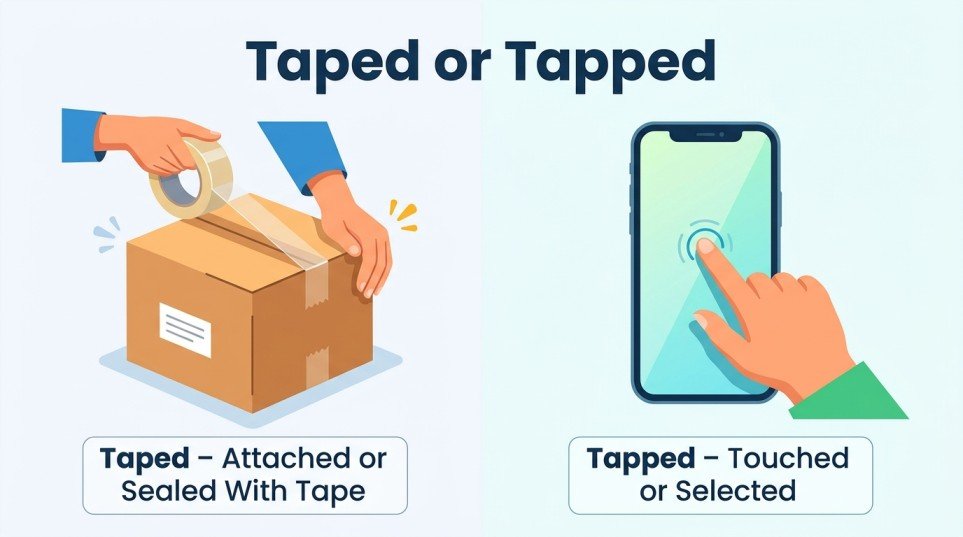
Quick Ans: The difference between taped or tapped comes down to meaning and usage. “Taped” refers to attaching, recording, or sealing something with tape, while “tapped” means touching lightly, selecting something, or drawing liquid from a source. Although the words sound similar, they are used in completely different situations.
Many English learners confuse taped or tapped because the words look and sound alike. Both share similar spelling. Both use the same root style. However, their meanings are very different.
“Taped” relates to tape. People use it when sticking, sealing, wrapping, or recording something. “Tapped,” on the other hand, usually means touching lightly with fingers or an object. It can also mean accessing a resource or selecting something on a screen.
This confusion often appears in writing and conversation. For example, someone may write “He taped the screen” when they actually mean “He tapped the screen.” Small spelling mistakes like this can completely change the sentence meaning.
Understanding the difference between taped or tapped improves grammar, writing accuracy, and communication skills. It also helps students avoid common English mistakes.
In this guide, you will learn definitions, examples, grammar rules, comparisons, common errors, exercises, and practical usage tips. By the end, you will know exactly when to use each word.
Quick Answer: Taped or Tapped
The easiest way to understand taped or tapped is to focus on the action.
| Word | Meaning | Example |
|---|---|---|
| Taped | Attached or recorded using tape | She taped the box closed. |
| Tapped | Touched lightly or selected | He tapped the phone screen. |
In simple terms:
- Taped = used tape
- Tapped = touched lightly
What Does “Taped” Mean?
The word taped is the past tense of “tape.” It usually relates to using adhesive tape or recording something.
Common Meanings of Taped
“Taped” can mean:
- Sealed with tape
- Attached using tape
- Wrapped with tape
- Recorded on audio or video
Examples of Taped
Here are common examples:
- She taped the package before shipping it.
- The teacher taped the poster to the wall.
- They taped the interview for later viewing.
- He taped his ankle before the game.
Each sentence involves tape or recording.
Common Situations Using Taped
People commonly use “taped” in:
- Packaging
- Sports injuries
- Home repairs
- Video recording
- Audio recording
Because of technology changes, “taped” as a recording term is less common today. However, many people still use the expression.
What Does “Tapped” Mean?
The word tapped is the past tense of “tap.” It refers to touching lightly, hitting gently, or accessing something.
Common Meanings of Tapped
“Tapped” can mean:
- Lightly touched
- Softly hit
- Selected on a screen
- Drew liquid from a source
- Used a resource or talent
Examples of Tapped
Consider these examples:
- She tapped the table with her fingers.
- He tapped the app icon on his phone.
- The worker tapped the maple tree for syrup.
- The company tapped new markets for growth.
In each case, no tape is involved.
Common Situations Using Tapped
People often use “tapped” in:
- Smartphone use
- Computer screens
- Light knocking
- Resource extraction
- Business language
Modern technology has made “tapped” even more common because touchscreens require tapping actions.
Key Differences Between Taped or Tapped
Meaning
The biggest difference between taped or tapped is meaning.
- Taped relates to tape or recording.
- Tapped relates to touching or selecting.
Physical Action
“Taped” usually involves attaching or sealing something. Meanwhile, “tapped” involves quick light contact.
Technology Usage
Modern devices frequently use “tapped.”
For example:
- Correct: She tapped the screen.
- Incorrect: She taped the screen.
Recording Usage
“Taped” can refer to recorded programs.
For example:
- We taped the football game last night.
Although digital recording is more common now, the phrase still exists.
Advantages and Disadvantages of Each Word Choice
Advantages of Using “Taped” Correctly
- Improves grammar accuracy
- Makes writing clear
- Describes sealing or recording properly
Problems With Incorrect “Taped” Usage
Using “taped” incorrectly may confuse readers.
For example:
- Incorrect: He taped the button on the phone.
- Correct: He tapped the button on the phone.
Advantages of Using “Tapped” Correctly
- Clearly describes light touching
- Matches modern technology language
- Improves communication precision
Problems With Incorrect “Tapped” Usage
Wrong usage changes sentence meaning.
For example:
- Incorrect: She tapped the package closed.
- Correct: She taped the package closed.
Therefore, spelling matters greatly in English writing.
Real World Examples
In Schools
Teachers may say:
- “Please tape your project to the wall.”
Students using tablets may hear:
- “Tap the screen to continue.”
In Sports
Athletes often tape ankles or wrists for support.
Meanwhile, coaches may tap players on the shoulder for attention.
In Offices
Employees may tape labels onto boxes.
At the same time, they tap icons on computers and phones throughout the day.
These examples show how both words appear in everyday life.
Regional and Global Usage
American English
Both “taped” and “tapped” are commonly used in American English.
British English
British English also uses both words similarly. However, recording technology terms may vary slightly.
Digital Influence Worldwide
As smartphones spread globally, “tapped” became more common because touchscreens rely on tapping actions.
Consequently, technology has increased everyday use of the word “tapped.”
Related Concepts and Comparisons
Taped vs Glued
“Taped” uses adhesive tape. “Glued” uses liquid adhesive.
Tapped vs Clicked
“Tapped” usually refers to touchscreens. “Clicked” often relates to computer mice.
Taped or Tapped in Technology
| Action | Correct Word |
|---|---|
| Touching phone screen | Tapped |
| Recording TV show | Taped |
| Closing package with adhesive | Taped |
| Selecting app icon | Tapped |
These comparisons make the difference easier to remember.
Common Mistakes About Taped or Tapped
Confusing Touching With Sealing
Many learners mix these actions.
Incorrect:
- He taped the phone icon.
Correct:
- He tapped the phone icon.
Spelling Errors
Since the words differ by one letter, typing mistakes happen frequently.
Using Old Recording Terms Incorrectly
Some people misunderstand “taped” in media language.
For example:
- “The interview was taped yesterday” means recorded, not physically covered with tape.
Forgetting Context
Context determines which word fits best.
If the action involves fingers touching lightly, “tapped” is correct. If the action involves adhesive tape or recording, “taped” works better.
Beginner to Advanced Grammar Tips
Beginner Level
Remember this simple rule:
- Tape = taped
- Tap = tapped
Intermediate Level
Pay attention to context clues.
Examples:
- Packaging usually uses “taped.”
- Smartphones usually use “tapped.”
Advanced Level
Notice figurative meanings.
Example:
- “The company tapped into new markets.”
This means the company accessed opportunities, not physically touched anything.
Understanding figurative language improves advanced English skills.
Step By Step Usage Scenario
Imagine someone using a smartphone while preparing a package.
First, they taped the shipping box closed.
Next, they tapped the delivery app on their phone.
Then, they taped the label securely onto the package.
Finally, they tapped the confirmation button.
This example shows how both words can appear in the same situation while carrying different meanings.
Exercises With Answers
Exercise 1
Which word relates to adhesive tape?
Answer: Taped.
Exercise 2
Which word describes touching a phone screen?
Answer: Tapped.
Exercise 3
Choose the correct sentence:
A. She tapped the box shut.
B. She taped the box shut.
Answer: B.
Exercise 4
Choose the correct sentence:
A. He taped the app icon.
B. He tapped the app icon.
Answer: B.
Exercise 5
True or False: “Tapped” can describe accessing resources.
Answer: True.
When Should You Use Taped or Tapped?
Use “taped” when:
- Sealing boxes
- Attaching objects
- Recording programs
- Wrapping injuries
Use “tapped” when:
- Touching screens
- Knocking lightly
- Selecting digital options
- Accessing resources
Careful context reading helps you choose correctly.
FAQs About Taped or Tapped
What is the difference between taped or tapped?
“Taped” involves tape or recording, while “tapped” means touching lightly or selecting something.
Is it tapped the screen or taped the screen?
The correct phrase is “tapped the screen.”
Can taped mean recorded?
Yes. “Taped” often means audio or video recorded.
Why do people confuse taped or tapped?
The words sound similar and differ by only one letter.
Is tapped used for smartphones?
Yes. People tap phone screens, apps, and buttons.
Can taped refer to sports injuries?
Yes. Athletes often tape ankles, wrists, or fingers for support.
What does tapped into mean?
It means accessed or used a resource, market, or opportunity.
Is taped outdated for recordings?
Digital recording is more common today, but many people still say “taped.”
Can tapped mean hit lightly?
Yes. Someone can tap a table, shoulder, or door softly.
How can I remember taped or tapped easily?
Think of “tape” for taped and “touch” for tapped.
Conclusion
Understanding taped or tapped is important for accurate English communication. Although the words look similar, their meanings differ completely.
“Taped” relates to tape, sealing, attaching, or recording. “Tapped” refers to touching lightly, selecting something, or accessing a resource.
Context helps determine the correct choice. Packaging and recording usually involve “taped.” Smartphones, touchscreens, and light contact usually involve “tapped.”
These small spelling differences can greatly affect sentence meaning. Therefore, learning proper usage improves grammar, writing clarity, and speaking confidence.
With regular practice and careful reading, choosing between taped or tapped becomes easy. Understanding the context behind each word is the best way to avoid mistakes.
Discover More:-

Lisa Thompson is a USA-based content writer and language specialist focused on grammar, writing improvement and digital publishing.
She holds a degree in English Language and Communication and has professional experience in educational and web content creation.
As the author of Gramtivo.Com, she aims to help readers improve their writing skills through clear and practical guidance.