
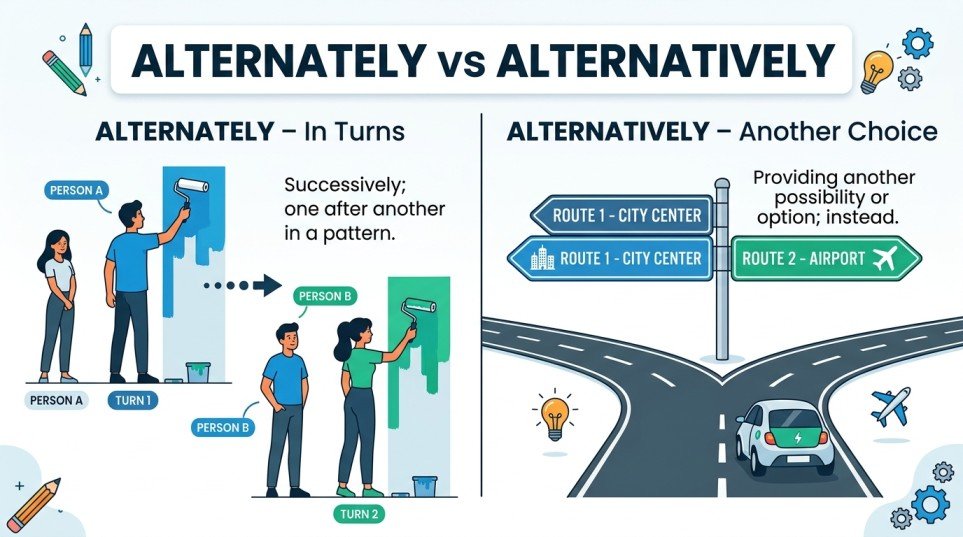
Quick Ans: The main difference between alternately vs alternatively is meaning and usage. “Alternately” refers to things happening one after another in turns, while “alternatively” means another option or choice. Although the words look similar, they are not interchangeable in most sentences.
Many English learners struggle with alternately vs alternatively because the words look almost identical. Both come from the word “alternate.” Both appear in formal and informal writing. However, their meanings differ.
This confusion often leads to grammar mistakes in emails, essays, business writing, and everyday conversation. For example, someone may write “You can alternately choose tea” when “alternatively” is the correct word.
The problem becomes bigger because spell check tools may not always catch the mistake. As a result, writers sometimes use the wrong word without realizing it.
Understanding the difference between alternately vs alternatively improves grammar accuracy and communication clarity. It also helps students, professionals, and content writers sound more natural in English.
This guide explains everything in simple language. You will learn definitions, examples, grammar rules, common mistakes, exercises, and real world usage scenarios. By the end, you will know exactly when to use each word.
Quick Answer: Alternately vs Alternatively
The easiest way to understand alternately vs alternatively is to focus on meaning.
| Word | Meaning | Example |
|---|---|---|
| Alternately | In turns or one after another | The lights flashed alternately. |
| Alternatively | As another option or possibility | Alternatively, we can stay home. |
In simple terms:
- Alternately = taking turns
- Alternatively = another choice
What Does Alternately Mean?
The word alternately describes actions happening in turns or in repeated succession.
It usually refers to switching back and forth between two things.
Common Uses of Alternately
People use alternately when discussing:
- Rotating actions
- Repeated patterns
- Switching order
- Turn based activities
Examples of Alternately
Here are some simple examples:
- The children answered questions alternately.
- Red and blue lights flashed alternately.
- The team members worked alternately during the night shift.
In each sentence, the action switches between people or things.
How Alternately Works in Sentences
Think of alternately as a pattern.
For example:
- Person A speaks.
- Then Person B speaks.
- Then Person A again.
That repeating sequence is alternating behavior.
Because of this meaning, alternately often appears in descriptions of movement, schedules, or repeated actions.
What Does Alternatively Mean?
The word alternatively introduces another option, suggestion, or possibility.
It often works like phrases such as:
- On the other hand
- Another option is
- Instead
Common Uses of Alternatively
Writers use alternatively when:
- Offering choices
- Presenting another solution
- Suggesting different plans
- Giving replacement ideas
Examples of Alternatively
Consider these examples:
- We can drive to the beach. Alternatively, we can take the train.
- Alternatively, you may submit the form online.
- You could study in the library. Alternatively, you can work from home.
Each sentence introduces another possible option.
How Alternatively Works in Sentences
Imagine someone asks how to travel somewhere.
One answer may be:
- We can fly.
Another choice might be:
- Alternatively, we can drive.
The second statement introduces a different option.
Therefore, alternatively connects ideas involving choices and alternatives.
Key Differences Between Alternately vs Alternatively
Meaning
The biggest difference between alternately vs alternatively is meaning.
- Alternately refers to taking turns.
- Alternatively refers to another possibility.
Sentence Function
Alternately describes action patterns. Alternatively introduces optional ideas or choices.
Grammar Role
Alternately usually modifies verbs or actions. Meanwhile, alternatively often acts as a sentence adverb connecting ideas.
Usage Context
Alternately appears more often in physical actions or repeated sequences. Alternatively commonly appears in discussions, writing, planning, and decision making.
Comparison Table for Alternately vs Alternatively
| Feature | Alternately | Alternatively |
|---|---|---|
| Main Meaning | In turns | Another option |
| Focus | Sequence or rotation | Choice or possibility |
| Common Context | Patterns and actions | Suggestions and decisions |
| Example | Players kicked alternately. | Alternatively, we can cancel the trip. |
This comparison makes the distinction easier to remember.
Advantages and Disadvantages of Each Word
Advantages of Using Alternately Correctly
Using alternately properly helps:
- Describe rotating actions clearly
- Improve sentence precision
- Avoid confusion in instructions
Disadvantages of Misusing Alternately
Incorrect use may:
- Change sentence meaning
- Create grammar confusion
- Make writing sound unnatural
Advantages of Using Alternatively Correctly
Proper use of alternatively:
- Improves professional writing
- Presents options clearly
- Makes transitions smoother
Disadvantages of Misusing Alternatively
Wrong usage can:
- Confuse readers
- Weaken sentence clarity
- Create awkward wording
Therefore, understanding alternately vs alternatively improves communication quality.
Real World Examples
Business Communication
Correct:
- Alternatively, we can schedule the meeting tomorrow.
Incorrect:
- Alternately, we can schedule the meeting tomorrow.
In this case, the speaker is offering another option, so alternatively is correct.
Sports Example
Correct:
- The players kicked the ball alternately.
This sentence describes turn based action.
Classroom Example
Correct:
- Students answered questions alternately.
The action rotates between students.
Travel Planning Example
Correct:
- Alternatively, we could stay at another hotel.
The sentence introduces a different choice.
These examples show how context determines the correct word.
Regional and Global Usage
American English
Both words appear regularly in American English. However, alternatively is more common in business and academic writing.
British English
British English also uses both terms frequently. Formal British writing often prefers alternatively for presenting options politely.
International English Learners
English learners around the world commonly confuse these words because they share similar spelling.
Consequently, grammar teachers often explain alternately vs alternatively together.
Related Concepts and Comparisons
Alternate vs Alternative
These base words create similar confusion.
- Alternate often means switching back and forth.
- Alternative refers to another possibility or choice.
Alternating Pattern
An alternating pattern repeats in sequence.
Example:
- Red, blue, red, blue
Alternative Solution
An alternative solution means another possible answer or approach.
These related concepts help explain the meanings more clearly.
Common Mistakes About Alternately vs Alternatively
Using Alternately for Choices
Incorrect:
- Alternately, you can call customer support.
Correct:
- Alternatively, you can call customer support.
The sentence presents another option, not a rotating action.
Using Alternatively for Rotation
Incorrect:
- The workers lifted the boxes alternatively.
Correct:
- The workers lifted the boxes alternately.
The action happens in turns.
Assuming Both Words Are Interchangeable
Although they look similar, they usually cannot replace each other.
Ignoring Context
The sentence meaning determines which word fits best.
Avoiding these mistakes improves grammar accuracy.
Beginner to Advanced Usage Tips
Beginner Level
Remember this simple trick:
- Alternately = alternating turns
- Alternatively = alternative choice
Intermediate Level
Focus on sentence context before choosing the word.
Ask yourself:
- Is this about rotation?
- Or is this about another option?
Advanced Level
Use alternatively for smooth transitions in professional writing. Meanwhile, use alternately for technical descriptions involving sequences or repeated patterns.
Strong writers choose words based on precise meaning.
Step By Step Grammar Scenario
Imagine two situations.
Situation One
Two children swing on playground equipment one after another.
Correct sentence:
- The children played alternately.
Situation Two
A family discusses dinner plans.
Correct sentence:
- Alternatively, we could order pizza.
The first sentence involves turns. The second introduces another choice.
This simple comparison helps clarify alternately vs alternatively.
Exercises With Answers
Exercise 1
Choose the correct word:
“The lights blinked ______ throughout the night.”
Answer: Alternately.
Exercise 2
Choose the correct word:
“_______, we can meet online tomorrow.”
Answer: Alternatively.
Exercise 3
Which word refers to taking turns?
Answer: Alternately.
Exercise 4
Which word introduces another option?
Answer: Alternatively.
Exercise 5
True or False: Alternately and alternatively always mean the same thing.
Answer: False.
When Should You Use Alternately vs Alternatively?
Use alternately when:
- Actions happen in turns
- Events repeat in sequence
- People switch roles repeatedly
Use alternatively when:
- Offering another idea
- Presenting different options
- Suggesting replacement plans
Understanding context makes choosing easier.
FAQs About Alternately vs Alternatively
What is the difference between alternately vs alternatively?
Alternately means taking turns, while alternatively means another option or possibility.
Can alternately and alternatively be used interchangeably?
No. In most cases, the meanings differ significantly.
When should I use alternatively in a sentence?
Use alternatively when presenting another choice or suggestion.
What does alternately mean in grammar?
Alternately describes actions happening one after another in turns.
Is alternatively formal English?
Yes. Alternatively commonly appears in professional and academic writing.
Which word should I use for rotating actions?
Use alternately for rotating or turn based actions.
Can alternatively start a sentence?
Yes. Alternatively often appears at the beginning of sentences introducing another option.
Why do people confuse alternately vs alternatively?
The words look very similar and come from related root words.
Is alternately common in everyday speech?
Yes, especially when describing repeated actions or turn taking.
How can I remember the difference between alternately vs alternatively?
Remember that alternately relates to alternating turns, while alternatively relates to alternative choices.
Conclusion
Understanding alternately vs alternatively improves grammar clarity and communication accuracy. Although the words look similar, their meanings are different.
Alternately refers to actions happening in turns or repeated sequences. Alternatively introduces another option, possibility, or suggestion.
Using the wrong word can confuse readers and weaken sentence meaning. Therefore, context matters greatly when choosing between them.
If your sentence involves rotation or switching order, use alternately. If your sentence presents another idea or choice, use alternatively.
Practicing with real examples helps build confidence. Over time, recognizing the difference becomes natural.
Now that you understand alternately vs alternatively clearly, you can write and speak with greater precision and confidence.
Discover More:-

Robert Mitchell is a U.S.-based writer at Gramtivo.Com who focuses on grammar, writing improvement, and language-related content. He holds a degree in English and Linguistics from a U.S. university. His work aims to help readers enhance their writing skills with clear and practical guidance.