
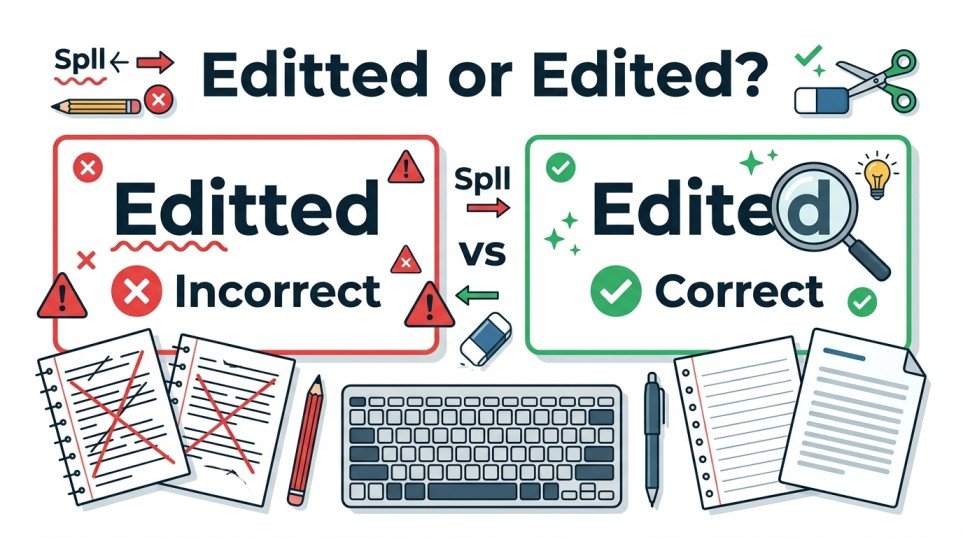
Quick Ans: The correct spelling is edited, not editted. The word “edited” comes from the verb “edit,” and standard English grammar only adds “ed” to form the past tense. Although many people mistakenly write “editted,” it is considered incorrect in modern English.
Many English learners and writers search for editted or edited because the two spellings look very similar. One version has one “t,” while the other has two. This small difference creates a lot of confusion.
The correct spelling is actually simple once you understand the grammar rule.
English verbs follow patterns when forming the past tense. Some words double the final consonant before adding “ed.” Others do not. Because of this, many people incorrectly assume that “edit” becomes “editted.”
Mistakes like this appear in emails, essays, blog posts, captions, and even professional documents. Spell checkers usually catch the error, but understanding the reason behind the correct spelling helps improve writing skills.
Learning the difference between editted or edited is important for students, content writers, business professionals, and anyone who uses English daily.
This guide explains the correct spelling, grammar rules, examples, common mistakes, exercises, and related word comparisons in a clear and easy way.
Quick Answer: Editted or Edited
The correct spelling is edited.
| Word | Correct or Incorrect |
|---|---|
| Edited | Correct |
| Editted | Incorrect |
The verb “edit” becomes “edited” in past tense and past participle form.
Examples:
- She edited the document yesterday.
- The video was edited professionally.
“Editted” is not accepted in standard English grammar.
What Does “Edited” Mean?
The word edited is the past tense of the verb “edit.”
To edit means:
- To correct mistakes
- To improve written content
- To shorten or revise text
- To modify photos or videos
People edit many types of content every day.
Examples include:
- Editing essays
- Editing photos
- Editing videos
- Editing business reports
- Editing social media posts
Because digital content is everywhere, the word “edited” appears frequently in modern communication.
Why “Edited” Is Correct
Understanding the grammar rule makes the answer clearer.
The base verb is:
- Edit
To form the past tense, English usually adds “ed”:
- Edit → Edited
The final “t” is not doubled because “edit” does not follow the consonant doubling rule used for words like “stop” or “plan.”
Therefore:
- Edit → Edited ✅
- Edit → Editted ❌
This is the standard spelling in American English and British English.
Why People Write “Editted”
Many writers become confused because English spelling rules can feel inconsistent.
Words like these double the final consonant:
| Base Word | Past Tense |
|---|---|
| Stop | Stopped |
| Plan | Planned |
| Admit | Admitted |
As a result, some people assume “edit” should become “editted.”
However, “edit” follows a different pattern.
The stress in the word matters. Since “edit” does not stress the final syllable, the consonant is not doubled.
Grammar Rule Behind Edited
Consonant Doubling Rule
English sometimes doubles the final consonant before adding “ed.”
This usually happens when:
- The word has one syllable
- The word ends in consonant vowel consonant pattern
- The final syllable is stressed
Examples:
| Base Word | Correct Past Tense |
|---|---|
| Stop | Stopped |
| Plan | Planned |
| Jog | Jogged |
However, “edit” has two syllables:
- Ed it
The stress falls on the first syllable, not the second.
Therefore, the final consonant stays single:
- Edited
Real World Examples of Edited
Writing and Publishing
Editors review articles before publication. For example:
- The journalist edited the news story carefully.
Video Production
Video creators edit footage before uploading content online.
Example:
- The YouTuber edited the video overnight.
Photography
Photographers often edit images to improve lighting and color.
Example:
- She edited the wedding photos professionally.
Business Communication
Professionals edit emails and reports before sending them.
Example:
- The manager edited the presentation twice.
These examples show how commonly the word “edited” appears in daily life.
Editted or Edited in American and British English
Some spelling differences exist between American and British English. For instance:
| American English | British English |
|---|---|
| Color | Colour |
| Organize | Organise |
However, the spelling of “edited” remains the same in both versions of English.
Therefore:
- Edited ✅
- Editted ❌
The incorrect spelling is not accepted in either form.
Common Mistakes About Editted or Edited
Adding an Extra “T”
The most common mistake is writing:
- Editted ❌
This error happens because writers incorrectly apply consonant doubling rules.
Relying Only on Pronunciation
Some people spell words based on sound. Since “edited” contains a strong “t” sound, they assume two “t” letters are needed.
English spelling, however, does not always match pronunciation directly.
Ignoring Spell Check Warnings
Modern writing tools usually underline “editted” as incorrect. Ignoring those warnings can lead to grammar mistakes in professional writing.
Confusing Similar Verbs
Writers sometimes compare “edit” to verbs like “admit” or “permit,” which double consonants. However, grammar patterns differ.
Avoiding these mistakes improves both spelling accuracy and writing confidence.
Advantages of Using Correct Spelling
Better Professional Writing
Correct spelling makes emails, reports, and articles look more professional.
Improved SEO Content
Search engines prefer high quality content with accurate grammar and spelling.
Stronger Academic Performance
Students lose marks for spelling errors in essays and assignments.
Clear Communication
Correct spelling reduces confusion for readers.
Therefore, learning the difference between editted or edited helps in school, work, and online communication.
Related Word Comparisons
Editing vs Editting
| Word | Correct or Incorrect |
|---|---|
| Editing | Correct |
| Editting | Incorrect |
The correct form uses one “t.”
Editor vs Editter
| Word | Correct or Incorrect |
|---|---|
| Editor | Correct |
| Editter | Incorrect |
Again, only one “t” is correct.
Edited vs Revised
Although both words involve improving content, they are slightly different.
- Edited means correcting or modifying content.
- Revised means reviewing and changing content more deeply.
Example:
- She edited the grammar mistakes.
- He revised the entire chapter.
Beginner to Advanced Usage Tips
Beginner Level
Remember this simple pattern:
- Edit + ed = Edited
Intermediate Level
Use grammar tools to catch spelling mistakes in documents and emails.
Advanced Level
Learn stress based spelling rules to understand when consonants double in English.
Examples:
- Prefer → Preferred
- Begin → Beginned ❌
- Begin → Began ✅
Studying these patterns improves advanced writing accuracy.
Step By Step Memory Trick
Here is an easy way to remember the correct spelling.
- Start with the base word “edit”
- Add “ed”
- Do not double the “t”
- Final spelling becomes “edited”
You can also remember this phrase:
- “One edit, one t.”
This simple trick helps many learners avoid mistakes.
Exercises With Answers
Exercise 1
Which spelling is correct?
A. Editted
B. Edited
Answer: B. Edited.
Exercise 2
Fill in the blank:
She _____ the report before sending it.
Answer: Edited.
Exercise 3
True or False:
“Editted” is accepted in modern English dictionaries.
Answer: False.
Exercise 4
Which sentence is correct?
A. He editted the photo.
B. He edited the photo.
Answer: B. He edited the photo.
Exercise 5
What is the base verb of “edited”?
Answer: Edit.
When Should You Use “Edited”?
Use “edited” whenever you describe completed editing actions.
Examples include:
- Edited documents
- Edited videos
- Edited photos
- Edited articles
- Edited presentations
The word works in both formal and informal writing.
FAQs About Editted or Edited
Which is correct, editted or edited?
The correct spelling is “edited.” The spelling “editted” is incorrect.
Why is editted wrong?
“Editted” incorrectly doubles the final consonant. The verb “edit” simply becomes “edited.”
Is edited correct in American English?
Yes. “Edited” is correct in both American and British English.
Why do people spell edited as editted?
Many writers mistakenly apply consonant doubling rules from words like “stopped” or “planned.”
Is editing spelled with one t or two?
The correct spelling is “editing” with one “t.”
Does edit follow consonant doubling rules?
No. The stress pattern in “edit” does not require consonant doubling.
Can spell check detect editted?
Yes. Most grammar and spell check tools mark “editted” as incorrect.
Is edited a verb or adjective?
It can be both. For example, “She edited the file” uses it as a verb, while “an edited version” uses it as an adjective.
How can I remember the correct spelling of edited?
Use the memory trick: “One edit, one t.”
Is editted ever acceptable in informal writing?
No. Even in casual writing, “edited” remains the correct spelling.
Conclusion
Understanding the difference between editted or edited is important for clear and professional writing. Although both spellings may look similar, only “edited” is correct in standard English grammar.
The confusion usually happens because some English verbs double the final consonant before adding “ed.” However, the verb “edit” does not follow that pattern. Instead, it simply becomes “edited.”
Using the correct spelling improves communication, academic work, professional documents, and online content. It also helps writers appear more credible and polished.
Whenever you write about correcting or improving text, photos, videos, or documents, remember the correct form:
- Edited ✅
- Editted ❌
With practice and awareness of the grammar rule, avoiding this mistake becomes easy.
Discover More:-
- Hemsworth or Pratt: Comparing Acting Style, Movies, and Hollywood Success
- Cake or Death Meaning: Origin, Humor, and Popular Usage Explained

Lisa Thompson is a USA-based content writer and language specialist focused on grammar, writing improvement and digital publishing.
She holds a degree in English Language and Communication and has professional experience in educational and web content creation.
As the author of Gramtivo.Com, she aims to help readers improve their writing skills through clear and practical guidance.