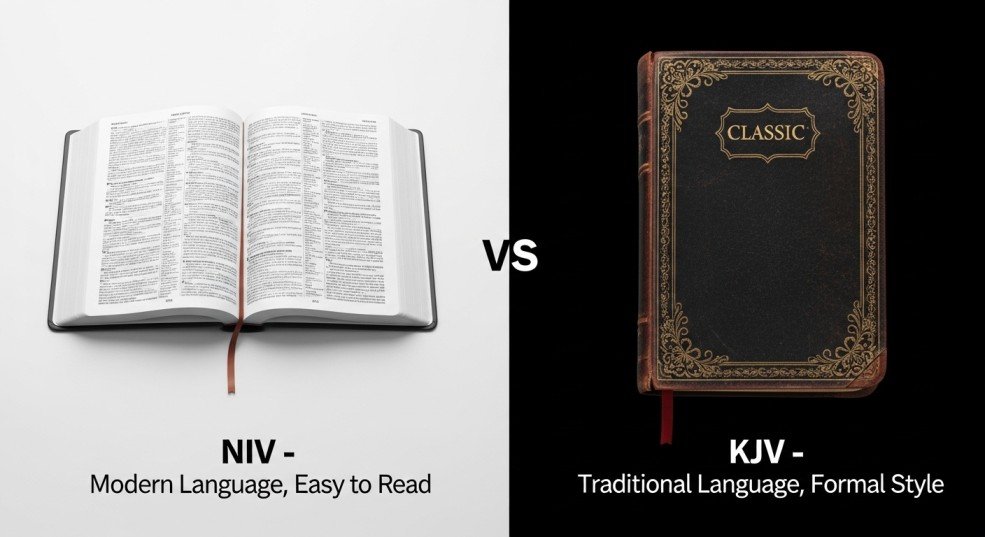
The main difference between NIV vs KJV is translation style and language. The New International Version uses modern, easy-to-read English, while the King James Version uses older, formal English from the 1600s. Both are trusted Bible translations, but they serve different reading preferences and purposes.
Many people compare NIV vs KJV when choosing a Bible to read or study. Both versions are popular. Both are widely used around the world. However, they feel very different when you read them.
The King James Version uses older English words. It sounds poetic and formal. The New International Version uses modern language. It feels easier to understand for most readers.
Because of these differences, people often feel confused about which one to choose. Some prefer tradition and beauty. Others want clarity and simplicity.
Choosing the right version matters. It affects how well you understand the text. It also shapes your reading experience.
This guide explains NIV vs KJV in a simple way. You will learn definitions, key differences, advantages, disadvantages, real-world examples, and common mistakes. By the end, you will know which version suits your needs.
Quick Answer: NIV vs KJV
To quickly understand NIV vs KJV, focus on language and translation style.
| Feature | NIV | KJV |
|---|---|---|
| Full Name | New International Version | King James Version |
| Language Style | Modern English | Old English |
| Readability | Easy | Moderate to difficult |
| Translation Approach | Thought-for-thought | Word-for-word |
| First Published | 1978 | 1611 |
In simple terms, NIV is easier to read, while KJV is more traditional and formal.
What Is NIV?
The New International Version (NIV) is a modern English translation of the Bible. It was created to make the Bible easier to understand for today’s readers.
Key Features of NIV
The NIV focuses on clarity and readability. It uses everyday language that most people can understand.
Common features include:
- Simple sentence structure
- Modern vocabulary
- Smooth reading flow
- Balanced translation style
Because of these features, the NIV is popular among beginners and general readers.
Translation Style
The NIV uses a “thought-for-thought” method. This means translators focus on conveying the meaning of each sentence rather than translating every word exactly.
As a result, the text feels natural and easier to follow.
Common Uses
People often use the NIV for:
- Daily reading
- Personal devotion
- Teaching beginners
- Church services
Therefore, it is widely accepted in many modern Christian communities.
What Is KJV?
The King James Version (KJV) is one of the oldest and most famous English Bible translations. It was first published in 1611.
Key Features of KJV
The KJV is known for its poetic and formal language. It uses words and grammar from Early Modern English.
Common features include:
- Formal tone
- Traditional vocabulary
- Rhythmic structure
- Literary beauty
Because of this style, many readers appreciate its historical and spiritual depth.
Translation Style
The KJV follows a “word-for-word” approach. Translators aimed to stay close to the original Hebrew and Greek texts.
As a result, the translation is more literal, though sometimes harder to understand.
Common Uses
People often use the KJV for:
- Traditional worship
- Memorization
- Formal reading
- Historical study
Thus, it remains important in many churches and traditions.
Key Differences Between NIV vs KJV
Language Style
The most obvious difference in NIV vs KJV is language.
The NIV uses modern English that feels natural. The KJV uses older English, including words like “thee,” “thou,” and “ye.”
Readability
Most readers find the NIV easier to understand. In contrast, the KJV requires more effort due to older grammar and vocabulary.
Translation Method
The NIV uses a thought-for-thought approach. The KJV uses a word-for-word method.
Tone and Feel
The NIV feels conversational and clear. The KJV feels formal and poetic.
Advantages and Disadvantages
NIV Advantages
- Easy to read and understand
- Suitable for beginners
- Clear and modern language
- Good for daily use
NIV Disadvantages
- Less traditional tone
- Some meanings may feel simplified
KJV Advantages
- Rich and poetic language
- Strong historical value
- Closer to original wording
- Widely respected
KJV Disadvantages
- Harder to understand for modern readers
- Uses outdated words
- Can feel complex
Choosing between NIV vs KJV depends on your reading preference.
Real World Examples
Personal Reading
A beginner may choose NIV for clarity. An experienced reader may prefer KJV for depth and tradition.
Church Settings
Some churches use NIV for teaching. Others prefer KJV for traditional services.
Study and Memorization
The NIV helps with understanding meaning. The KJV works well for memorization due to its rhythm.
These examples show how NIV vs KJV fits different situations.
Historical and Global Usage
Historical Background
The KJV has a long history dating back to 1611. It influenced English literature and culture.
The NIV is a modern translation created in the late 20th century.
Global Reach
The NIV is widely used worldwide due to its accessibility. The KJV remains popular in traditional and conservative communities.
Modern Trends
Today, many readers choose NIV for ease of reading. However, the KJV still holds strong cultural and religious significance.
Related Concepts and Comparisons
NIV vs ESV
The English Standard Version is more literal than NIV but easier to read than KJV.
KJV vs NKJV
The New King James Version updates KJV language while keeping its style.
NIV vs KJV vs ESV
| Feature | NIV | KJV | ESV |
|---|---|---|---|
| Language | Modern | Old | Modern |
| Style | Balanced | Formal | Literal |
| Readability | Easy | Harder | Moderate |
Understanding these comparisons helps clarify NIV vs KJV further.
Common Mistakes About NIV vs KJV
Assuming One Is “More Accurate”
Accuracy depends on translation method, not just version.
Ignoring Readability
Choosing a version that is too difficult may reduce understanding.
Thinking Older Means Better
Older language does not always mean clearer meaning.
Overlooking Purpose
Different situations require different versions.
Avoiding these mistakes helps you choose wisely.
Beginner to Advanced Reading Tips
Beginner Level
Start with NIV for easy understanding. Focus on meaning rather than wording.
Intermediate Level
Compare NIV with other versions. Notice differences in phrasing.
Advanced Level
Study multiple translations. Analyze original meanings and context.
As you grow, your preference may change.
Step By Step Reading Scenario
Imagine you are reading a Bible passage.
If you choose NIV:
- Read the passage easily
- Understand the meaning quickly
- Focus on message
If you choose KJV:
- Read carefully
- Interpret older words
- Reflect on deeper language
Both approaches provide value in different ways.
Exercises With Answers
Exercise 1
Which version uses modern English in the NIV vs KJV comparison?
Answer: NIV.
Exercise 2
Which version was published in 1611?
Answer: KJV.
Exercise 3
Which version is easier for beginners?
Answer: NIV.
Exercise 4
Which version uses older words like “thee” and “thou”?
Answer: KJV.
Exercise 5
True or False: NIV follows a word-for-word translation style.
Answer: False.
When Should You Choose NIV vs KJV?
Choose NIV if you:
- Want easy readability
- Prefer modern language
- Are new to Bible reading
Choose KJV if you:
- Prefer traditional language
- Value historical style
- Enjoy poetic wording
Your choice depends on comfort and purpose.
FAQs About NIV vs KJV
What is the main difference between NIV vs KJV?
The main difference is language style. NIV uses modern English, while KJV uses older, traditional English.
Which is easier to read, NIV or KJV?
The NIV is easier to read because it uses simple, modern language.
Is KJV more accurate than NIV?
Not necessarily. Both are accurate but use different translation approaches.
Why does KJV sound different?
It uses Early Modern English from the 1600s, which includes older grammar and vocabulary.
Can beginners read KJV?
Yes, but it may require extra effort to understand.
Why is NIV popular today?
Because it is easy to understand and widely used in modern settings.
Is NIV good for study?
Yes. It helps readers understand meaning clearly.
Do churches use both NIV and KJV?
Yes. Different churches prefer different versions.
Which is better for memorization?
Many people prefer KJV due to its rhythm and structure.
Can I use both NIV and KJV together?
Yes. Comparing both can improve understanding.
Conclusion
Understanding NIV vs KJV helps you choose the right Bible for your needs. Both versions are respected and widely used. However, their language and style differ greatly.
The NIV offers clear and modern wording. It is ideal for beginners and everyday reading. The KJV provides a traditional and poetic experience. It connects readers with historical language and literary beauty.
Your choice should depend on your comfort level and purpose. If you want clarity, choose NIV. If you value tradition, choose KJV.
Many readers use both versions together. This approach provides deeper understanding and balance.
Ultimately, the best Bible is the one you will read regularly and understand well.
Discover More:-
- Morphine vs Oxycodone: Differences, Uses, Safety, and Pain Relief Guide
- Sarape vs Poncho: Key Differences, Uses, and Cultural Guide

Jennifer Collins is a professional grammar expert and language educator at gramtivo.com, specializing in English grammar, writing skills, and language improvement. She holds a Master’s degree in English Language and Literature from a recognized university in the United States. With years of teaching and content development experience, she is dedicated to helping learners improve their communication skills with clear and practical guidance.