
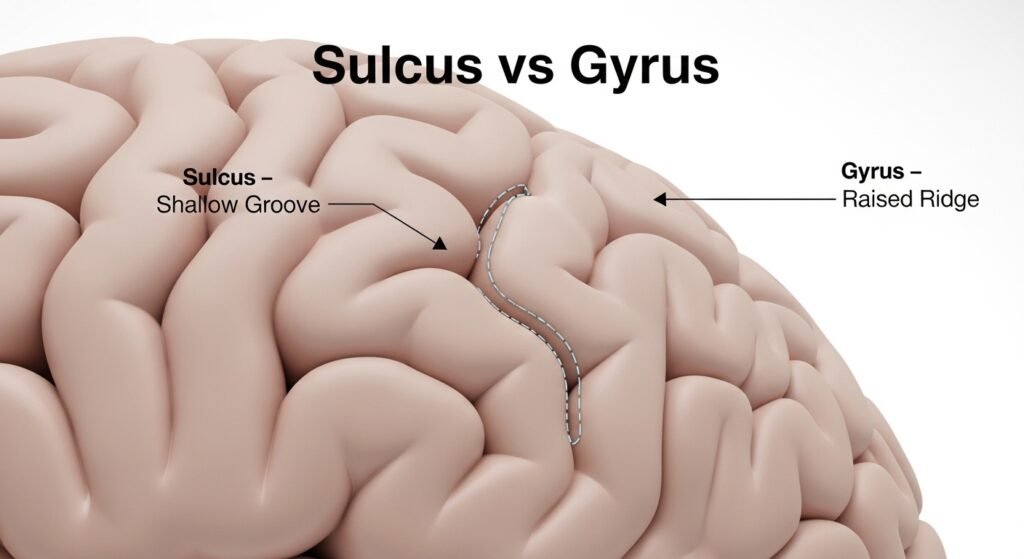
Quick Ans: The main difference between sulcus vs gyrus is structure and function in the brain. A sulcus is a shallow groove or fold on the brain’s surface, while a gyrus is the raised ridge between those grooves. Together, they increase brain surface area and help organize important brain functions.
Many students and learners search for sulcus vs gyrus when studying brain anatomy. Both terms describe features of the brain’s outer layer. Both appear in textbooks, diagrams, and exams. However, they are easy to confuse.
A sulcus is a groove or indentation. A gyrus is a raised ridge. Because they sit next to each other, they form a pattern across the brain’s surface.
This pattern is not random. It helps the brain fit more neurons into a limited space. As a result, the brain becomes more powerful without increasing much in size.
Confusion often happens because both terms sound technical and similar. In addition, diagrams may not clearly label them. Therefore, understanding the difference between sulcus vs gyrus is important for students, healthcare learners, and anyone interested in neuroscience.
In this guide, you will learn definitions, functions, comparisons, examples, and common mistakes. By the end, you will easily recognize each structure.
Quick Answer: Sulcus vs Gyrus
To quickly understand sulcus vs gyrus, focus on shape and position.
| Feature | Sulcus | Gyrus |
|---|---|---|
| Structure | Groove or indentation | Raised ridge |
| Appearance | Valley like | Hill like |
| Function | Separates gyri | Contains brain tissue |
| Role | Creates boundaries | Supports brain activity |
| Visibility | Narrow lines | Wider folds |
In simple terms, a sulcus is a groove, while a gyrus is a ridge.
What Is a Sulcus?
A sulcus is a shallow groove found on the surface of the brain. These grooves run between raised areas and form boundaries.
Sulci are part of the cerebral cortex, which is the outer layer of the brain.
Key Features of Sulci
Sulci have several defining characteristics:
- Narrow and shallow grooves
- Separate neighboring gyri
- Increase surface area
- Found across the entire brain
Because of these grooves, the brain can fold inward without losing function.
Common Examples of Sulci
Some well known sulci include:
- Central sulcus
- Lateral sulcus
- Parieto occipital sulcus
Each sulcus helps divide different functional areas of the brain.
Why Sulci Are Important
Sulci play a key role in brain organization. They separate regions responsible for different tasks such as movement, sensation, and vision.
They also allow more brain tissue to fit inside the skull. Without sulci, the brain would need to be much larger.
What Is a Gyrus?
A gyrus is a raised ridge located between two sulci. These ridges contain most of the brain’s active neurons.
Gyri are also part of the cerebral cortex.
Key Features of Gyri
Gyri have several important characteristics:
- Elevated folds or ridges
- Contain nerve cells
- Support brain processing
- Larger than sulci
Because gyri hold neurons, they play a direct role in thinking, movement, and sensation.
Common Examples of Gyri
Examples of well known gyri include:
- Precentral gyrus
- Postcentral gyrus
- Superior temporal gyrus
Each gyrus is linked to specific brain functions.
Why Gyri Are Important
Gyri contain the gray matter of the brain. This area processes information, controls movement, and interprets sensory input.
Without gyri, the brain would not function effectively.
Key Differences Between Sulcus vs Gyrus
Structure
The most obvious difference in sulcus vs gyrus is shape. A sulcus forms a groove, while a gyrus forms a ridge.
Function
Sulci separate regions of the brain. Gyri carry out brain functions through neurons.
Appearance
Sulci appear as thin lines or valleys. Gyri look like raised folds or hills.
Role in Brain Surface
Sulci increase folding by creating grooves. Gyri increase surface area by forming raised regions.
Together, they create the brain’s folded appearance.
Advantages and Disadvantages
Sulcus Advantages
Sulci provide several benefits:
- Increase brain surface area
- Help organize brain regions
- Allow compact brain structure
Sulcus Disadvantages
Some limitations exist:
- Difficult to identify in diagrams for beginners
- Can vary slightly between individuals
Gyrus Advantages
Gyri offer important advantages:
- Contain active brain cells
- Support major brain functions
- Enable complex thinking
Gyrus Disadvantages
There are also challenges:
- Damage to gyri affects brain function directly
- Complex structure can be hard to memorize
Understanding both helps in studying sulcus vs gyrus effectively.
Real World Examples
Brain Imaging
Doctors use MRI scans to identify sulci and gyri. These features help locate brain regions.
Neurology Studies
Medical students learn sulcus vs gyrus to understand brain mapping. This knowledge helps diagnose conditions.
Surgery Planning
Surgeons use sulci as landmarks. Gyri guide them to functional areas during procedures.
These examples show how important this distinction is in real life.
Regional and Global Usage
In Education
Biology and medical textbooks worldwide use sulcus and gyrus as standard terms.
In Research
Neuroscientists rely on these structures to study brain function.
In Healthcare
Doctors use these terms when describing brain scans and conditions.
Therefore, sulcus vs gyrus is a global concept in neuroscience.
Related Concepts and Comparisons
Sulcus vs Fissure
A fissure is a deeper groove than a sulcus. It separates major brain regions.
Gyrus vs Cortex
The cortex refers to the entire outer layer of the brain. A gyrus is one part of that layer.
Sulcus vs Gyrus vs Fissure
| Feature | Sulcus | Gyrus | Fissure |
|---|---|---|---|
| Shape | Groove | Ridge | Deep groove |
| Depth | Shallow | Raised | Deep |
| Function | Separation | Processing | Major division |
These comparisons help clarify brain anatomy.
Common Mistakes About Sulcus vs Gyrus
Mixing Up Terms
Many learners confuse sulci with gyri. Remember that sulci are grooves and gyri are ridges.
Ignoring Function
Some focus only on shape. Function is equally important in understanding brain roles.
Misreading Diagrams
Diagrams may look complex. Careful labeling helps avoid confusion.
Overlooking Variations
Brain folds vary slightly between individuals. However, the general pattern remains consistent.
Avoiding these mistakes improves learning accuracy.
Beginner to Advanced Study Tips
Beginner Level
Start with simple diagrams. Label sulci and gyri clearly.
Intermediate Level
Use 3D brain models to understand depth and structure.
Advanced Level
Study brain mapping and functional areas. Connect gyri to specific tasks.
Progressing step by step makes learning easier.
Step By Step Learning Scenario
Imagine you are studying a brain diagram.
If you identify a sulcus:
- Look for a groove
- Check if it separates regions
- Observe its depth
If you identify a gyrus:
- Look for a raised ridge
- Check surrounding sulci
- Identify possible function
This approach simplifies sulcus vs gyrus recognition.
Exercises With Answers
Exercise 1
Which structure is a groove in the sulcus vs gyrus comparison?
Answer: Sulcus.
Exercise 2
Which structure contains neurons?
Answer: Gyrus.
Exercise 3
Which appears like a raised ridge?
Answer: Gyrus.
Exercise 4
Which separates brain regions?
Answer: Sulcus.
Exercise 5
True or False: A sulcus is higher than a gyrus.
Answer: False.
When Should You Focus on Sulcus vs Gyrus?
Focus on these terms when you:
- Study brain anatomy
- Prepare for biology exams
- Learn neuroscience basics
- Analyze brain imaging
Understanding them builds a strong foundation for advanced topics.
FAQs About Sulcus vs Gyrus
What is the main difference between sulcus vs gyrus?
A sulcus is a groove on the brain surface, while a gyrus is a raised ridge between grooves.
Is a sulcus deeper than a gyrus?
No. A sulcus is a shallow groove, whereas a gyrus is elevated.
Why does the brain have sulci and gyri?
They increase surface area and allow more neurons to fit inside the skull.
Which contains neurons, sulcus or gyrus?
Gyri contain most of the neurons responsible for brain function.
Are sulci the same in every person?
Patterns are similar, but slight variations exist between individuals.
What is a fissure compared to sulcus vs gyrus?
A fissure is a deeper groove than a sulcus and separates major brain areas.
Can damage to a gyrus affect function?
Yes. Since gyri contain neurons, damage can affect specific brain functions.
Are sulci important for brain organization?
Yes. Sulci help separate and define functional brain regions.
Do sulci and gyri develop at birth?
They begin forming before birth and continue developing after.
Why is sulcus vs gyrus important in medicine?
Doctors use them to identify brain regions and diagnose conditions.
Conclusion
Understanding sulcus vs gyrus is essential for learning brain anatomy. Both structures shape the brain’s surface and support its function. However, they differ in form and role.
A sulcus forms a groove that separates brain regions. A gyrus forms a raised ridge that contains neurons and supports processing. Together, they increase surface area and improve brain efficiency.
These structures are not just anatomical features. They play a direct role in movement, sensation, thinking, and memory. Therefore, recognizing their differences helps in education, research, and medical practice.
Students should focus on both shape and function when studying these terms. Using diagrams, models, and repetition can improve understanding.
By mastering sulcus vs gyrus, you build a strong foundation for neuroscience and human biology.
Discover More:-
- Uber Eats vs DoorDash: Key Differences, Pricing, and Best Choice
- Fennel vs Anise: Differences, Flavor, Uses, and Cooking Guide

Robert Mitchell is a U.S.-based writer at Gramtivo.Com who focuses on grammar, writing improvement, and language-related content. He holds a degree in English and Linguistics from a U.S. university. His work aims to help readers enhance their writing skills with clear and practical guidance.