
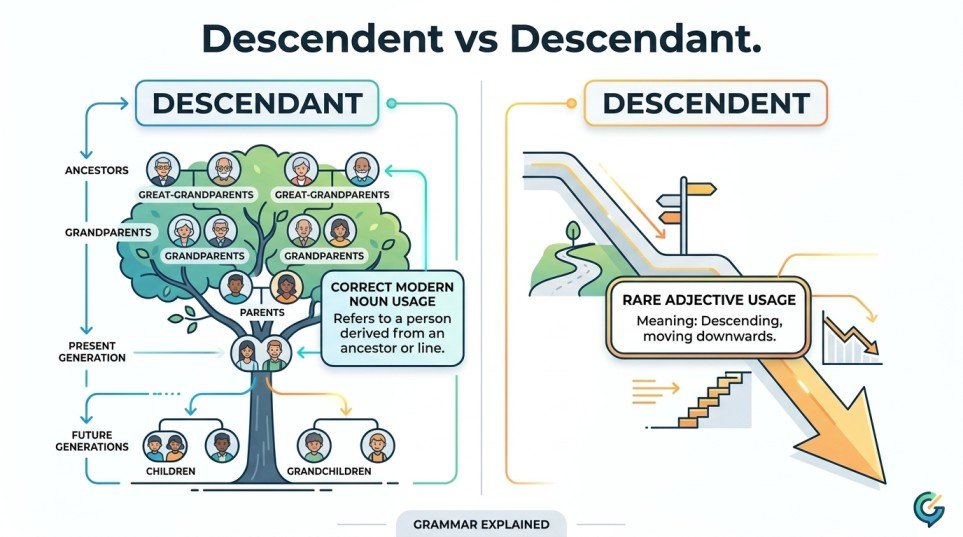
Quick Ans: The difference between descendent or descendant is simple but important. “Descendant” is the correct and most common noun used for a person related to an ancestor, while “descendent” is usually an adjective or a less common spelling variation. In modern English, “descendant” is the preferred word in most writing situations.
Many people get confused about descendent or descendant because the words look almost identical. The spelling changes by only one letter. However, that small difference can affect grammar, meaning, and professional writing.
Both words come from the same Latin root connected to “descending” or moving downward through generations. Because of this shared origin, the terms often appear interchangeable. Still, modern English uses them differently.
Writers commonly wonder which spelling belongs in family history, genealogy, academic writing, or everyday conversation. Students also struggle with these words during grammar exercises and spelling tests.
For example, should you say “a descendant of kings” or “a descendent of kings”? In most cases, only one option sounds natural to native speakers.
Understanding descendent or descendant helps improve grammar, writing accuracy, and vocabulary confidence. This guide explains definitions, usage rules, examples, mistakes, comparisons, and exercises in simple language. By the end, you will know exactly when to use each word.
Quick Answer: Descendent or Descendant
The easiest way to remember descendent or descendant is this:
| Word | Main Use | Common? |
|---|---|---|
| Descendant | Noun for family lineage | Very common |
| Descendent | Adjective or rare variant | Less common |
In modern English:
- Descendant is usually correct when talking about family generations.
- Descendent appears less often and is mainly used as an adjective.
What Does Descendant Mean?
A descendant is a person, animal, or group that comes from an earlier ancestor.
For example:
- She is a descendant of royal leaders.
- The dog is a descendant of wolves.
- Many people are descendants of immigrants.
The word functions mainly as a noun.
Common Uses of Descendant
People use “descendant” in:
- Family history
- Genealogy
- Historical writing
- Biology and evolution
- Cultural discussions
Because it is widely accepted, “descendant” appears in schools, books, and professional documents.
Simple Definition
A descendant is someone who comes after an ancestor in a family line.
For example:
Grandparent → Parent → Child → Descendant
What Does Descendent Mean?
The word descendent is less common in modern English. Traditionally, it works as an adjective that describes something moving downward or descending.
For example:
- A descendent slope
- Descendent movement
Sometimes, older dictionaries also list “descendent” as a noun spelling variant of “descendant.” However, this usage is uncommon today.
Why Descendent Causes Confusion
Confusion happens because:
- The words look nearly identical
- Some dictionaries accept both spellings
- Older English texts use “descendent” more often
Even so, modern grammar guides strongly prefer “descendant” for family relationships.
Key Differences Between Descendent or Descendant
Part of Speech
The biggest difference involves grammar.
| Word | Part of Speech |
|---|---|
| Descendant | Mostly noun |
| Descendent | Usually adjective |
Modern Usage
“Descendant” dominates modern English usage. Meanwhile, “descendent” rarely appears in everyday writing.
Popularity
Writers, teachers, and editors almost always choose “descendant” for genealogy and ancestry topics.
Clarity
Using “descendant” avoids confusion because readers immediately understand the meaning.
Advantages and Disadvantages
Advantages of Using Descendant
- Grammatically preferred
- Widely accepted
- Clear meaning
- Common in professional writing
- Easy for readers to understand
Disadvantages of Using Descendant
- Few disadvantages exist
- Some learners may still confuse spelling
Advantages of Using Descendent
- Historically recognized spelling
- Can function as adjective
Disadvantages of Using Descendent
- Rare in modern English
- May appear incorrect to readers
- Can confuse grammar checkers
Therefore, “descendant” is usually the safer choice.
Real World Examples
Family History Example
Correct:
- Maria is a descendant of Spanish settlers.
Less common:
- Maria is a descendent of Spanish settlers.
Most readers expect “descendant” here.
Academic Writing Example
Historians and genealogists almost always use “descendant” in research papers and family records.
Biological Example
Scientists may say:
- Birds are descendants of dinosaurs.
This sentence sounds natural because “descendants” is the standard form.
Regional and Global Usage
American English
American English strongly prefers “descendant” for noun usage.
British English
British English also favors “descendant,” although “descendent” occasionally appears in older texts.
Historical Writing
Older books sometimes use “descendent” more frequently. Modern publications, however, overwhelmingly choose “descendant.”
Consequently, global English usage supports “descendant” as the standard spelling.
Related Concepts and Comparisons
Ancestor vs Descendant
An ancestor comes before you in a family line. A descendant comes after.
Example:
- Grandparents are ancestors.
- Children and grandchildren are descendants.
Descendant vs Relative
A relative can include cousins, siblings, or extended family members. A descendant specifically refers to direct family lineage.
Descendant vs Offspring
“Offspring” often refers to immediate children. “Descendant” can include many generations.
Common Mistakes About Descendent or Descendant
Using Descendent as a Noun
Many people write:
- He is a descendent of the king.
Although some dictionaries allow it, modern English prefers:
- He is a descendant of the king.
Confusing Grammar Roles
“Descendant” usually acts as a noun. “Descendent” traditionally functions as an adjective.
Assuming Both Are Equally Common
They are not equally common today. “Descendant” appears far more often in books, articles, and formal writing.
Ignoring Context
Context matters. Family lineage almost always requires “descendant.”
Avoiding these mistakes improves professional and academic writing.
Beginner to Advanced Usage Tips
Beginner Level
Use “descendant” whenever discussing family generations.
Intermediate Level
Remember that “descendent” is rare in modern English.
Advanced Level
Study historical and linguistic contexts where “descendent” appears as an adjective or older noun variation.
These tips help writers avoid confusion in formal communication.
Step By Step Usage Scenario
Imagine you are writing about family history.
If you mean a person from a family line:
- Think about ancestry
- Choose the noun form
- Use “descendant”
If you describe downward movement:
- Think about descending direction
- Use adjective form
- Choose “descendent” if appropriate
This process simplifies the descendent or descendant decision.
Exercises With Answers
Exercise 1
Which word is the standard noun for a person related to an ancestor?
Answer: Descendant.
Exercise 2
Which word is less common in modern English?
Answer: Descendent.
Exercise 3
Fill in the blank:
“She is a _____ of ancient rulers.”
Answer: Descendant.
Exercise 4
True or False: “Descendent” is the preferred spelling in genealogy writing.
Answer: False.
Exercise 5
Which word do most grammar guides recommend?
Answer: Descendant.
When Should You Use Descendent or Descendant?
Use descendant when:
- Discussing ancestry
- Writing family history
- Referring to future generations
- Creating academic or professional documents
Use descendent when:
- Referring to downward movement as an adjective
- Reading older English texts
- Studying historical grammar usage
In most everyday situations, “descendant” is the correct choice.
FAQs About Descendent or Descendant
What is the difference between descendent or descendant?
“Descendant” is the standard noun for a person related to an ancestor, while “descendent” is usually an adjective or rare spelling variation.
Which spelling is correct, descendent or descendant?
For family lineage, “descendant” is the correct and preferred spelling.
Is descendent wrong?
Not completely. Some dictionaries accept it, but modern English rarely uses it as a noun.
Why is descendant more common?
Grammar guides, dictionaries, and modern publications strongly favor “descendant.”
Can descendent and descendant mean the same thing?
In older texts, yes. However, modern English separates their usage more clearly.
How do you remember descendant correctly?
Think of “ancestor” and “descendant” as opposite family terms.
Do genealogy experts use descendent or descendant?
Genealogy experts almost always use “descendant.”
Is descendant a noun or adjective?
“Descendant” is mainly used as a noun.
Can descendant refer to animals?
Yes. Scientists often discuss descendants of ancient species.
Should students use descendant in essays?
Yes. “Descendant” is the safest and most professional choice for academic writing.
Conclusion
Understanding descendent or descendant improves grammar accuracy and writing confidence. Although the words look similar, modern English treats them differently.
“Descendant” is the standard noun used for family lineage, ancestry, and future generations. It appears in professional writing, academic research, genealogy records, and everyday communication.
“Descendent,” on the other hand, is much less common. Traditionally, it functions as an adjective connected to downward movement. While some dictionaries still accept it as a noun variant, most modern writers avoid that usage.
Choosing the correct spelling matters because it improves clarity and professionalism. Readers instantly recognize “descendant” in family and historical contexts.
Whenever you discuss ancestry or genealogy, “descendant” is almost always the best option. Understanding this distinction helps students, writers, and professionals communicate more effectively.
Discover More:-
- Anterolisthesis vs Spondylolisthesis: Key Differences, Symptoms, and Treatment Guide
- Nikon or Canon: Differences, Camera Comparison, and Buying Guide

Robert Mitchell is a U.S.-based writer at Gramtivo.Com who focuses on grammar, writing improvement, and language-related content. He holds a degree in English and Linguistics from a U.S. university. His work aims to help readers enhance their writing skills with clear and practical guidance.