
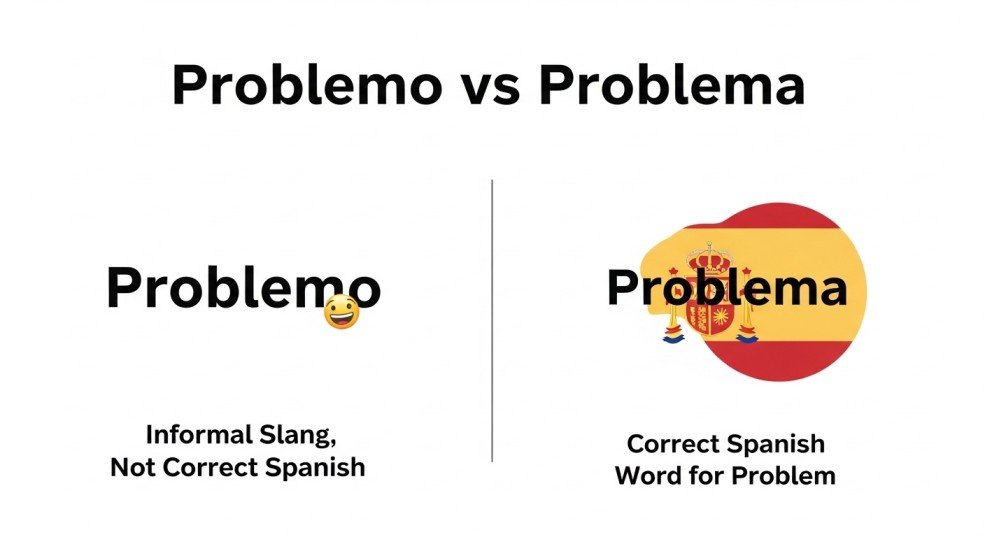
Quick Ans: The difference between problemo or problema comes down to correctness and language. “Problema” is the proper Spanish word for “problem,” while “problemo” is informal slang used humorously in English. In formal writing or correct Spanish, “problema” is always the right choice.
Many people wonder about problemo or problema when they hear both words used in conversation. Both sound similar. Both relate to the idea of a problem. However, only one is correct in real language use.
“Problema” is a standard Spanish word. It appears in dictionaries, books, and everyday Spanish conversations. In contrast, “problemo” is not a proper Spanish word. It is often used jokingly in English phrases like “no problemo.”
The confusion usually happens because “problemo” sounds like it should be Spanish. In reality, it is a playful variation, not grammatically correct in Spanish.
Understanding the difference between problemo or problema helps you avoid mistakes in writing and speaking. It also helps you sound more professional and accurate when using Spanish or English expressions.
This guide explains everything in simple terms. You will learn definitions, examples, common mistakes, and practice exercises to master the topic.
Quick Answer: Problemo or Problema
To quickly understand problemo or problema, focus on correctness.
| Word | Language | Correct Usage | Meaning |
|---|---|---|---|
| Problema | Spanish | Correct | Problem |
| Problemo | Informal English slang | Incorrect in Spanish | Joke or casual phrase |
In short, “problema” is correct, while “problemo” is informal slang.
What Is “Problema”?
“Problema” is a Spanish noun that means “problem.” It is widely used in Spanish speaking countries and follows proper grammar rules.
Interestingly, “problema” ends with the letter “a,” but it is a masculine noun in Spanish.
Examples of “Problema”
Here are simple examples:
- Tengo un problema. (I have a problem.)
- No hay problema. (There is no problem.)
- Este problema es difícil. (This problem is difficult.)
Because “problema” is a real word, it should be used in formal writing, conversations, and learning contexts.
Grammar Note
Although it ends in “a,” the word uses masculine articles:
- el problema (the problem)
- un problema (a problem)
This detail often surprises beginners.
What Is “Problemo”?
“Problemo” is not a correct Spanish word. Instead, it is a playful or humorous version used in English.
People often say:
- No problemo
- Big problemo
These expressions sound fun and casual. However, they are not grammatically correct in Spanish.
Where Did “Problemo” Come From?
The phrase “no problemo” became popular through movies, TV shows, and pop culture. Over time, it became a joking way to say “no problem.”
Even though it sounds Spanish, it does not follow Spanish grammar rules.
When Is It Used?
“Problemo” is used in:
- Casual conversations
- Humor
- Informal settings
It should not be used in formal writing or when speaking proper Spanish.
Key Differences Between Problemo or Problema
Correctness
“Problema” is grammatically correct. “Problemo” is not.
Language Use
“Problema” belongs to Spanish. “Problemo” belongs to informal English slang.
Tone
“Problema” sounds neutral and professional. “Problemo” sounds playful and humorous.
Context
“Problema” works in formal and informal settings. “Problemo” works only in casual or joking situations.
Advantages and Disadvantages
Problema Advantages
- Correct grammar
- Works in formal writing
- Accepted in Spanish language
- Clear and professional
Problema Disadvantages
- Requires understanding of Spanish grammar
- May confuse beginners due to masculine form
Problemo Advantages
- Fun and expressive
- Easy to remember
- Common in pop culture
Problemo Disadvantages
- Not correct Spanish
- Sounds unprofessional in formal situations
- Can cause confusion in language learning
Therefore, choosing between problemo or problema depends on context and purpose.
Real World Examples
Formal Writing
Use “problema” in essays, emails, or academic work:
- Este problema necesita solución.
Using “problemo” here would be incorrect.
Casual Conversation
Friends may jokingly say:
- No problemo, I got it.
This works in relaxed settings but not in professional environments.
Language Learning
Students learning Spanish should always use “problema.” Using “problemo” may lead to mistakes and confusion.
Regional and Global Usage
Spanish Speaking Countries
“Problema” is standard across all Spanish speaking regions.
English Speaking Countries
“Problemo” appears in casual speech, especially in humorous expressions.
Global Context
Globally, “problema” is recognized as correct Spanish. Meanwhile, “problemo” is seen as slang influenced by media.
Thus, understanding problemo or problema is important for cross cultural communication.
Related Concepts and Comparisons
Problema vs Problem
“Problema” is the Spanish version of the English word “problem.”
No Problema vs No Problem
Both mean the same thing. One is Spanish, while the other is English.
Problemo vs No Problemo
“No problemo” is a playful English phrase. It does not follow Spanish grammar rules.
Common Mistakes About Problemo or Problema
Using “Problemo” in Spanish Sentences
Incorrect: Tengo un problemo.
Correct: Tengo un problema.
Assuming “Problemo” Is Spanish
Many learners believe it is real Spanish. In reality, it is slang.
Mixing Formal and Informal Language
Using “problemo” in professional writing can reduce credibility.
Ignoring Gender Rules
Some learners use “la problema,” which is incorrect. The correct form is “el problema.”
Avoiding these mistakes improves language accuracy.
Beginner to Advanced Learning Tips
Beginner Level
Memorize the correct word “problema.” Practice simple sentences daily.
Intermediate Level
Learn gender rules and sentence structure in Spanish.
Advanced Level
Study more Spanish nouns with unusual gender patterns. Practice speaking in real conversations.
Consistent practice helps build confidence.
Step By Step Usage Scenario
Imagine you want to say “no problem.”
In Spanish:
- Use “no hay problema.”
- Speak clearly and naturally.
In casual English slang:
- Say “no problemo.”
- Use it in informal conversation only.
Understanding the situation helps you choose correctly.
Exercises With Answers
Exercise 1
Which word is correct in Spanish?
Answer: Problema.
Exercise 2
Is “problemo” a real Spanish word?
Answer: No.
Exercise 3
Which phrase is correct: “no hay problema” or “no hay problemo”?
Answer: No hay problema.
Exercise 4
Which word should be used in formal writing?
Answer: Problema.
Exercise 5
True or False: “Problema” is a feminine noun.
Answer: False.
When Should You Choose Problemo or Problema?
Choose “problema” when you:
- Write in Spanish
- Speak formally
- Want correct grammar
Choose “problemo” when you:
- Speak casually in English
- Use humor
- Want a playful tone
Context determines the correct choice.
FAQs About Problemo or Problema
What is the difference between problemo or problema?
“Problema” is the correct Spanish word, while “problemo” is informal slang used in English.
Is “problemo” correct Spanish?
No. It is not a real Spanish word.
Why do people say “no problemo”?
It became popular through movies and casual speech as a humorous phrase.
Can I use “problemo” in formal writing?
No. It is not appropriate in professional or academic contexts.
What does “problema” mean in English?
It means “problem.”
Is “problema” masculine or feminine?
It is masculine, even though it ends in “a.”
Which is better for learning Spanish, problemo or problema?
“Problema” is correct and should always be used.
Is “no hay problema” formal or informal?
It works in both formal and informal situations.
Do native Spanish speakers use “problemo”?
No. Native speakers use “problema.”
Can using “problemo” cause confusion?
Yes. It may make your Spanish sound incorrect.
Conclusion
The comparison of problemo or problema is simple once you understand the basics. “Problema” is the correct Spanish word used in both formal and informal contexts. “Problemo,” on the other hand, is informal slang used mainly in English for humor.
Using the correct word improves communication and avoids misunderstandings. When speaking or writing in Spanish, always choose “problema.” This ensures accuracy and professionalism.
“Problemo” may still be useful in casual conversations with friends. However, it should never replace proper language in serious situations.
For learners, focusing on correct grammar builds strong language skills. Practicing real examples helps reinforce understanding over time.
Now that you understand the difference between problemo or problema, you can use each word confidently in the right context.
Discover More:-
- Partnership vs LLC: Key Differences, Benefits, and Business Structure Guide
- Custodian vs Janitor: Key Differences, Roles, Duties, and Career Guide

Lisa Thompson is a USA-based content writer and language specialist focused on grammar, writing improvement and digital publishing.
She holds a degree in English Language and Communication and has professional experience in educational and web content creation.
As the author of Gramtivo.Com, she aims to help readers improve their writing skills through clear and practical guidance.