
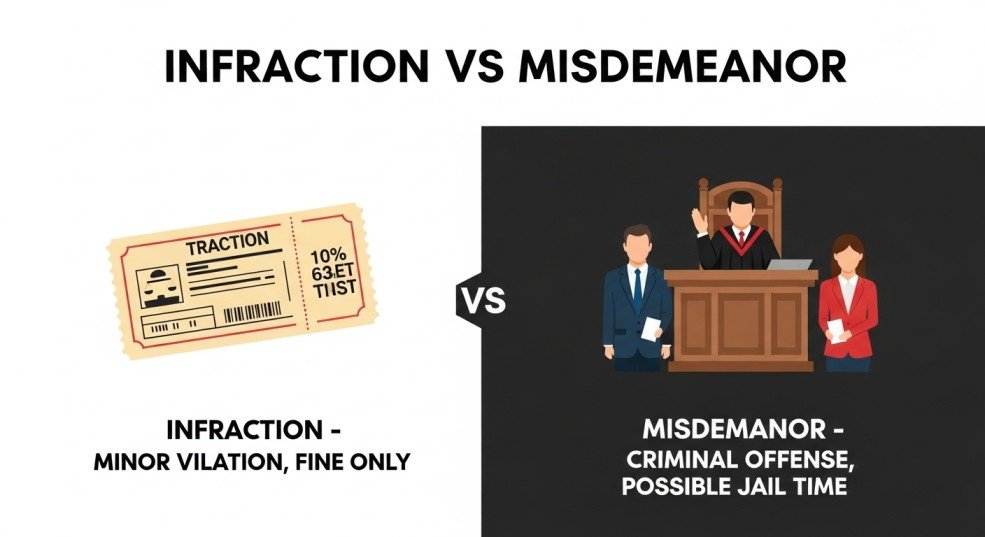
Quick Ans: The main difference between infraction vs misdemeanor is the level of severity and punishment. An infraction is a minor violation usually punishable by a fine, while a misdemeanor is a more serious offense that can lead to fines, probation, or even jail time. Although both are less severe than felonies, they carry different legal consequences.
Many people search for infraction vs misdemeanor when trying to understand legal charges. Both terms appear in traffic tickets, court notices, and legal discussions. However, they are not the same.
An infraction is the least serious type of offense. A misdemeanor is more serious but still less severe than a felony. Because the names sound similar, confusion is common.
For example, a speeding ticket is usually an infraction. Driving under the influence may be charged as a misdemeanor. The difference affects penalties, criminal records, and court procedures.
Understanding infraction vs misdemeanor helps you respond correctly if you face a legal issue. It also helps you know your rights and possible consequences.
This guide explains everything in simple terms. You will learn definitions, key differences, advantages, disadvantages, examples, common mistakes, and practical exercises.
Quick Answer: Infraction vs Misdemeanor
To understand infraction vs misdemeanor, focus on severity and penalties.
| Feature | Infraction | Misdemeanor |
|---|---|---|
| Severity | Minor violation | Moderate offense |
| Jail Time | No | Possible |
| Fine | Yes | Yes |
| Criminal Record | Usually no | Yes |
| Examples | Traffic ticket | Petty theft |
In simple terms, an infraction is minor, while a misdemeanor is more serious and may involve jail time.
What Is an Infraction?
An infraction is a minor violation of the law. It is not considered a criminal offense in many legal systems.
Infractions usually result in fines instead of jail time.
Common Examples of Infractions
Typical infractions include:
- Speeding
- Parking violations
- Not wearing a seatbelt
- Minor noise violations
These offenses are often handled quickly in court or through payment of fines.
Key Characteristics of Infractions
Several features define infractions:
- No jail time
- No jury trial in most cases
- Usually no criminal record
- Lower fines compared to misdemeanors
Because infractions are minor, they are often resolved without a formal court appearance.
How Infractions Are Handled
The process is usually simple:
- Receive a ticket or citation
- Pay the fine or contest it
- Attend a hearing if necessary
As a result, infractions involve less legal complexity.
What Is a Misdemeanor?
A misdemeanor is a criminal offense that is more serious than an infraction but less serious than a felony.
Unlike infractions, misdemeanors can lead to jail time.
Common Examples of Misdemeanors
Examples include:
- Petty theft
- Simple assault
- Disorderly conduct
- First time DUI
These offenses are treated as criminal cases.
Key Characteristics of Misdemeanors
Misdemeanors have several important features:
- Possible jail time
- Higher fines
- Criminal record
- Right to a trial
Because of these factors, misdemeanors carry more serious consequences.
How Misdemeanors Are Handled
The legal process is more complex:
- Arrest or citation
- Court appearance
- Possible trial
- Sentencing
Therefore, legal representation is often recommended.
Key Differences Between Infraction vs Misdemeanor
Severity
The main difference in infraction vs misdemeanor is severity. Infractions are minor violations. Misdemeanors are more serious crimes.
Jail Time
Infractions do not lead to jail. Misdemeanors can result in jail time depending on the offense.
Criminal Record
Infractions usually do not create a criminal record. Misdemeanors do.
Legal Process
Infractions involve simple procedures. Misdemeanors require formal court proceedings.
Examples
Speeding is typically an infraction. Theft or assault may be charged as misdemeanors.
Advantages and Disadvantages
Infraction Advantages
Infractions have some benefits:
- No jail time
- Lower fines
- Faster resolution
- Less legal stress
Infraction Disadvantages
However, there are drawbacks:
- Still involves fines
- May affect driving record
- Repeated violations can escalate
Misdemeanor Advantages
Misdemeanors may offer:
- Opportunity for legal defense
- Possible plea deals
- Chance for reduced charges
Misdemeanor Disadvantages
They also carry risks:
- Possible jail time
- Criminal record
- Higher legal costs
- Long term consequences
Thus, the stakes are much higher in infraction vs misdemeanor situations involving misdemeanors.
Real World Examples
Traffic Situation
A driver exceeds the speed limit slightly. This usually results in an infraction with a fine.
Another driver causes a minor accident while driving recklessly. This could lead to a misdemeanor charge.
Public Behavior
Playing loud music late at night may result in an infraction. However, fighting in public could lead to a misdemeanor.
Workplace Scenario
Breaking minor workplace rules may lead to a fine or warning. Stealing company property could result in a misdemeanor charge.
These examples show how severity changes the classification.
Regional and Legal Variations
Different Countries
Laws vary by country. Some legal systems use different terms but similar concepts.
State Differences
In some regions, the same act may be treated differently. For example, certain traffic violations may be misdemeanors in one state and infractions in another.
Legal Classification
Some jurisdictions classify infractions as civil offenses. Misdemeanors are always criminal.
Therefore, always check local laws when comparing infraction vs misdemeanor.
Related Concepts and Comparisons
Misdemeanor vs Felony
A felony is more serious than a misdemeanor and often involves longer prison sentences.
Infraction vs Citation
A citation is a notice given by law enforcement. It may relate to an infraction or misdemeanor.
Infraction vs Misdemeanor vs Felony
| Category | Infraction | Misdemeanor | Felony |
|---|---|---|---|
| Severity | Low | Medium | High |
| Jail Time | No | Possible | Yes |
| Record | Usually none | Yes | Yes |
| Examples | Parking ticket | Theft | Robbery |
This comparison helps clarify legal categories.
Common Mistakes About Infraction vs Misdemeanor
Thinking Infractions Are Crimes
Many people assume infractions are criminal offenses. In most cases, they are not.
Ignoring Misdemeanor Consequences
Some believe misdemeanors are minor. However, they can lead to jail time and lasting records.
Not Contesting Tickets
People often pay fines without understanding their rights. In some cases, contesting may reduce penalties.
Confusing Legal Terms
Terms like citation, offense, and charge are often misunderstood.
Avoiding these mistakes helps you handle legal situations more effectively.
Beginner to Advanced Legal Tips
Beginner Level
Understand the type of charge you face. Read the citation carefully.
Intermediate Level
Learn your legal rights. Consider consulting a lawyer for misdemeanors.
Advanced Level
Explore options such as plea bargains, record expungement, or legal defenses.
Taking the right steps early can reduce long term impact.
Step By Step Legal Scenario
Imagine receiving a traffic ticket.
If it is an infraction:
- Review the ticket
- Pay the fine or contest it
- Attend hearing if required
If it is a misdemeanor:
- Appear in court
- Consider hiring a lawyer
- Prepare a defense
- Follow court procedures
The process differs significantly in infraction vs misdemeanor cases.
Exercises With Answers
Exercise 1
Which offense can lead to jail time in the infraction vs misdemeanor comparison?
Answer: Misdemeanor.
Exercise 2
Which type usually results only in a fine?
Answer: Infraction.
Exercise 3
Which creates a criminal record?
Answer: Misdemeanor.
Exercise 4
Which is considered a minor violation?
Answer: Infraction.
Exercise 5
True or False: Infractions can result in jail time.
Answer: False.
When Should You Be Concerned About Infraction vs Misdemeanor?
Be concerned about a misdemeanor if you:
- Face possible jail time
- Have a criminal record risk
- Need legal representation
Infractions still matter, but they are less serious. Paying attention to the classification helps you respond appropriately.
FAQs About Infraction vs Misdemeanor
What is the main difference between infraction vs misdemeanor?
The main difference is severity. Infractions are minor violations, while misdemeanors are criminal offenses that may involve jail time.
Is an infraction considered a crime?
In most cases, no. Infractions are usually treated as non criminal violations.
Can a misdemeanor lead to jail time?
Yes. Misdemeanors can result in short jail sentences depending on the offense.
Do infractions go on your record?
They may appear on driving records but usually not on criminal records.
Which is worse, infraction or misdemeanor?
A misdemeanor is more serious because it can lead to jail time and a criminal record.
Can an infraction become a misdemeanor?
Repeated violations or serious circumstances can sometimes escalate charges.
Should you hire a lawyer for a misdemeanor?
Yes. Legal advice is recommended due to potential consequences.
Do you need to go to court for an infraction?
Often no. Many infractions can be resolved by paying a fine.
Can misdemeanors be removed from your record?
In some cases, expungement is possible depending on local laws.
Are traffic tickets always infractions?
Not always. Some serious traffic violations can be charged as misdemeanors.
Conclusion
Understanding infraction vs misdemeanor is essential for handling legal situations correctly. Although both are less serious than felonies, they differ in severity, penalties, and long term impact.
An infraction is a minor violation that usually results in a fine and does not involve jail time. A misdemeanor is a criminal offense that can lead to fines, probation, or even jail.
The difference affects your legal rights, court process, and future record. Therefore, recognizing the type of charge you face is critical.
If you deal with an infraction, careful review and timely payment may resolve the issue. However, if you face a misdemeanor, seeking legal advice is often the best step.
By understanding infraction vs misdemeanor, you can make informed decisions and protect your rights.
Discover More:-
- Goats vs Sheep: Key Differences, Farming Uses, Behavior, and Identification Guide
- Waterpik vs Floss: Which Is Better for Gum Health and Plaque Removal?

Robert Mitchell is a U.S.-based writer at Gramtivo.Com who focuses on grammar, writing improvement, and language-related content. He holds a degree in English and Linguistics from a U.S. university. His work aims to help readers enhance their writing skills with clear and practical guidance.