
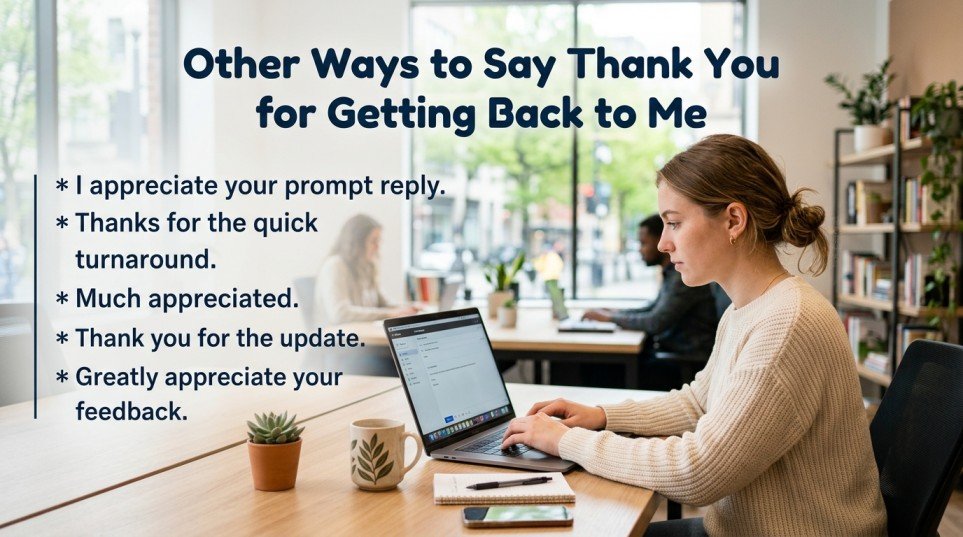
Quick Answer: Instead of saying thank you for getting back to me, you can say: I appreciate your response, thanks for your reply, thank you for your prompt response, I appreciate you getting back to me, thanks for responding.
The phrase “thank you for getting back to me” is commonly used when someone responds to an email, message, or inquiry. It shows appreciation for the person’s time and effort in replying.
Although this phrase is polite and widely accepted, using it repeatedly can make your communication sound repetitive. Native English speakers often choose different expressions depending on the level of formality and the situation.
Learning alternatives to “thank you for getting back to me” can help you sound more natural and professional. It improves your written communication, expands your vocabulary, and helps you express excitement in English or gratitude more effectively in both business and personal conversations.
Quick Categories Section
Formal alternatives to “thank you for getting back to me”
- Thank you for your response
- I appreciate your prompt reply
- Thank you for your timely response
- I appreciate your correspondence
Pro Tip: These phrases work well in formal emails, client communication, and professional settings.
Casual alternatives
- Thanks for getting back to me
- Thanks for replying
- Appreciate the reply
- Thanks for writing back
Pro Tip: Use these with friends, colleagues you know well, or informal business contacts.
Professional alternatives
- Thank you for your prompt response
- I appreciate your quick reply
- Thank you for responding so promptly
- Many thanks for your response
Pro Tip: These phrases help create a polished and professional impression.
Informal expressions
- Thanks for the update
- Glad to hear from you
- Thanks for reaching out
- Appreciate you getting back to me
Pro Tip: Save these for relaxed conversations and friendly correspondence.
“Small changes in wording can make your emails sound more professional and engaging.”
Common Mistakes
- Using the same phrase in every email
Example: Starting every message with “Thank you for getting back to me.” - Being too informal in professional communication
Example: “Thanks a bunch for replying!” - Forgetting to acknowledge the response
Example: Jumping straight into your request without appreciation. - Using overly formal language in casual conversations
Example: “I sincerely appreciate your correspondence” to a close friend. - Adding unnecessary wording
Example: “Thank you very much indeed for getting back to me so quickly.”
What Does “Thank You for Getting Back to Me” Mean?
The phrase means you appreciate someone for replying to your message, email, or request.
It is commonly used after receiving a response and serves as a polite acknowledgment.
Example Sentence:
Thank you for getting back to me regarding the project details.
When to Use “Thank You for Getting Back to Me”
- After receiving an email reply
- When someone responds to a request
- During customer service interactions
- In professional correspondence
- In personal messages and conversations
Spoken vs Written: Mostly written but can be spoken.
Formal vs Informal: Neutral and suitable for most situations.
Is It Professional or Polite to Say “Thank You for Getting Back to Me”?
Polite? ✔️ Yes
Professional? ✔️ Yes
Unlike many conversational phrases, this expression is appropriate in professional communication.
Business Example:
“Thank you for getting back to me regarding the proposal. I appreciate your clarification.”
Pros and Cons of Using “Thank You for Getting Back to Me”
Pros
- Professional and polite
- Easy to understand
- Appropriate in most situations
- Shows appreciation
Cons
- Can become repetitive
- Slightly generic
- Lacks personality
- May sound formulaic in frequent emails
“Professional communication becomes stronger when you vary your vocabulary.”
Other Ways to Say “Thank You for Getting Back to Me” (With Examples)
These alternatives will help you sound more fluent, confident, and natural in different situations.
Use them according to tone, context, and audience to improve your communication skills.
1. Phrase: Thank you for your response
Meaning: Appreciation for someone’s reply.
Explanation: A professional and widely accepted alternative.
Example Sentence: Thank you for your response regarding the upcoming meeting.
Best Use: business emails
Worst Use: casual texting
Tone: professional, polite
Context Variability: professional / written
2. Phrase: I appreciate your reply
Meaning: Gratitude for responding.
Explanation: Slightly warmer than the original phrase.
Example Sentence: I appreciate your reply and the information you provided.
Best Use: workplace communication
Worst Use: very casual chats
Tone: appreciative, professional
Context Variability: professional / written
3. Phrase: Thanks for replying
Meaning: Thank you for responding.
Explanation: Casual and friendly.
Example Sentence: Thanks for replying so quickly.
Best Use: everyday communication
Worst Use: formal correspondence
Tone: casual, friendly
Context Variability: casual / spoken
4. Phrase: Thank you for your prompt response
Meaning: Appreciation for a quick reply.
Explanation: Highlights responsiveness.
Example Sentence: Thank you for your prompt response to my inquiry.
Best Use: business communication
Worst Use: personal texts
Tone: professional, respectful
Context Variability: professional / written
5. Phrase: I appreciate you getting back to me
Meaning: Gratitude for responding.
Explanation: Friendly yet professional.
Example Sentence: I appreciate you getting back to me so quickly.
Best Use: workplace emails
Worst Use: legal documents
Tone: warm, professional
Context Variability: professional / spoken
“The best professional reaction phrases combine appreciation with clarity.”
6. Phrase: Thanks for your reply
Meaning: Appreciation for a response.
Explanation: Simple and versatile.
Example Sentence: Thanks for your reply and helpful feedback.
Best Use: general communication
Worst Use: formal letters
Tone: polite, friendly
Context Variability: casual / professional
7. Phrase: Thank you for responding
Meaning: Gratitude for a response.
Explanation: Direct and professional.
Example Sentence: Thank you for responding to my request.
Best Use: professional emails
Worst Use: casual chats
Tone: professional, neutral
Context Variability: professional / written
8. Phrase: Many thanks for your response
Meaning: Strong appreciation.
Explanation: Slightly formal and courteous.
Example Sentence: Many thanks for your response and assistance.
Best Use: business correspondence
Worst Use: texting friends
Tone: formal, appreciative
Context Variability: professional
9. Phrase: Thank you for the update
Meaning: Appreciation for information provided.
Explanation: Useful when someone responds with new information.
Example Sentence: Thank you for the update on the project timeline.
Best Use: project communication
Worst Use: unrelated replies
Tone: professional, appreciative
Context Variability: professional
10. Phrase: Thanks for getting back to me so quickly
Meaning: Appreciation for a fast response.
Explanation: A more specific version of the original phrase.
Example Sentence: Thanks for getting back to me so quickly.
Best Use: workplace communication
Worst Use: formal reports
Tone: friendly, appreciative
Context Variability: professional / casual
11. Phrase: I appreciate your quick reply
Meaning: Gratitude for a fast response.
Explanation: Highlights efficiency.
Example Sentence: I appreciate your quick reply regarding my application.
Best Use: professional emails
Worst Use: casual texting
Tone: professional, thankful
Context Variability: professional
12. Phrase: Thank you for your timely response
Meaning: Appreciation for replying on time.
Explanation: Common in business communication.
Example Sentence: Thank you for your timely response to my inquiry.
Best Use: formal correspondence
Worst Use: friendly chats
Tone: formal, professional
Context Variability: professional
13. Phrase: Thanks for writing back
Meaning: Appreciation for replying in writing.
Explanation: Casual and conversational.
Example Sentence: Thanks for writing back with the details.
Best Use: informal emails
Worst Use: corporate reports
Tone: casual, friendly
Context Variability: casual
14. Phrase: Glad to hear from you
Meaning: Pleasure in receiving a response.
Explanation: Friendly and personal.
Example Sentence: Glad to hear from you after so long.
Best Use: personal communication
Worst Use: formal requests
Tone: warm, conversational
Context Variability: casual
15. Phrase: Thank you for reaching out
Meaning: Appreciation for initiating contact.
Explanation: Often used in customer service and business communication.
Example Sentence: Thank you for reaching out regarding our services.
Best Use: customer communication
Worst Use: direct reply acknowledgment
Tone: professional, welcoming
Context Variability: professional
“Using the right phrase can make your message feel more thoughtful and professional.”
16. Phrase: I appreciate your feedback
Meaning: Gratitude for comments or suggestions.
Explanation: Ideal when the reply contains advice or opinions.
Example Sentence: I appreciate your feedback on the proposal.
Best Use: reviews and discussions
Worst Use: simple confirmations
Tone: professional, appreciative
Context Variability: professional
17. Phrase: Thank you for your input
Meaning: Appreciation for someone’s contribution.
Explanation: Useful in collaborative settings.
Example Sentence: Thank you for your input during the meeting.
Best Use: teamwork
Worst Use: casual texting
Tone: professional, respectful
Context Variability: professional
18. Phrase: Thanks for the information
Meaning: Appreciation for shared details.
Explanation: Direct and practical.
Example Sentence: Thanks for the information you provided.
Best Use: everyday communication
Worst Use: highly formal writing
Tone: neutral, friendly
Context Variability: casual / professional
19. Phrase: Thank you for the clarification
Meaning: Appreciation for explaining something.
Explanation: Useful when a reply resolves confusion.
Example Sentence: Thank you for the clarification regarding the policy.
Best Use: workplace communication
Worst Use: casual chatting
Tone: professional, appreciative
Context Variability: professional
20. Phrase: I appreciate your assistance
Meaning: Gratitude for help provided.
Explanation: Polite and professional.
Example Sentence: I appreciate your assistance with this matter.
Best Use: business emails
Worst Use: casual texts
Tone: professional, respectful
Context Variability: professional
21. Phrase: Thank you for your help
Meaning: Appreciation for support.
Explanation: Simple and versatile.
Example Sentence: Thank you for your help with the project.
Best Use: general communication
Worst Use: none
Tone: polite, friendly
Context Variability: casual / professional
22. Phrase: Much appreciated
Meaning: Strong gratitude.
Explanation: Short and effective.
Example Sentence: Your quick response is much appreciated.
Best Use: emails and messages
Worst Use: formal contracts
Tone: appreciative, concise
Context Variability: professional
23. Phrase: Thank you for taking the time to respond
Meaning: Appreciation for effort and time.
Explanation: Emphasizes the person’s effort.
Example Sentence: Thank you for taking the time to respond to my questions.
Best Use: professional communication
Worst Use: quick casual chats
Tone: respectful, professional
Context Variability: professional
24. Phrase: I’m grateful for your response
Meaning: Strong appreciation.
Explanation: More heartfelt than standard alternatives.
Example Sentence: I’m grateful for your response and support.
Best Use: meaningful communication
Worst Use: routine updates
Tone: sincere, appreciative
Context Variability: professional / personal
25. Phrase: Thank you for the quick turnaround
Meaning: Appreciation for fast action.
Explanation: Common in business environments.
Example Sentence: Thank you for the quick turnaround on this request.
Best Use: workplace projects
Worst Use: casual chats
Tone: professional, appreciative
Context Variability: professional
26. Phrase: Thanks for following up
Meaning: Appreciation for continued communication.
Explanation: Useful when someone checks in or provides updates.
Example Sentence: Thanks for following up on my application.
Best Use: ongoing conversations
Worst Use: first-time responses
Tone: professional, friendly
Context Variability: professional
27. Phrase: I appreciate the update
Meaning: Gratitude for new information.
Explanation: Similar to thanking someone for responding.
Example Sentence: I appreciate the update regarding the shipment.
Best Use: project updates
Worst Use: personal greetings
Tone: professional, appreciative
Context Variability: professional
28. Phrase: Thank you for your attention to this matter
Meaning: Appreciation for addressing an issue.
Explanation: Formal and business-oriented.
Example Sentence: Thank you for your attention to this matter.
Best Use: formal correspondence
Worst Use: casual messaging
Tone: formal, respectful
Context Variability: professional
29. Phrase: Thanks for keeping me informed
Meaning: Appreciation for updates.
Explanation: Suitable for ongoing communication.
Example Sentence: Thanks for keeping me informed throughout the process.
Best Use: project communication
Worst Use: first responses
Tone: professional, friendly
Context Variability: professional
30. Phrase: Your response is greatly appreciated
Meaning: Strong gratitude for a reply.
Explanation: Formal and courteous.
Example Sentence: Your response is greatly appreciated.
Best Use: formal emails
Worst Use: casual conversations
Tone: formal, appreciative
Context Variability: professional / written
“A thoughtful thank-you can strengthen both professional and personal relationships.”
Mini Quiz / Self-Check
1. Which phrase is most suitable for a formal business email?
A. Thanks for replying
B. Thank you for your timely response
C. Glad to hear from you
Answer: B
2. Which phrase is the most casual?
A. Thank you for your response
B. Thanks for writing back
Answer: B
3. Which phrase emphasizes speed?
A. Thank you for your prompt response
B. Thank you for your input
Answer: A
Comparison Table: Top Alternatives
| Phrase | Tone | Best Use |
|---|---|---|
| Thank you for your response | Professional | Business emails |
| I appreciate your reply | Professional | Workplace communication |
| Thanks for replying | Casual | Everyday messages |
| Thank you for your prompt response | Formal | Professional emails |
| I appreciate you getting back to me | Warm | Business and personal |
| Thanks for your reply | Friendly | General communication |
| Thank you for responding | Professional | Formal correspondence |
| Many thanks for your response | Formal | Client communication |
| Thank you for the update | Professional | Project updates |
| I appreciate your quick reply | Professional | Workplace emails |
FAQs
What is the most professional alternative to “thank you for getting back to me”?
“Thank you for your prompt response” and “Thank you for your timely response” are excellent professional alternatives.
Can I use “thanks for replying” in a business email?
Yes, but it is more casual. For formal communication, choose a more professional alternative.
What are some formal alternatives to “thank you for getting back to me”?
Examples include “Thank you for your response,” “Many thanks for your response,” and “Your response is greatly appreciated.”
Why should I learn other ways to say “thank you for getting back to me”?
Using varied expressions improves fluency, prevents repetition, and strengthens professional communication.
Which alternative sounds the warmest?
“I appreciate you getting back to me” sounds friendly, personal, and appreciative while remaining professional.
Conclusion
Learning other ways to say thank you for getting back to me helps you communicate more effectively in both personal and professional settings. The right phrase can make your emails sound more polished, appreciative, and engaging.
Practice these alternatives regularly and pay attention to tone. The more expressions you know, the easier it becomes to adapt your language and build stronger communication skills.
CTA: Which alternative do you use most often? Try replacing it with a new phrase in your next email.
Discover More:-
- Other Ways to Say Thank You for Following Up (30+ Examples)
- Other Ways to Say How Can I Help You (30+ Examples)

Lisa Thompson is a USA-based content writer and language specialist focused on grammar, writing improvement and digital publishing.
She holds a degree in English Language and Communication and has professional experience in educational and web content creation.
As the author of Gramtivo.Com, she aims to help readers improve their writing skills through clear and practical guidance.