
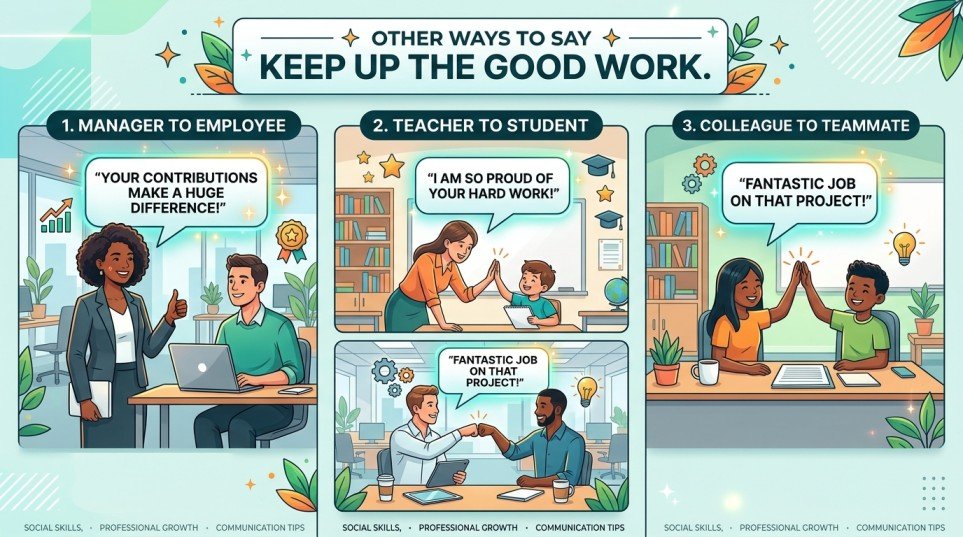
Quick Answer: Instead of saying keep up the good work, you can use phrases like great job, you’re doing excellent work, keep it up, fantastic effort, continue the great work.
The phrase “keep up the good work” is a common expression used to encourage someone to continue performing well. It shows appreciation, recognition, and support for a person’s efforts.
While the phrase is widely understood, using it repeatedly can make your communication sound predictable. Native English speakers often use a variety of expressions to praise achievements and motivate others.
Learning alternatives to “keep up the good work” helps you sound more fluent and engaging. It also improves your ability to adapt your language to different situations, whether you’re speaking with friends, colleagues, students, or team members. These phrases can also help you express excitement in English and deliver encouragement more effectively.
Quick Categories Section
Formal alternatives to “keep up the good work”
- Continue your excellent work
- Your efforts are greatly appreciated
- Maintain the high standard
- Keep achieving great results
Pro Tip: Use these phrases in reports, evaluations, and professional correspondence.
Casual alternatives
- Keep it up
- Great job
- You’re doing awesome
- Nicely done
Pro Tip: These work well among friends, family, and casual conversations.
Professional alternatives
- Excellent work so far
- Continue the great work
- You’re making a valuable contribution
- Keep delivering strong results
Pro Tip: Professional praise should sound encouraging without being overly emotional.
Informal expressions
- You’re crushing it
- Way to go
- You’re on fire
- Keep rocking
Pro Tip: Save highly informal expressions for relaxed environments.
“The right words of encouragement can boost confidence and motivation instantly.”
Common Mistakes
- Overusing the same phrase
Example: Repeating “keep up the good work” in every feedback session.
- Being too generic
Example: Saying “good job” without specifying what was done well.
- Using informal praise in professional settings
Example: “You’re crushing it!” in a formal performance review.
- Giving praise without sincerity
Example: Using encouragement that sounds automatic or forced.
- Ignoring the audience
Example: Using workplace language with children or students.
What Does “Keep Up the Good Work” Mean?
The phrase means continue performing well and maintain your current level of success or effort.
It is commonly used as encouragement after someone has already demonstrated positive performance.
Example Sentence:
You’ve made excellent progress this month. Keep up the good work.
When to Use “Keep Up the Good Work”
- Praising employee performance
- Encouraging students
- Motivating teammates
- Recognizing achievements
- Supporting personal goals
Spoken vs Written: Common in both forms
Formal vs Informal: Neutral and versatile
Is It Professional or Polite to Say “Keep Up the Good Work”?
Polite? ✔️ Yes
Professional? ✔️ Yes
Business Example:
“Your attention to detail has significantly improved project quality. Keep up the good work.”
Pros and Cons of Using “Keep Up the Good Work”
Pros
- Simple and clear
- Encouraging tone
- Universally understood
- Suitable for many situations
Cons
- Can become repetitive
- Sometimes sounds generic
- Lacks personalization
- May feel less impactful over time
“Specific praise often creates a stronger impact than general compliments.”
Other Ways to Say “Keep Up the Good Work” (With Examples)
These alternatives will help you sound more fluent, confident, and natural in different situations.
Use them according to tone, context, and audience to provide encouragement, appreciation, or motivation.
1. Phrase: Keep it up
Meaning: Continue doing well.
Explanation: A short and common expression of encouragement.
Example Sentence: You’re making great progress. Keep it up!
Best Use: casual praise
Worst Use: formal reports
Tone: encouraging, friendly
Context Variability: casual / spoken
2. Phrase: Great job
Meaning: Recognition for excellent performance.
Explanation: One of the most common praise expressions.
Example Sentence: Great job on completing the project ahead of schedule.
Best Use: general praise
Worst Use: detailed evaluations
Tone: positive, supportive
Context Variability: casual / professional
3. Phrase: You’re doing excellent work
Meaning: The quality of work is outstanding.
Explanation: Professional and specific encouragement.
Example Sentence: You’re doing excellent work on this account.
Best Use: workplace feedback
Worst Use: casual jokes
Tone: professional, appreciative
Context Variability: professional / written
4. Phrase: Continue the great work
Meaning: Maintain your current success.
Explanation: A professional variation of the original phrase.
Example Sentence: Continue the great work you’ve been doing.
Best Use: business communication
Worst Use: playful conversations
Tone: professional, motivating
Context Variability: professional
5. Phrase: Fantastic effort
Meaning: Recognition of hard work and dedication.
Explanation: Focuses on effort rather than results.
Example Sentence: Fantastic effort on today’s presentation.
Best Use: motivation
Worst Use: formal reports
Tone: enthusiastic, positive
Context Variability: casual / professional
“Encouragement becomes more meaningful when it highlights effort and progress.”
6. Phrase: Well done
Meaning: You performed successfully.
Explanation: A classic phrase suitable for many contexts.
Example Sentence: Well done on achieving your goals.
Best Use: general praise
Worst Use: highly detailed reviews
Tone: positive, respectful
Context Variability: casual / professional
7. Phrase: Outstanding work
Meaning: Exceptionally high-quality performance.
Explanation: Strong praise for impressive results.
Example Sentence: Outstanding work on the client proposal.
Best Use: workplace recognition
Worst Use: minor tasks
Tone: professional, appreciative
Context Variability: professional
8. Phrase: You’re doing great
Meaning: Performance is going very well.
Explanation: Friendly and encouraging.
Example Sentence: You’re doing great, keep moving forward.
Best Use: motivation
Worst Use: formal documentation
Tone: supportive, warm
Context Variability: casual / spoken
9. Phrase: Excellent work so far
Meaning: Current performance is excellent.
Explanation: Encourages continued success.
Example Sentence: Excellent work so far on the campaign.
Best Use: workplace feedback
Worst Use: casual banter
Tone: professional, encouraging
Context Variability: professional
10. Phrase: Nice work
Meaning: Good performance.
Explanation: Casual and positive.
Example Sentence: Nice work on fixing that issue quickly.
Best Use: everyday praise
Worst Use: formal evaluations
Tone: friendly, positive
Context Variability: casual
11. Phrase: Way to go
Meaning: Congratulations on success.
Explanation: Celebrates achievement enthusiastically.
Example Sentence: Way to go! You exceeded your target.
Best Use: achievements
Worst Use: formal reports
Tone: enthusiastic, casual
Context Variability: casual
12. Phrase: You’re making great progress
Meaning: Improvement is noticeable.
Explanation: Focuses on development.
Example Sentence: You’re making great progress in your studies.
Best Use: coaching
Worst Use: quick praise
Tone: encouraging, supportive
Context Variability: casual / professional
13. Phrase: Keep delivering excellent results
Meaning: Continue achieving success.
Explanation: Professional encouragement.
Example Sentence: Keep delivering excellent results for the team.
Best Use: workplace
Worst Use: personal chats
Tone: professional, motivating
Context Variability: professional
14. Phrase: You’re on the right track
Meaning: Current actions are leading to success.
Explanation: Encourages continued effort.
Example Sentence: You’re on the right track, keep going.
Best Use: coaching
Worst Use: formal praise letters
Tone: supportive, motivating
Context Variability: casual / professional
15. Phrase: Impressive work
Meaning: Work has exceeded expectations.
Explanation: Highlights strong performance.
Example Sentence: Impressive work on such a challenging project.
Best Use: recognition
Worst Use: minor tasks
Tone: appreciative, positive
Context Variability: professional
“Recognition is most effective when it acknowledges specific achievements.”
16. Phrase: Maintain the great momentum
Meaning: Continue progressing successfully.
Explanation: Encourages sustained effort.
Example Sentence: Maintain the great momentum you’ve built.
Best Use: professional growth
Worst Use: casual jokes
Tone: motivating, professional
Context Variability: professional
17. Phrase: Keep pushing forward
Meaning: Continue making progress.
Explanation: Motivational encouragement.
Example Sentence: Keep pushing forward toward your goals.
Best Use: motivation
Worst Use: formal reports
Tone: inspiring, positive
Context Variability: casual / professional
18. Phrase: You’re doing an amazing job
Meaning: Performance is exceptional.
Explanation: Strong praise.
Example Sentence: You’re doing an amazing job leading the team.
Best Use: appreciation
Worst Use: formal reviews
Tone: enthusiastic, supportive
Context Variability: casual / professional
19. Phrase: Keep achieving great things
Meaning: Continue succeeding.
Explanation: Future-focused encouragement.
Example Sentence: Keep achieving great things in your career.
Best Use: inspiration
Worst Use: task-specific feedback
Tone: uplifting, positive
Context Variability: professional
20. Phrase: You’re making a difference
Meaning: Contributions are meaningful.
Explanation: Recognizes impact.
Example Sentence: You’re making a difference with your work.
Best Use: recognition
Worst Use: casual games
Tone: appreciative, motivating
Context Variability: professional
21. Phrase: Keep striving for excellence
Meaning: Continue aiming for high standards.
Explanation: Encourages ambition.
Example Sentence: Keep striving for excellence in everything you do.
Best Use: professional development
Worst Use: casual praise
Tone: professional, inspiring
Context Variability: professional
22. Phrase: Bravo
Meaning: Excellent performance.
Explanation: A concise expression of praise.
Example Sentence: Bravo on your successful presentation.
Best Use: achievements
Worst Use: corporate reports
Tone: celebratory, positive
Context Variability: spoken
23. Phrase: You’re crushing it
Meaning: You’re performing exceptionally well.
Explanation: Highly informal praise.
Example Sentence: You’re crushing it this quarter.
Best Use: casual workplace culture
Worst Use: formal reviews
Tone: energetic, informal
Context Variability: casual
24. Phrase: Excellent effort
Meaning: Hard work is recognized.
Explanation: Focuses on dedication.
Example Sentence: Excellent effort on this assignment.
Best Use: education
Worst Use: executive evaluations
Tone: supportive, encouraging
Context Variability: casual / professional
25. Phrase: Keep reaching higher
Meaning: Continue improving.
Explanation: Motivational expression.
Example Sentence: Keep reaching higher and challenging yourself.
Best Use: personal growth
Worst Use: routine tasks
Tone: inspiring, positive
Context Variability: casual / professional
26. Phrase: You’re setting a great example
Meaning: Others can learn from your actions.
Explanation: Recognizes leadership.
Example Sentence: You’re setting a great example for the team.
Best Use: leadership praise
Worst Use: minor accomplishments
Tone: respectful, appreciative
Context Variability: professional
27. Phrase: Keep the momentum going
Meaning: Continue current success.
Explanation: Encourages consistency.
Example Sentence: Keep the momentum going into next month.
Best Use: team motivation
Worst Use: casual greetings
Tone: motivating, energetic
Context Variability: professional
28. Phrase: Superb work
Meaning: Extremely high-quality work.
Explanation: Strong compliment.
Example Sentence: Superb work on the final report.
Best Use: recognition
Worst Use: minor tasks
Tone: appreciative, positive
Context Variability: professional
29. Phrase: Keep shining
Meaning: Continue succeeding and standing out.
Explanation: Warm and encouraging.
Example Sentence: Keep shining and sharing your talents.
Best Use: personal encouragement
Worst Use: formal evaluations
Tone: warm, uplifting
Context Variability: casual
30. Phrase: Continue exceeding expectations
Meaning: Keep performing above standards.
Explanation: Professional recognition.
Example Sentence: Continue exceeding expectations with your excellent work.
Best Use: workplace praise
Worst Use: casual conversation
Tone: professional, appreciative
Context Variability: professional / written
“The best praise is specific, sincere, and matched to the situation.”
Mini Quiz / Self-Check
1. Which phrase is most professional?
A. You’re crushing it
B. Continue exceeding expectations
C. Way to go
Answer: B
2. Which phrase is most informal?
A. Outstanding work
B. Keep delivering excellent results
C. You’re crushing it
Answer: C
3. Which phrase focuses on improvement?
A. You’re making great progress
B. Bravo
C. Superb work
Answer: A
Comparison Table: Top Alternatives
| Phrase | Tone | Best Use |
|---|---|---|
| Keep it up | Casual | Everyday encouragement |
| Great job | Positive | General praise |
| You’re doing excellent work | Professional | Workplace feedback |
| Continue the great work | Professional | Business communication |
| Well done | Neutral | General recognition |
| Outstanding work | Professional | Major achievements |
| Excellent work so far | Professional | Progress reviews |
| You’re making great progress | Supportive | Coaching |
| Keep delivering excellent results | Professional | Employee feedback |
| Continue exceeding expectations | Professional | Performance recognition |
FAQs
1. What are the best alternatives to “keep up the good work”?
Some of the best alternatives include great job, keep it up, outstanding work, and continue the great work.
2. Is “keep up the good work” professional?
Yes. It is both polite and professional, making it suitable for workplace communication.
3. What can managers say instead of “keep up the good work”?
Managers can use phrases like excellent work so far, keep delivering strong results, or continue exceeding expectations.
4. Are there casual alternatives to “keep up the good work”?
Yes. Popular casual alternatives include keep it up, way to go, and you’re crushing it.
5. Why should I learn other ways to say “keep up the good work”?
Using different expressions helps improve fluency, avoid repetition, and make praise sound more genuine.
Conclusion
Learning other ways to say “keep up the good work” helps you provide encouragement in a more natural, engaging, and effective way. Different situations call for different levels of formality, and having multiple options improves your communication skills.
Practice these phrases regularly and pay attention to tone and context. The more variety you use, the more confident and fluent your English will sound.
CTA: Which alternative do you use most often? Try incorporating a new one into your next conversation.
Discover More:-
- Other Ways to Say I Will Keep You Updated (30+ Examples)
- Other Ways to Say Thank You for the Confirmation (30+ Examples)

Lisa Thompson is a USA-based content writer and language specialist focused on grammar, writing improvement and digital publishing.
She holds a degree in English Language and Communication and has professional experience in educational and web content creation.
As the author of Gramtivo.Com, she aims to help readers improve their writing skills through clear and practical guidance.