
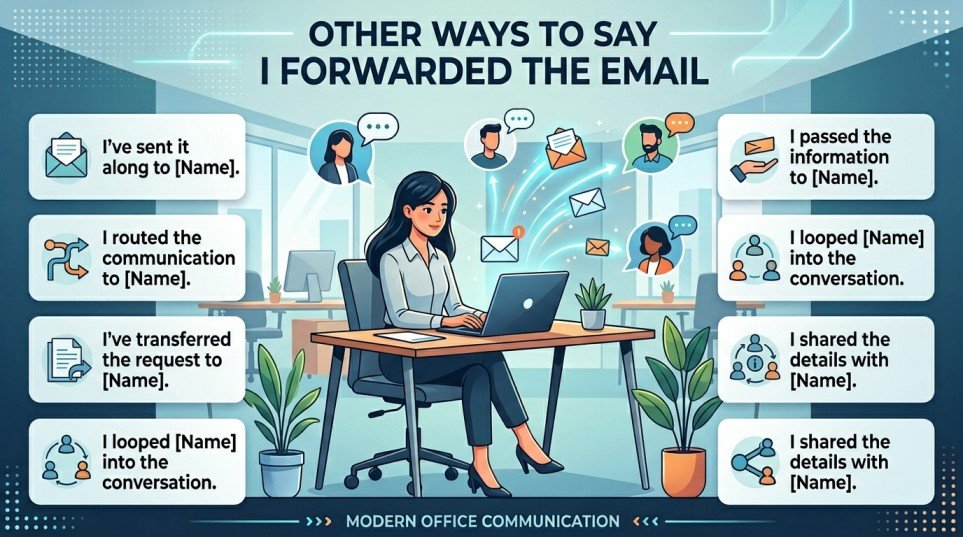
Quick Answer: Instead of saying I forwarded the email, you can say I’ve passed it along, I shared the email with them, I sent it over, I relayed the message, or I’ve forwarded it for your review.
The phrase “I forwarded the email” is commonly used in workplace communication to indicate that an email has been sent to another person for review, action, or information.
Although the phrase is clear and professional, using it repeatedly can make your emails sound repetitive. Native speakers often use different expressions depending on the audience, formality level, and purpose of the message.
Learning alternatives to “I forwarded the email” can help you write more naturally and professionally. These phrases improve your communication skills, enhance workplace writing, and expand your vocabulary for business English.
Quick Categories Section
Formal alternatives to “I forwarded the email”
- I have forwarded the correspondence
- I have transmitted the email
- I have sent the message onward
- I have directed the email accordingly
Pro Tip: Use these phrases in formal business correspondence and client communications.
Casual alternatives
- I passed it along
- I sent it over
- I shared it with them
- I shot it over
Pro Tip: These work well with colleagues and familiar contacts.
Professional alternatives
- I forwarded it for your review
- I have shared the email with the team
- I have copied the relevant parties
- I relayed the information
Pro Tip: These phrases add clarity and context in workplace communication.
Informal expressions
- I sent it their way
- I got it over to them
- I passed the message on
- I sent it across
Pro Tip: Reserve these for casual conversations rather than formal emails.
“Professional communication sounds stronger when you vary your vocabulary.”
Common Mistakes
- Repeating the same phrase in every email
Example: “I forwarded the email” multiple times in one thread. - Using casual phrases with clients
Example: “I shot it over” may sound too informal. - Not specifying the recipient
Example: “I forwarded it” without saying to whom. - Using unclear wording
Example: “I dealt with it” doesn’t indicate an email was forwarded. - Mixing formal and informal tone
Example: “I have transmitted the email” followed by “I shot it over.”
What Does “I Forwarded the Email” Mean?
The phrase “I forwarded the email” means that you sent an email you received to another person or group.
Grammatically, it uses the past tense verb forwarded to describe a completed action.
Example Sentence:
I forwarded the email to the finance department this morning.
When to Use “I Forwarded the Email”
- When sharing information with another person
- When escalating a request
- When transferring communication
- During project collaboration
- In internal and external business communication
Spoken vs Written: Mostly written, but also used in workplace conversations.
Formal vs Informal: Generally professional and neutral.
Is It Professional or Polite to Say “I Forwarded the Email”?
Polite? ✔️ Yes
Professional? ✔️ Yes
Business Example:
“I forwarded the email to the project manager for further review.”
Pros and Cons of Using “I Forwarded the Email”
Pros
- Clear and direct
- Widely understood
- Professional tone
- Suitable for workplace communication
Cons
- Can become repetitive
- Lacks variety
- Sounds mechanical when overused
- May not provide enough context
“A small change in wording can make your emails sound more polished and professional.”
Other Ways to Say “I Forwarded the Email” (With Examples)
These alternatives will help you sound more fluent, confident, and professional in workplace communication.
Use them according to the level of formality, audience, and purpose of your message.
1. Phrase: I passed it along
Meaning: I sent the information to another person.
Explanation: A common and friendly alternative.
Example Sentence: I passed it along to the marketing team.
Best Use: team communication
Worst Use: legal correspondence
Tone: casual, friendly
Context Variability: casual / workplace
2. Phrase: I sent it over
Meaning: I sent the email to someone.
Explanation: Common in business communication.
Example Sentence: I sent it over this morning.
Best Use: colleague emails
Worst Use: formal reports
Tone: professional, conversational
Context Variability: professional / spoken
3. Phrase: I shared the email with them
Meaning: I provided the email to another person.
Explanation: Clear and straightforward.
Example Sentence: I shared the email with the leadership team.
Best Use: workplace updates
Worst Use: legal documents
Tone: neutral, professional
Context Variability: professional
4. Phrase: I relayed the information
Meaning: I communicated the message onward.
Explanation: Focuses on the information rather than the email itself.
Example Sentence: I relayed the information to the department head.
Best Use: formal updates
Worst Use: casual chat
Tone: formal, professional
Context Variability: professional
5. Phrase: I forwarded it for your review
Meaning: I sent it so someone could examine it.
Explanation: Common in professional settings.
Example Sentence: I forwarded it for your review yesterday.
Best Use: workplace communication
Worst Use: casual texting
Tone: professional, courteous
Context Variability: professional
“The best business communicators choose words that match the audience and purpose.”
6. Phrase: I sent the message onward
Meaning: I transmitted the email to another recipient.
Explanation: Formal and clear.
Example Sentence: I sent the message onward to the relevant department.
Best Use: formal communication
Worst Use: casual conversations
Tone: formal, professional
Context Variability: professional
7. Phrase: I have shared it with the team
Meaning: The team has received the email.
Explanation: Highlights the recipient group.
Example Sentence: I have shared it with the team for feedback.
Best Use: workplace updates
Worst Use: personal messages
Tone: professional, collaborative
Context Variability: professional
8. Phrase: I copied the relevant parties
Meaning: I included others in the communication.
Explanation: Often used when CCing people.
Example Sentence: I copied the relevant parties on the email.
Best Use: project management
Worst Use: casual chats
Tone: professional, precise
Context Variability: professional
9. Phrase: I directed the email to them
Meaning: I sent the email to the intended recipient.
Explanation: More formal wording.
Example Sentence: I directed the email to the appropriate contact.
Best Use: business communication
Worst Use: casual workplace chat
Tone: formal, professional
Context Variability: professional
10. Phrase: I transmitted the email
Meaning: I sent the email electronically.
Explanation: Highly formal expression.
Example Sentence: I transmitted the email earlier today.
Best Use: formal correspondence
Worst Use: everyday office chat
Tone: formal, technical
Context Variability: professional
11. Phrase: I passed the message on
Meaning: I communicated the information to someone else.
Explanation: Common and natural.
Example Sentence: I passed the message on to management.
Best Use: workplace updates
Worst Use: legal writing
Tone: friendly, neutral
Context Variability: casual / professional
12. Phrase: I shared it internally
Meaning: I distributed the email within the organization.
Explanation: Useful in business environments.
Example Sentence: I shared it internally for review.
Best Use: corporate communication
Worst Use: personal discussions
Tone: professional, concise
Context Variability: professional
13. Phrase: I routed the email
Meaning: I directed the email to the correct recipient.
Explanation: Common in administrative settings.
Example Sentence: I routed the email to customer support.
Best Use: operations teams
Worst Use: casual conversations
Tone: professional, technical
Context Variability: professional
14. Phrase: I sent it their way
Meaning: I forwarded it to them.
Explanation: Casual and conversational.
Example Sentence: I sent it their way this afternoon.
Best Use: colleague conversations
Worst Use: client emails
Tone: casual, friendly
Context Variability: casual
15. Phrase: I got it over to them
Meaning: I successfully sent it.
Explanation: Informal workplace phrase.
Example Sentence: I got it over to them before lunch.
Best Use: team chats
Worst Use: formal communication
Tone: informal, conversational
Context Variability: casual
“Using varied professional reaction phrases improves clarity and credibility.”
16. Phrase: I sent it across
Meaning: I delivered the email to someone.
Explanation: Common in international business English.
Example Sentence: I sent it across to the HR team.
Best Use: workplace communication
Worst Use: legal documents
Tone: professional, neutral
Context Variability: professional
17. Phrase: I forwarded the correspondence
Meaning: I sent the communication onward.
Explanation: More formal than “email.”
Example Sentence: I forwarded the correspondence to our advisor.
Best Use: formal business writing
Worst Use: casual chats
Tone: formal, professional
Context Variability: professional
18. Phrase: I circulated the email
Meaning: I distributed the email to multiple people.
Explanation: Useful for group communication.
Example Sentence: I circulated the email among the stakeholders.
Best Use: team projects
Worst Use: one-on-one chats
Tone: professional, formal
Context Variability: professional
19. Phrase: I distributed the message
Meaning: I shared the email with several recipients.
Explanation: Emphasizes broad sharing.
Example Sentence: I distributed the message to all departments.
Best Use: announcements
Worst Use: personal emails
Tone: formal, professional
Context Variability: professional
20. Phrase: I referred the email onward
Meaning: I passed the communication to another person.
Explanation: Often used when transferring responsibility.
Example Sentence: I referred the email onward for action.
Best Use: support requests
Worst Use: casual use
Tone: formal, administrative
Context Variability: professional
21. Phrase: I escalated the email
Meaning: I sent it to someone with higher authority.
Explanation: Common in support and management.
Example Sentence: I escalated the email to senior management.
Best Use: issue resolution
Worst Use: routine updates
Tone: professional, authoritative
Context Variability: professional
22. Phrase: I submitted it to the team
Meaning: I provided the email for consideration.
Explanation: Useful in collaborative environments.
Example Sentence: I submitted it to the team for discussion.
Best Use: project work
Worst Use: casual conversations
Tone: professional, collaborative
Context Variability: professional
23. Phrase: I conveyed the message
Meaning: I communicated the information.
Explanation: Formal and polished.
Example Sentence: I conveyed the message to the director.
Best Use: executive communication
Worst Use: casual texting
Tone: formal, refined
Context Variability: professional
24. Phrase: I transferred the email
Meaning: I moved the communication to another recipient.
Explanation: Direct and professional.
Example Sentence: I transferred the email to the appropriate department.
Best Use: administrative tasks
Worst Use: informal chats
Tone: professional, direct
Context Variability: professional
25. Phrase: I shared the details
Meaning: I passed along the information.
Explanation: Focuses on content rather than the email.
Example Sentence: I shared the details with the client.
Best Use: status updates
Worst Use: technical reporting
Tone: professional, neutral
Context Variability: professional
26. Phrase: I brought it to their attention
Meaning: I made someone aware of the email.
Explanation: Highlights awareness rather than forwarding.
Example Sentence: I brought it to their attention yesterday.
Best Use: important issues
Worst Use: routine updates
Tone: professional, thoughtful
Context Variability: professional
27. Phrase: I delivered the message
Meaning: I ensured the communication reached them.
Explanation: Emphasizes successful transmission.
Example Sentence: I delivered the message to the manager.
Best Use: formal updates
Worst Use: casual office chat
Tone: formal, direct
Context Variability: professional
28. Phrase: I notified them via email
Meaning: I informed them using email.
Explanation: Focuses on notification.
Example Sentence: I notified them via email this morning.
Best Use: official communication
Worst Use: casual conversations
Tone: professional, precise
Context Variability: professional
29. Phrase: I shared the communication
Meaning: I passed the email to another person.
Explanation: Formal business wording.
Example Sentence: I shared the communication with the stakeholders.
Best Use: corporate settings
Worst Use: personal messages
Tone: formal, professional
Context Variability: professional
30. Phrase: I sent it for consideration
Meaning: I forwarded it so others could review it.
Explanation: Useful when approval is needed.
Example Sentence: I sent it for consideration by the committee.
Best Use: approvals
Worst Use: casual chats
Tone: formal, professional
Context Variability: professional
“The most effective workplace writers avoid repetition and choose precise language.”
Mini Quiz / Self-Check
1. Which phrase is best for a formal client email?
A. I got it over to them
B. Transmitted the email
Answer: B
2. Which phrase is most casual?
A. I relayed the information
B. I sent it their way
Answer: B
3. Which phrase works best when sending an email to management for action?
A. I escalated the email
B. Passed it along
Answer: A
Comparison Table: Top Alternatives
| Phrase | Tone | Best Use |
|---|---|---|
| I passed it along | Casual | Team chats |
| I sent it over | Professional | Colleagues |
| I relayed the information | Formal | Reports |
| I forwarded it for your review | Professional | Workplace |
| I shared it with the team | Professional | Collaboration |
| I copied the relevant parties | Professional | Projects |
| I routed the email | Technical | Administration |
| I circulated the email | Formal | Group updates |
| I escalated the email | Professional | Management |
| I conveyed the message | Formal | Executive communication |
FAQs
1. What can I say instead of “I forwarded the email”?
You can say I passed it along, I shared it with the team, or I relayed the information.
2. What is the most professional alternative?
I forwarded it for your review and I relayed the information are highly professional choices.
3. Can I use “I sent it over” in business emails?
Yes, it is professional enough for most workplace communication.
4. Which alternative is best for formal writing?
I transmitted the email and I conveyed the message work well in formal contexts.
5. Why should I use alternatives to “I forwarded the email”?
Using varied language improves clarity, professionalism, and overall communication skills.
Conclusion
Learning other ways to say “I forwarded the email” helps you write more effectively and avoid repetitive business language. Different situations require different tones, and these alternatives allow you to communicate with greater precision.
Practice using these phrases in emails, reports, and workplace conversations. The more variety you develop, the more polished and professional your communication will sound.
CTA: Which alternative do you use most often in emails? Try introducing a new one in your next message.
Discover More:-
- Other Ways to Say At Your Earliest Convenience (30+ Examples)
- Other Ways to Say Please Let Me Know Your Availability (30+ Examples)

Lisa Thompson is a USA-based content writer and language specialist focused on grammar, writing improvement and digital publishing.
She holds a degree in English Language and Communication and has professional experience in educational and web content creation.
As the author of Gramtivo.Com, she aims to help readers improve their writing skills through clear and practical guidance.