
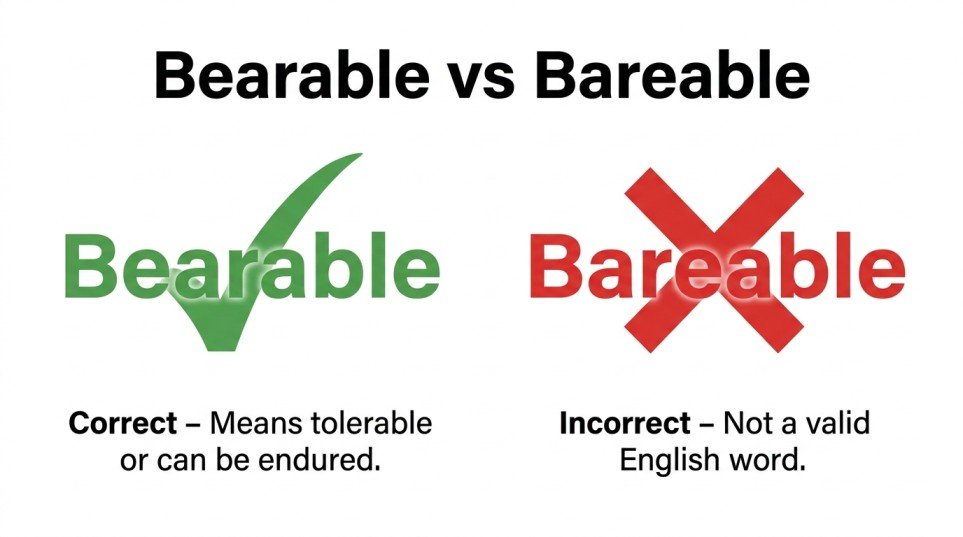
Quick Ans: The correct spelling is bearable, which means something is tolerable or can be endured. The word bareable is incorrect in standard English and should not be used. If you mean “able to tolerate,” always choose bearable.
Many writers get confused about bearable or bareable. The two words sound the same when spoken. However, only one is correct in standard English.
This confusion often happens because both “bear” and “bare” are real words. Each has its own meaning. Still, only one form works when you want to describe something that can be endured.
For example, people may write “the heat is bareable.” That looks close, but it is not correct. The right spelling is “the heat is bearable.”
Understanding the difference between bearable or bareable helps you avoid spelling mistakes. It also improves your writing clarity and professionalism.
In this guide, you will learn definitions, examples, common mistakes, memory tips, and practice exercises. By the end, you will confidently use the correct spelling every time.
Quick Answer: Bearable or Bareable
Here is the simple answer:
| Word | Correct? | Meaning |
|---|---|---|
| Bearable | Yes | Able to be tolerated or endured |
| Bareable | No | Not a standard English word |
In short, always use bearable when you mean something is tolerable.
What Does Bearable Mean?
The word bearable comes from the verb “bear,” which means to carry, endure, or tolerate something.
Simple Definition
Bearable means something you can handle, even if it is unpleasant.
Examples
- The pain is bearable after taking medicine.
- The weather is hot but still bearable.
- The noise became less bearable over time.
Easy Explanation
Think of “bear” as “carry.” If you can carry the discomfort, it is bearable.
What Does Bareable Mean?
The word bareable is not a correct English word. It appears due to confusion with the word “bare.”
Why People Use It
People often mix up:
- Bear (to endure)
- Bare (meaning empty or uncovered)
Because they sound the same, some writers incorrectly form “bareable.”
Correct Understanding
“Bare” does not relate to tolerance or endurance. Therefore, “bareable” is incorrect and should be avoided.
Key Differences Between Bearable or Bareable
Spelling
- Bearable is the correct spelling.
- Bareable is incorrect.
Meaning
- Bearable relates to tolerance or endurance.
- Bareable has no valid meaning in English.
Usage
- Use bearable in all situations where something can be endured.
- Avoid using bareable entirely.
Advantages and Disadvantages
Using Bearable Correctly
Advantages:
- Improves writing accuracy
- Enhances clarity
- Builds credibility
Disadvantages:
- Requires understanding spelling rules
Using Bareable Incorrectly
Disadvantages:
- Causes confusion
- Looks unprofessional
- May reduce writing quality
Therefore, choosing the correct word in bearable or bareable is important.
Real World Examples
Everyday Conversation
- “The traffic was bad, but it was bearable.”
- “The cold weather feels bearable today.”
Writing and Emails
Using correct spelling in professional writing matters.
Correct:
- “The workload is heavy but bearable.”
Incorrect:
- “The workload is heavy but bareable.”
Academic Writing
Students must use correct spelling to maintain quality writing.
Common Mistakes About Bearable or Bareable
Confusing “Bear” and “Bare”
“Bear” relates to endurance. “Bare” means empty or uncovered.
Writing Based on Sound
Because both words sound the same, people spell them incorrectly.
Ignoring Spell Check
Sometimes writers ignore spelling tools that highlight “bareable” as incorrect.
Quick Fix
Whenever in doubt, remember:
- Bear = endure
- Bearable = can endure
Beginner to Advanced Usage Tips
Beginner Level
Always remember that bearable is the only correct form.
Intermediate Level
Use context to check meaning. If the sentence talks about tolerance, use bearable.
Advanced Level
Understand related words:
- Bear (verb)
- Bearing (endurance or direction)
- Unbearable (not tolerable)
This deeper understanding improves writing accuracy.
Step By Step Usage Scenario
Imagine you are describing hot weather.
Incorrect sentence:
- “The heat is bareable.”
Correct steps:
- Identify meaning (tolerable)
- Choose correct root word (bear)
- Use correct spelling (bearable)
Final sentence:
- “The heat is bearable.”
Exercises With Answers
Exercise 1
Which is correct: bearable or bareable?
Answer: Bearable.
Exercise 2
Fill in the blank: The pain was ______.
Answer: Bearable.
Exercise 3
True or False: Bareable is a correct English word.
Answer: False.
Exercise 4
Which word means “able to endure”?
Answer: Bearable.
Exercise 5
Correct the sentence: The noise was bareable.
Answer: The noise was bearable.
Related Concepts and Comparisons
Bear vs Bare
| Word | Meaning | Example |
|---|---|---|
| Bear | To endure or carry | I can bear the pain |
| Bare | Empty or uncovered | The room is bare |
Bearable vs Unbearable
- Bearable = tolerable
- Unbearable = not tolerable
Understanding these related words helps avoid confusion.
When Should You Use Bearable?
Use bearable when:
- Describing pain
- Talking about weather
- Explaining discomfort
- Expressing tolerance
Avoid bareable in all situations.
FAQs About Bearable or Bareable
Which is correct, bearable or bareable?
The correct spelling is bearable. The word bareable is incorrect in standard English.
Is bareable ever correct?
No. In the bearable or bareable comparison, only bearable is valid.
What does bearable mean?
It means something can be tolerated or endured.
Why do people write bareable?
People confuse “bear” and “bare” because they sound the same.
How can I remember the correct spelling?
Think of “bear” as “endure.” Therefore, bearable means something you can endure.
Is bearable formal or informal?
It works in both formal and informal writing.
What is the opposite of bearable?
The opposite is “unbearable,” meaning not tolerable.
Can I use bearable in academic writing?
Yes. It is a correct and standard English word.
Does bareable appear in dictionaries?
No. It is not recognized as a valid English word.
Is this a common mistake in English?
Yes. Many learners confuse bearable or bareable due to similar pronunciation.
Conclusion
Understanding bearable or bareable is simple once you know the rule. Only bearable is correct, and it means something can be tolerated or endured. The word bareable is a common spelling mistake and should not be used.
The confusion comes from similar sounding words like “bear” and “bare.” However, their meanings differ completely. “Bear” relates to endurance, while “bare” refers to something empty or uncovered.
Using the correct spelling improves writing clarity and professionalism. It also prevents confusion in both casual and formal communication.
Whenever you feel unsure, remember this simple idea: if you can endure it, it is bearable. This quick check will help you avoid mistakes every time.
By applying what you learned in this guide, you can confidently choose the correct word in the bearable or bareable comparison.
Discover More:-
- GT vs Duke: Key Differences, Performance, and Buying Guide
- Cellentani vs Cavatappi: Differences, Uses, and Best Pasta Guide

Jennifer Collins is a professional grammar expert and language educator at gramtivo.com, specializing in English grammar, writing skills, and language improvement. She holds a Master’s degree in English Language and Literature from a recognized university in the United States. With years of teaching and content development experience, she is dedicated to helping learners improve their communication skills with clear and practical guidance.