
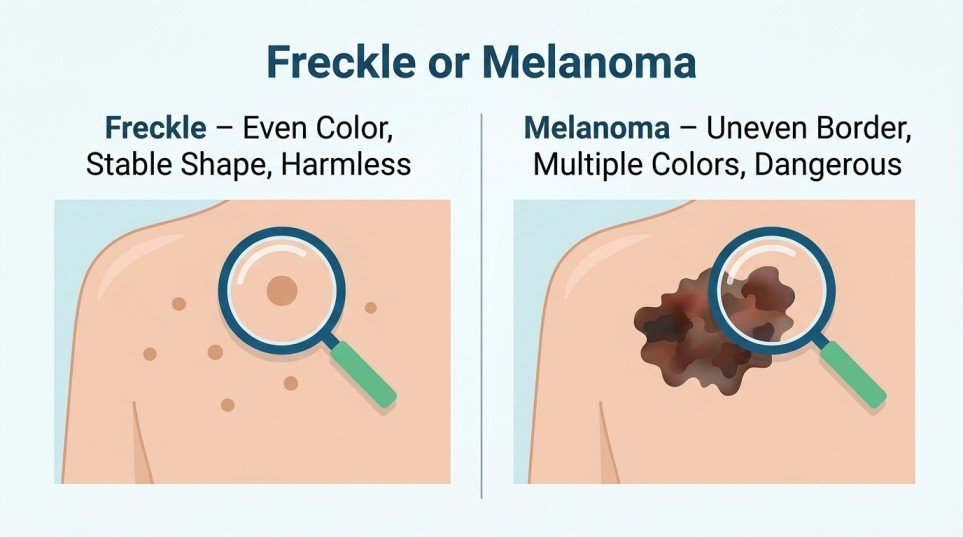
Quick Ans: The main difference between a freckle or melanoma is that freckles are harmless small spots caused by sun exposure, while melanoma is a dangerous type of skin cancer that can grow and spread. Freckles are usually even in color and shape, whereas melanoma often changes in size, color, or appearance over time.
Many people become worried when they notice a new spot on their skin. Some spots are harmless freckles. Others may be signs of skin cancer. Because of this, people often search for freckle or melanoma to understand the difference.
At first glance, the two can look similar. Both may appear as small brown spots on the skin. However, important differences exist.
Freckles are common and usually harmless. Sun exposure often causes them to appear or darken. Melanoma, on the other hand, is a serious medical condition that requires early treatment.
Understanding the warning signs can help protect your health. Early detection greatly improves treatment success for melanoma. Therefore, learning how to recognize suspicious skin changes is extremely important.
This guide explains the differences between freckles and melanoma in simple language. You will learn causes, symptoms, warning signs, examples, common mistakes, and practical skin checking tips.
Quick Answer: Freckle or Melanoma
The easiest way to compare freckle or melanoma is by looking at shape, color, and change over time.
| Feature | Freckle | Melanoma |
|---|---|---|
| Harmful? | Usually harmless | Dangerous skin cancer |
| Shape | Small and even | Uneven or irregular |
| Color | Uniform color | Multiple colors |
| Change Over Time | Usually stable | Often changes |
| Texture | Flat and smooth | May become raised |
In simple terms, freckles remain stable while melanoma often changes and looks irregular.
What Is a Freckle?
A freckle is a small flat spot that appears on the skin. These spots develop because of increased melanin production caused by sunlight.
Freckles commonly appear on:
- Face
- Arms
- Shoulders
- Neck
- Hands
People with lighter skin tones often develop freckles more easily.
Why Freckles Form
Sun exposure triggers melanin production in the skin. Instead of tanning evenly, some areas produce concentrated pigment spots.
As a result, freckles become more visible after spending time outdoors.
Common Freckle Characteristics
Freckles usually have several clear features:
- Small size
- Round shape
- Even color
- Flat surface
- Stable appearance
Most freckles are harmless and painless.
Types of Freckles
Two common types exist:
Ephelides
These are traditional freckles caused by sunlight. They often appear during summer and fade during winter.
Solar Lentigines
These spots are sometimes called age spots or sun spots. They develop after long term sun exposure and may not fade easily.
What Is Melanoma?
Melanoma is a serious type of skin cancer that develops in pigment producing cells called melanocytes.
Although melanoma is less common than other skin cancers, it is far more dangerous because it can spread to other parts of the body.
Common Melanoma Locations
Melanoma can appear almost anywhere, including:
- Face
- Back
- Legs
- Arms
- Scalp
- Under nails
Sometimes melanoma develops in places that receive little sunlight.
Why Melanoma Happens
Several risk factors increase melanoma risk:
- Excessive sun exposure
- Tanning beds
- Family history
- Fair skin
- Frequent sunburns
DNA damage inside skin cells can trigger abnormal growth.
Common Melanoma Characteristics
Melanoma often shows warning signs such as:
- Irregular borders
- Uneven colors
- Growing size
- Itching or bleeding
- Shape changes
Unlike freckles, melanoma usually changes over time.
Key Differences Between Freckle or Melanoma
Shape
Freckles are usually round and symmetrical. Melanoma often has uneven or jagged edges.
Color
Most freckles contain one consistent shade of brown. Melanoma may include black, brown, red, pink, or blue shades.
Size
Freckles are generally small. Melanoma can grow larger over time.
Change
Stable appearance is common with freckles. Melanoma frequently changes in shape, size, or color.
Texture
Freckles remain flat and smooth. Melanoma may become raised or rough.
The ABCDE Rule for Melanoma
Doctors often use the ABCDE rule to evaluate suspicious spots.
| Letter | Meaning | Warning Sign |
|---|---|---|
| A | Asymmetry | One side differs from the other |
| B | Border | Uneven or blurred edges |
| C | Color | Multiple colors present |
| D | Diameter | Larger than 6 mm |
| E | Evolving | Changing appearance |
This method helps identify possible melanoma early.
Advantages and Disadvantages of Monitoring Skin at Home
Advantages
Checking your skin regularly can:
- Help detect melanoma early
- Increase awareness of changes
- Improve treatment success
- Reduce anxiety through monitoring
Disadvantages
However, self diagnosis also has limitations:
- Freckles and melanoma can look similar
- Anxiety may increase unnecessarily
- Some melanomas appear unusual
- Professional evaluation may still be needed
Therefore, medical advice remains important for suspicious changes.
Real World Examples
Example 1: Harmless Freckle
A small light brown spot appears on the shoulder after summer vacation. The spot remains flat and unchanged for years.
This is likely a freckle.
Example 2: Suspicious Melanoma
A dark spot on the arm becomes larger over several months. The edges appear uneven, and different colors develop.
This may indicate melanoma and requires medical attention.
Example 3: Sun Related Changes
A person notices many freckles becoming darker after beach exposure. During winter, the spots fade slightly.
This pattern commonly happens with freckles.
Regional and Global Usage
Sunny Regions
Freckles appear more often in sunny climates because ultraviolet exposure increases melanin production.
Countries With High UV Levels
Places with strong sunlight report higher melanoma rates. Australia is one well known example.
Urban and Indoor Lifestyles
People spending less time outdoors may develop fewer freckles. However, melanoma can still occur due to genetics or past sun exposure.
Skin protection matters regardless of location.
Related Concepts and Comparisons
Freckle vs Mole
Freckles are flat pigment spots caused by sunlight. Moles are clusters of pigment producing cells and may be raised.
Mole vs Melanoma
Most moles are harmless. However, some melanomas begin inside existing moles.
Freckle vs Sunspot
Sunspots usually develop later in life after long term sun exposure. Freckles often appear earlier and may fade seasonally.
Freckle or Melanoma vs Skin Rash
Rashes usually involve irritation, redness, or itching across larger areas. Freckles and melanoma are isolated spots.
Common Mistakes About Freckle or Melanoma
Ignoring Changes
Many people assume all spots are harmless. However, changing skin marks should always be monitored carefully.
Assuming Melanoma Is Always Black
Melanoma can appear brown, pink, red, or skin colored.
Believing Only Older Adults Get Melanoma
Although age increases risk, younger people can also develop melanoma.
Skipping Sunscreen
Freckles may darken with sun exposure. More importantly, UV damage increases melanoma risk.
Avoiding these mistakes improves skin health and early detection.
Beginner to Advanced Skin Monitoring Tips
Beginner Level
Start by checking your skin once per month in good lighting.
Intermediate Level
Take photos of moles or freckles to track changes over time.
Advanced Level
Use dermatologist recommended apps or schedule yearly skin examinations.
Professional monitoring provides extra safety for high risk individuals.
Step By Step Skin Check Scenario
Imagine finding a new spot on your arm.
- Check the shape carefully
- Look for uneven borders
- Compare color consistency
- Measure the size
- Watch for changes over several weeks
If the spot changes or appears unusual, contact a dermatologist.
Exercises With Answers
Exercise 1
Which condition is usually harmless in the freckle or melanoma comparison?
Answer: Freckle.
Exercise 2
Which condition commonly changes shape and color?
Answer: Melanoma.
Exercise 3
What does the “E” in the ABCDE rule mean?
Answer: Evolving or changing appearance.
Exercise 4
True or False: Freckles are usually raised above the skin.
Answer: False.
Exercise 5
Which condition requires medical evaluation if suspicious?
Answer: Melanoma.
When Should You See a Doctor?
You should contact a doctor if a skin spot:
- Changes quickly
- Bleeds or crusts
- Becomes painful
- Has uneven borders
- Shows multiple colors
Early diagnosis can save lives.
Dermatologists use tools and biopsies to determine whether a spot is harmless or dangerous.
FAQs About Freckle or Melanoma
What is the main difference between freckle or melanoma?
Freckles are harmless pigment spots, while melanoma is a dangerous form of skin cancer.
Can melanoma look like a freckle?
Yes. Early melanoma may resemble a freckle, which is why monitoring changes is important.
Are freckles dangerous?
Most freckles are harmless and do not require treatment.
How do I know if a spot is melanoma?
Look for uneven shape, color changes, growth, or evolving appearance using the ABCDE rule.
Can freckles turn into melanoma?
Freckles themselves usually do not become melanoma. However, sun damage increases overall skin cancer risk.
Should I worry about new freckles?
New freckles can be normal after sun exposure, but unusual or changing spots should be checked.
Is melanoma always dark brown or black?
No. Melanoma may appear pink, red, brown, or even skin colored.
Can young people get melanoma?
Yes. Although risk increases with age, melanoma can affect younger individuals too.
Do freckles disappear?
Some freckles fade during winter or with reduced sun exposure.
When should I see a dermatologist?
See a dermatologist if a spot changes, grows, bleeds, or looks irregular.
Conclusion
Understanding freckle or melanoma is important for protecting skin health. Freckles are common, harmless pigment spots often caused by sunlight. Melanoma, however, is a dangerous form of skin cancer that requires early detection and treatment.
Several differences help distinguish the two. Freckles usually stay small, even, and stable. Melanoma often changes in color, size, shape, or texture over time.
Regular skin checks can help identify suspicious changes early. Paying attention to the ABCDE warning signs improves awareness and supports faster medical evaluation.
Sun protection also plays a major role in reducing skin damage. Wearing sunscreen, protective clothing, and avoiding excessive ultraviolet exposure can lower melanoma risk.
If you notice unusual skin changes, consult a dermatologist promptly. Early action greatly improves treatment success and long term health outcomes.
Discover More:-
- Outter or Outer: Correct Spelling, Meaning, and Grammar Guide
- Alternately vs Alternatively: Meaning, Differences, and Correct Usage Guide

Lisa Thompson is a USA-based content writer and language specialist focused on grammar, writing improvement and digital publishing.
She holds a degree in English Language and Communication and has professional experience in educational and web content creation.
As the author of Gramtivo.Com, she aims to help readers improve their writing skills through clear and practical guidance.