Quick Ans: The main difference between aca vs aqui is how Spanish speakers refer to location. Both words mean “here,” but aquí usually refers to a precise location, while acá often indicates a broader or less exact area. The choice can also depend on regional Spanish usage and speaking style.
Spanish learners often feel confused when comparing aca vs aqui. Both words translate to “here” in English. Because of this similarity, many people assume they can always use them the same way.
However, that assumption is not completely correct.
Spanish includes several location words that describe distance and position. Words such as aquí, acá, allí, and allá help speakers describe where something is located. Among these, aquí and acá frequently appear in everyday conversation.
The confusion usually happens because both terms refer to the same general idea. Each one means “here,” yet their usage can vary depending on context, tone, and regional preferences.
For example, someone might say “Ven aquí” when pointing to an exact spot. Another speaker might say “Ven acá” when calling someone closer without referring to a precise point.
Understanding aca vs aqui helps Spanish learners communicate more naturally. It also improves listening skills when speaking with native speakers from different countries.
This guide explains the differences clearly. You will learn definitions, examples, advantages, regional usage, common mistakes, and practice exercises.
Quick Answer: Aca vs Aqui
Understanding aca vs aqui becomes easier when you compare their meaning and usage.
| Feature | Aquí | Acá |
|---|---|---|
| Meaning | Here | Here |
| Precision | More specific location | Less specific area |
| Tone | Neutral and formal | More conversational |
| Regional Use | Common in Spain | Common in Latin America |
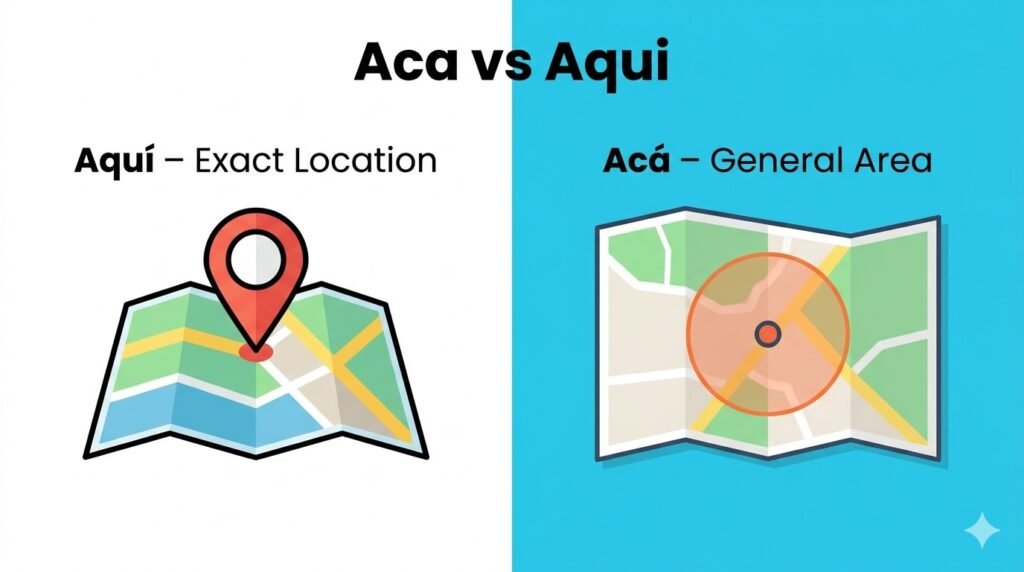
In simple terms, aquí usually refers to a specific place, while acá often describes a general area nearby.
What Does Aquí Mean?
Aquí is a Spanish adverb of place. It refers to a precise location where the speaker currently is.
Speakers often use aquí when they want to indicate an exact point.
Common Uses of Aquí
Here are typical situations where aquí appears:
- Giving directions
- Identifying a specific location
- Pointing to an exact spot
Examples:
- Estoy aquí.
I am here. - Pon el libro aquí.
Put the book here. - El restaurante está aquí.
The restaurant is here.
In each example, the speaker refers to a clear and specific location.
Characteristics of Aquí
Several features make aquí unique:
- Indicates precise position
- Frequently used in formal communication
- Common in both written and spoken Spanish
Because of these characteristics, learners often encounter aquí first when studying Spanish.
What Does Acá Mean?
Acá is also a Spanish adverb of place. It means “here,” but it usually refers to a broader or less exact area.
Instead of pointing to a specific spot, the word suggests general proximity.
Common Uses of Acá
Speakers frequently use acá in everyday conversation.
Examples include:
- Ven acá.
Come here. - Por acá está el parque.
The park is around here. - Qué haces acá?
What are you doing here?
In these sentences, the speaker refers to the general area rather than a precise point.
Characteristics of Acá
Several traits define this word:
- Suggests nearby space
- Sounds more conversational
- Appears frequently in Latin American Spanish
Because of its informal tone, many speakers prefer acá during casual conversations.
Key Differences Between Aca vs Aqui
Precision
The most noticeable difference in aca vs aqui is precision.
- Aquí refers to a specific location.
- Acá refers to a general nearby area.
Tone
Tone also changes the choice of word.
- Aquí sounds slightly more neutral or formal.
- Acá feels more conversational.
Regional Preference
Language patterns differ across Spanish speaking regions.
- Spain commonly uses aquí.
- Latin American countries often prefer acá in speech.
Communication Style
Speakers may choose one word over the other to create a certain tone. For example, acá may sound friendlier when inviting someone closer.
Advantages and Disadvantages
Advantages of Using Aquí
- Provides precise directions
- Works well in formal settings
- Common in written Spanish
Disadvantages of Using Aquí
- May sound less casual in conversation
- Sometimes feels too specific for general situations
Advantages of Using Acá
- Sounds natural in everyday speech
- Works well in casual conversations
- Common across Latin America
Disadvantages of Using Acá
- May sound informal in writing
- Does not always indicate an exact location
Therefore, choosing between aca vs aqui depends on context and communication style.
Real World Examples
Giving Directions
A tour guide might say:
- El museo está aquí.
The museum is here.
This sentence indicates a precise place on a map.
Calling Someone
A parent might say:
- Ven acá un momento.
Come here for a moment.
The sentence simply invites someone closer.
Asking Questions
A friend might ask:
- Qué haces acá?
What are you doing here?
This question refers to the general area rather than a single point.
These examples show how aca vs aqui changes depending on context.
Regional and Global Usage
Spain
In Spain, aquí appears frequently in both spoken and written Spanish.
Latin America
Many Latin American countries prefer acá in daily speech. Countries such as Argentina, Colombia, and Mexico commonly use it in conversations.
Mixed Usage
Some regions use both words interchangeably. Context usually determines which one sounds more natural.
Understanding these patterns helps learners communicate more effectively across Spanish speaking countries.
Related Concepts and Comparisons
Aquí vs Allí
Allí means “there.” It refers to a place farther away from the speaker.
Example:
- El banco está allí.
Acá vs Allá
Allá also means “there,” but it usually indicates a more distant area.
Example:
- La playa está allá.
Spanish Location Words
| Word | Meaning |
|---|---|
| Aquí | Here (specific) |
| Acá | Here (general) |
| Allí | There (specific distance) |
| Allá | There (far area) |
These words work together to describe spatial relationships.
Common Mistakes About Aca vs Aqui
Assuming They Are Always Interchangeable
Both words mean “here,” yet their tone and precision differ.
Ignoring Regional Differences
Using only aquí may sound unusual in some Latin American conversations.
Overthinking the Choice
Many learners worry too much about selecting the perfect word. In practice, native speakers usually understand either option.
Forgetting Context
Context helps determine which word feels natural in a sentence.
Avoiding these mistakes improves fluency.
Beginner to Advanced Learning Tips
Beginner Level
Start by learning the basic meaning of both words. Practice simple sentences such as “Estoy aquí.”
Intermediate Level
Listen to Spanish speakers from different countries. Notice when they use acá in conversation.
Advanced Level
Practice switching between the two depending on context. This skill helps you sound more natural.
Over time, exposure will make the difference easier to recognize.
Step By Step Usage Scenario
Imagine someone asking where you are.
If you want to indicate a specific location:
- Use aquí.
- Point to the exact place.
- Give additional directions if needed.
If you want to describe a general nearby area:
- Use acá.
- Gesture toward the area.
- Invite the person to come closer.
This scenario shows how context influences the aca vs aqui choice.
Exercises With Answers
Exercise 1
Which word indicates a precise location?
Answer: Aquí
Exercise 2
Which word refers to a general nearby area?
Answer: Acá
Exercise 3
Choose the correct word: “Ven ___.”
Answer: Acá
Exercise 4
Choose the correct word: “Pon el vaso ___.”
Answer: Aquí
Exercise 5
True or False: Aquí and acá always have identical usage.
Answer: False.
When Should You Use Aca vs Aqui?
Use aquí when you:
- Refer to an exact place
- Give directions
- Write formal Spanish
Use acá when you:
- Speak casually
- Invite someone closer
- Refer to a general nearby area
Choosing correctly improves communication clarity.
FAQs About Aca vs Aqui
What is the difference between aca vs aqui?
The difference lies in precision. Aquí refers to a specific location, while acá describes a more general nearby area.
Do aca and aqui both mean here?
Yes. In the aca vs aqui comparison, both words translate to “here,” but their usage depends on context.
Which word is more common in Latin America?
Acá appears frequently in conversational Spanish across many Latin American countries.
Is aquí more formal than acá?
Aquí can sound slightly more neutral or formal, especially in written Spanish.
Can you use aca and aqui interchangeably?
Sometimes. However, context and tone often influence the best choice.
Do Spanish speakers understand both words?
Yes. Native speakers understand both regardless of regional preference.
Is acá used in Spain?
It exists in Spain, but speakers there generally prefer using aquí.
Which word should beginners learn first?
Many learners start with aquí because it appears often in textbooks.
Do aca and aqui change sentence meaning?
Usually the meaning remains similar. The difference mainly affects tone and precision.
How can I practice aca vs aqui correctly?
Practice listening to native speakers and try using both words in conversation.
Conclusion
Understanding aca vs aqui helps Spanish learners speak more naturally and confidently. Both words translate to “here,” yet their usage differs slightly depending on context, tone, and region.
Aquí usually refers to a specific location. Acá describes a nearby area in a more conversational way. Because of these differences, the choice depends on whether the speaker wants precision or a relaxed tone.
Regional language patterns also influence usage. Spain commonly favors aquí, while many Latin American speakers use acá in daily conversation.
For beginners, learning both forms improves comprehension and speaking ability. Listening to native speakers also helps develop intuition for choosing the right word.
With practice, the distinction between aca vs aqui becomes easy to understand. Over time, you will naturally select the word that fits each situation.
Discover More:-
- Tumble vs Ruggable: Key Differences, Comfort, Price, and Washable Rug Guide
- Stretcher vs Gurney: Key Differences, Uses, and Medical Comparison Guide

Lisa Thompson is a USA-based content writer and language specialist focused on grammar, writing improvement and digital publishing.
She holds a degree in English Language and Communication and has professional experience in educational and web content creation.
As the author of Gramtivo.Com, she aims to help readers improve their writing skills through clear and practical guidance.