
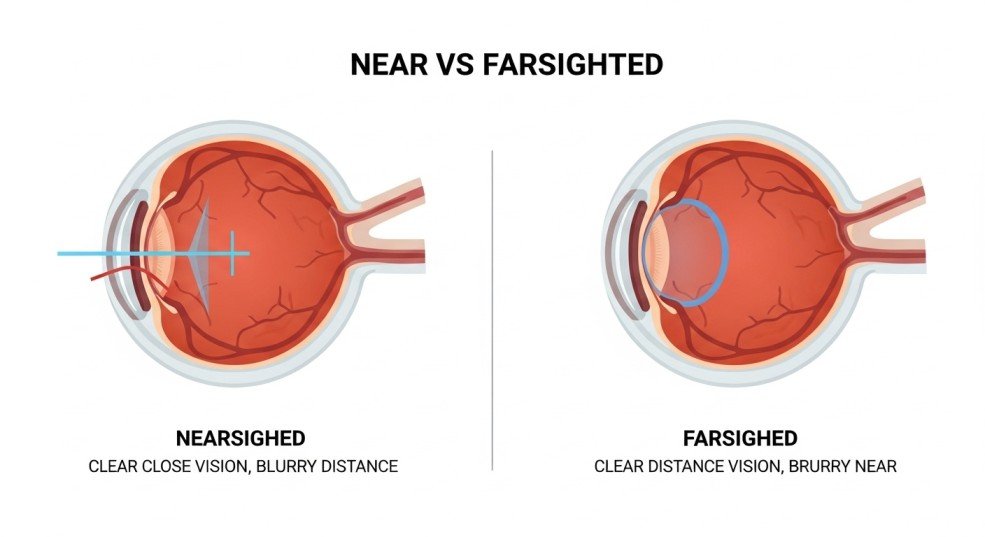
Quick Ans: The main difference between near vs farsighted vision is how clearly you see objects at different distances. Nearsightedness means you can see close objects clearly but distant objects appear blurry. Farsightedness is the opposite, where distant objects are clear but nearby objects may look blurry.
Many people feel confused when comparing near vs farsighted vision problems. Both affect how clearly you see. Both require glasses or treatment. However, they work in opposite ways.
Nearsighted people struggle to see things far away. Farsighted people struggle to see things up close. Because the symptoms can overlap slightly, it becomes easy to misunderstand the difference.
For example, a student may sit close to the board because distant text looks blurry. Another person may hold a book far away to read clearly. These are classic signs of two different conditions.
Understanding near vs farsighted vision is important for eye health. It helps you recognize symptoms early. It also helps you choose the right correction method.
In this guide, you will learn definitions, causes, advantages, disadvantages, real world examples, common mistakes, and practical exercises. By the end, the difference will be clear and easy to remember.
Quick Answer: Near vs Farsighted
To understand near vs farsighted, focus on how light enters the eye and where it focuses.
| Feature | Nearsighted (Myopia) | Farsighted (Hyperopia) |
|---|---|---|
| Vision Clarity | Clear up close | Clear far away |
| Blurry Vision | Far objects | Near objects |
| Eye Focus Point | In front of retina | Behind retina |
| Common Age | Often starts in childhood | Can appear at any age |
| Correction | Concave lenses | Convex lenses |
In simple terms, nearsighted means clear near, while farsighted means clear far.
What Is Nearsightedness?
Nearsightedness, also called myopia, is a vision condition where close objects appear clear but distant objects look blurry.
This happens because light focuses in front of the retina instead of directly on it.
Common Signs of Nearsightedness
People with nearsightedness may:
- Squint to see distant objects
- Sit close to screens or boards
- Struggle to read road signs
- Experience eye strain
These signs often appear during childhood or teenage years.
Causes of Nearsightedness
Several factors contribute to myopia:
- Eyeball is too long
- Cornea is too curved
- Genetics
- Excessive screen time or close work
Because of these factors, light rays do not reach the retina properly.
How It Is Corrected
Doctors usually recommend:
- Glasses with concave lenses
- Contact lenses
- Laser eye surgery
These methods help shift the focus point onto the retina.
What Is Farsightedness?
Farsightedness, also called hyperopia, is a condition where distant objects are clearer than nearby ones.
In this case, light focuses behind the retina instead of on it.
Common Signs of Farsightedness
People with farsightedness may:
- Have difficulty reading small text
- Experience headaches during close work
- Hold books farther away
- Feel eye fatigue
These symptoms often become noticeable with age.
Causes of Farsightedness
Hyperopia may result from:
- Shorter eyeball
- Flatter cornea
- Genetic factors
Because the eye is shorter, light does not focus correctly.
How It Is Corrected
Common treatments include:
- Glasses with convex lenses
- Contact lenses
- Laser surgery
These solutions help move the focal point forward onto the retina.
Key Differences Between Near vs Farsighted
Vision Range
The most obvious difference in near vs farsighted is clarity distance. Nearsighted people see close objects clearly. Farsighted people see distant objects clearly.
Light Focus
Light focuses differently in each condition. In myopia, it focuses in front of the retina. In hyperopia, it focuses behind it.
Daily Impact
Nearsighted individuals struggle with distance tasks like driving. Farsighted individuals struggle with reading or close work.
Correction Type
Different lenses are required. Concave lenses correct myopia. Convex lenses correct hyperopia.
Advantages and Disadvantages
Nearsighted Advantages
- Clear vision for reading and close work
- Less need for reading glasses at young age
Nearsighted Disadvantages
- Difficulty seeing far objects
- Dependence on glasses for driving
- Eye strain
Farsighted Advantages
- Clear distance vision
- Better long range focus
Farsighted Disadvantages
- Difficulty reading
- Eye fatigue during close work
- Headaches
Thus, the choice between near vs farsighted is not about preference but about vision condition.
Real World Examples
In School
A nearsighted student may sit in the front row. A farsighted student may struggle to read books or notes.
At Work
Office workers with farsightedness may find it hard to read screens. Meanwhile, nearsighted individuals may struggle with presentations or distant displays.
Driving
Nearsighted people may find road signs blurry. Farsighted individuals usually see distant signs clearly but may struggle with dashboard reading.
These examples make the near vs farsighted comparison easy to understand.
Regional and Global Usage
Global Prevalence
Nearsightedness is increasing worldwide, especially among younger populations.
Urban Trends
Urban lifestyles with more screen use contribute to higher myopia rates.
Age Factors
Farsightedness becomes more noticeable with aging, especially after 40.
Therefore, lifestyle and age both influence near vs farsighted conditions.
Related Concepts and Comparisons
Near vs Farsighted vs Astigmatism
Astigmatism causes blurred vision at all distances due to irregular eye shape.
Near vs Farsighted vs Presbyopia
Presbyopia is age related farsightedness that affects reading ability.
Comparison Table
| Condition | Vision Issue | Cause |
|---|---|---|
| Nearsighted | Blurry far | Long eyeball |
| Farsighted | Blurry near | Short eyeball |
| Astigmatism | Blurry all distances | Irregular cornea |
These comparisons expand the understanding of near vs farsighted.
Common Mistakes About Near vs Farsighted
Mixing Up the Terms
Many people confuse which condition affects near or far vision. Remember: near equals myopia, far equals hyperopia.
Ignoring Symptoms
Blurry vision is often ignored. Early diagnosis prevents worsening.
Using Wrong Glasses
Incorrect lenses can strain the eyes further.
Delaying Eye Exams
Regular checkups help detect vision issues early.
Avoiding these mistakes improves eye health.
Beginner to Advanced Eye Care Tips
Beginner Level
Take regular breaks from screens. Use proper lighting when reading.
Intermediate Level
Wear prescribed glasses consistently. Maintain a healthy diet for eye health.
Advanced Level
Consider laser correction if recommended. Monitor eye health regularly with professionals.
These steps support better management of near vs farsighted conditions.
Step By Step Vision Scenario
Imagine reading a book and looking at a distant object.
If you are nearsighted:
- The book looks clear
- Distant objects look blurry
If you are farsighted:
- The book looks blurry
- Distant objects look clear
This simple example clearly explains near vs farsighted.
Exercises With Answers
Exercise 1
Which condition causes blurry distant vision?
Answer: Nearsightedness.
Exercise 2
Which condition makes reading difficult?
Answer: Farsightedness.
Exercise 3
Where does light focus in myopia?
Answer: In front of the retina.
Exercise 4
Which lenses correct farsightedness?
Answer: Convex lenses.
Exercise 5
True or False: Nearsighted people see far objects clearly.
Answer: False.
When Should You Seek Help for Near vs Farsighted?
Seek help if you:
- Experience blurry vision
- Have frequent headaches
- Struggle with reading or distance vision
- Feel eye strain
Early diagnosis helps manage both conditions effectively.
FAQs About Near vs Farsighted
What is the main difference between near vs farsighted?
Nearsighted means clear near vision and blurry distance vision. Farsighted means clear distance vision and blurry near vision.
Is nearsighted the same as farsighted?
No. In the near vs farsighted comparison, they are opposite vision conditions.
Which is more common, nearsighted or farsighted?
Nearsightedness is more common, especially in younger populations.
Can you have both conditions?
Yes. Some people may have a combination of vision issues.
Do glasses fix both conditions?
Yes. Different lenses correct each condition effectively.
Is farsightedness worse with age?
Yes. It often becomes more noticeable over time.
Can screen time cause nearsightedness?
Excessive screen use may increase the risk of myopia.
Is laser surgery safe?
Laser surgery is generally safe but requires professional evaluation.
How often should I check my eyes?
Eye exams are recommended every 1 to 2 years.
Can children develop nearsightedness?
Yes. Myopia often starts in childhood.
Conclusion
Understanding near vs farsighted vision is essential for maintaining good eye health. Although both conditions affect clarity, they work in opposite ways.
Nearsightedness allows clear vision up close but causes distant objects to appear blurry. Farsightedness does the opposite, making nearby objects harder to see clearly.
Because these conditions affect daily activities differently, proper diagnosis is important. Glasses, contact lenses, and medical treatments can correct both issues effectively.
Lifestyle also plays a role. Reducing screen time, maintaining proper lighting, and scheduling regular eye exams can help protect your vision.
By learning the difference between near vs farsighted, you can recognize symptoms early and choose the right solution for clear, comfortable vision.
Discover More:-
- Beaver vs Woodchuck: Key Differences, Habitat, Behavior, and Identification Guide
- Yuca vs Yucca: Differences, Uses, Benefits, and Complete Guide

Lisa Thompson is a USA-based content writer and language specialist focused on grammar, writing improvement and digital publishing.
She holds a degree in English Language and Communication and has professional experience in educational and web content creation.
As the author of Gramtivo.Com, she aims to help readers improve their writing skills through clear and practical guidance.


Pingback: Hominy vs Corn: Differences, Uses, Nutrition, and Cooking Guide