
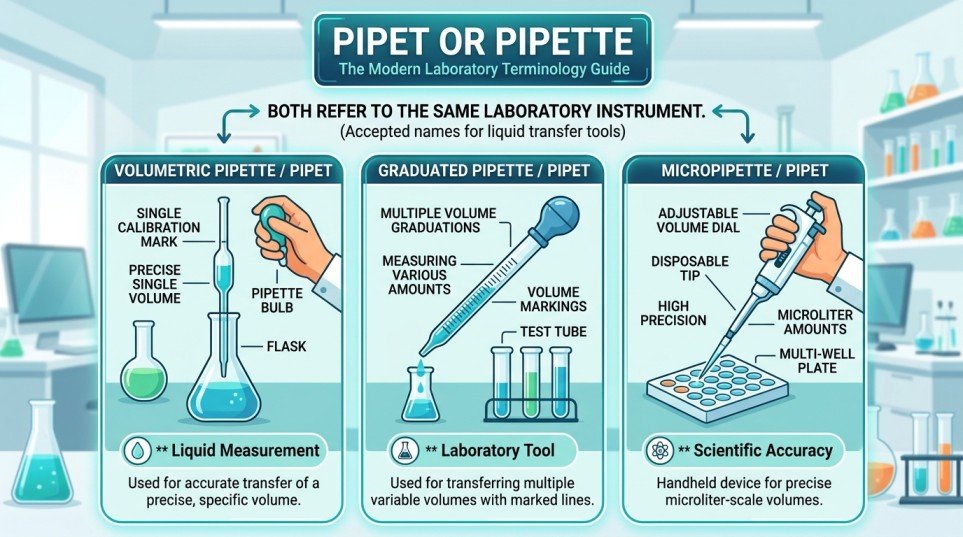
Quick Ans: The difference between pipet or pipette is mostly spelling and regional usage. Both words describe a laboratory tool used to transfer small amounts of liquid accurately. “Pipette” is the modern and more widely accepted spelling, while “pipet” is an older simplified version still used in some scientific settings.
Many students, researchers, and laboratory workers search for pipet or pipette because the two words look almost identical. Both appear in science textbooks. Both refer to the same liquid measuring tool.
However, confusion still exists.
Some teachers write “pipette” on lab instructions. Other laboratory manuals use “pipet.” As a result, beginners often wonder whether the terms describe different instruments.
In reality, the difference is mainly about spelling style and historical usage. The tool itself performs the same function. It transfers precise amounts of liquid during experiments, testing, and analysis.
Understanding pipet or pipette is important for students, scientists, healthcare workers, and laboratory technicians. Correct terminology improves communication and prevents mistakes in scientific writing.
This guide explains the full comparison clearly. You will learn definitions, types, advantages, disadvantages, laboratory examples, common mistakes, and practical exercises.
Quick Answer: Pipet or Pipette
To understand pipet or pipette quickly, focus on spelling and usage.
| Feature | Pipet | Pipette |
|---|---|---|
| Meaning | Liquid transfer tool | Liquid transfer tool |
| Usage Style | Simplified spelling | Standard modern spelling |
| Common Regions | Older scientific writing | Worldwide scientific use |
| Function | Measures liquid | Measures liquid |
| Difference in Tool | None | None |
In simple terms, pipet and pipette refer to the same laboratory instrument.
What Is a Pipette?
A pipette is a laboratory tool designed to transfer measured amounts of liquid accurately. Scientists use pipettes in chemistry, biology, medicine, microbiology, and pharmaceutical research.
Pipettes help ensure precision during experiments.
Common Uses of Pipettes
Laboratories use pipettes for many tasks:
- Measuring chemicals
- Transferring liquid samples
- Mixing solutions
- Performing medical tests
- Conducting biological experiments
Because scientific experiments require accuracy, pipettes are essential laboratory tools.
Basic Structure of a Pipette
Most pipettes include:
- Narrow tube or tip
- Measuring section
- Suction mechanism
- Disposable tip in modern models
Different designs exist depending on laboratory needs.
How a Pipette Works
The process usually involves:
- Drawing liquid into the pipette
- Measuring the required volume
- Releasing the liquid into another container
Accurate handling improves experiment reliability.
What Is a Pipet?
A pipet is simply another spelling of “pipette.” The meaning and function remain the same.
Historically, some scientific organizations preferred the shorter spelling. Older laboratory manuals and educational materials often used “pipet” instead of “pipette.”
Today, “pipette” is more common worldwide. Nevertheless, some laboratories and manufacturers still use “pipet” in technical documents.
Why Two Spellings Exist
Language changes over time. Some scientific terms receive simplified spellings for convenience.
For example:
- Catalog → Catalogue
- Sulfur → Sulphur
- Pipette → Pipet
Even though both spellings appear in scientific writing, “pipette” dominates modern usage.
Key Differences Between Pipet or Pipette
Spelling
The primary difference in pipet or pipette is spelling. “Pipette” contains two extra letters.
Modern Usage
Most modern laboratories, universities, and textbooks prefer “pipette.”
Historical Usage
The term “pipet” appears more often in older scientific documents.
Scientific Meaning
No functional difference exists. Both terms describe the same liquid transfer instrument.
Types of Pipettes
Several pipette types exist in laboratory work.
Volumetric Pipette
A volumetric pipette measures one exact liquid volume with high precision.
Graduated Pipette
Graduated pipettes contain measurement markings for different liquid volumes.
Micropipette
Micropipettes transfer extremely small liquid quantities, often measured in microliters.
Pasteur Pipette
Pasteur pipettes transfer liquids without requiring high precision.
Electronic Pipette
Electronic pipettes improve accuracy and reduce hand strain during repetitive work.
Each type serves different scientific purposes.
Advantages and Disadvantages
Pipette Advantages
Pipettes provide several important benefits:
- Accurate liquid measurement
- Reliable experiment results
- Easy handling
- Multiple volume options
- Essential for laboratory precision
Pipette Disadvantages
Some limitations also exist:
- Requires proper calibration
- Sensitive to handling errors
- Disposable tips increase waste
- High quality models can be expensive
Therefore, proper training is important for laboratory accuracy.
Real World Examples
Chemistry Laboratory
Chemists use pipettes to mix exact amounts of chemicals during reactions and testing.
Medical Testing
Healthcare laboratories use micropipettes to handle blood and diagnostic samples.
Biology Research
Biologists transfer DNA samples and cell cultures using pipettes.
Pharmaceutical Industry
Drug manufacturers rely on pipettes for accurate liquid formulation.
These examples show why pipettes are critical scientific tools.
Regional and Global Usage
United States
Both “pipet” and “pipette” appear in American scientific writing. However, “pipette” is now more common.
Europe
European laboratories strongly prefer the spelling “pipette.”
Educational Systems
Most schools and universities teach students to use “pipette” in modern scientific communication.
As a result, global scientific literature increasingly standardizes the term “pipette.”
Related Concepts and Comparisons
Pipette vs Dropper
Droppers transfer liquid less accurately than pipettes.
Pipette vs Burette
A burette releases controlled liquid amounts during titration experiments, while a pipette transfers fixed or measured volumes.
Pipette vs Syringe
Syringes inject or withdraw liquids using a plunger. Pipettes focus on precise laboratory measurement.
Pipette vs Micropipette
| Feature | Pipette | Micropipette |
|---|---|---|
| Volume Range | Larger volumes | Extremely small volumes |
| Precision | High | Very high |
| Common Use | General lab work | Molecular biology |
| Measurement Unit | Milliliters | Microliters |
Understanding these tools helps clarify the broader pipet or pipette discussion.
Common Mistakes About Pipet or Pipette
Thinking They Are Different Tools
Many beginners assume pipet and pipette describe separate instruments. In reality, the terms refer to the same tool.
Incorrect Volume Reading
Poor eye positioning can lead to inaccurate liquid measurement.
Using the Wrong Pipette Type
Large volume pipettes should not measure microscopic liquid amounts.
Forgetting Calibration
Uncalibrated pipettes may produce incorrect experiment results.
Reusing Disposable Tips
Cross contamination becomes a major risk when tips are reused improperly.
Avoiding these mistakes improves laboratory safety and accuracy.
Beginner to Advanced Laboratory Tips
Beginner Level
Practice holding the pipette vertically for accurate liquid transfer.
Intermediate Level
Learn proper calibration techniques and volume adjustment methods.
Advanced Level
Develop advanced skills such as:
- Multichannel pipetting
- Sterile laboratory technique
- Precision micro volume handling
- Automated liquid transfer systems
Improved technique increases scientific reliability.
Step By Step Pipette Usage Scenario
Imagine you need to transfer a liquid sample.
- Select the correct pipette size
- Attach a clean disposable tip
- Press the plunger gently
- Draw liquid into the tip
- Transfer the liquid carefully
- Release the sample slowly
- Dispose of the used tip properly
Following these steps improves measurement accuracy.
Exercises With Answers
Exercise 1
What is the main difference between pipet or pipette?
Answer: The difference is mainly spelling and usage style.
Exercise 2
Which spelling is more common today?
Answer: Pipette.
Exercise 3
Which laboratory tool transfers small liquid volumes accurately?
Answer: Pipette or pipet.
Exercise 4
True or False: Pipet and pipette are different instruments.
Answer: False.
Exercise 5
Which pipette type handles extremely small liquid volumes?
Answer: Micropipette.
When Should You Use Pipet or Pipette?
Use “pipette” in most situations because it is the standard modern spelling.
Some older scientific organizations may still use “pipet.” However, modern textbooks, laboratories, and universities generally prefer “pipette.”
For professional writing, scientific reports, and academic communication, “pipette” is usually the safer choice.
FAQs About Pipet or Pipette
What is the difference between pipet or pipette?
The difference is mainly spelling. Both words describe the same laboratory liquid transfer tool.
Is pipet an incorrect spelling?
No. Pipet is an older simplified spelling still used in some scientific contexts.
Which spelling is more common today, pipet or pipette?
Pipette is much more common in modern scientific writing and education.
Do pipet and pipette perform different functions?
No. Both terms refer to the same instrument used for liquid measurement and transfer.
Why do laboratories use pipettes?
Pipettes provide accurate liquid measurement during scientific experiments and testing.
What is a micropipette?
A micropipette transfers extremely small liquid volumes, usually measured in microliters.
Are pipettes important in biology labs?
Yes. Biology laboratories use pipettes for DNA work, cell cultures, and chemical preparation.
Can pipettes improve experiment accuracy?
Yes. Proper pipette use increases precision and reduces measurement errors.
What happens if a pipette is not calibrated?
Incorrect calibration may lead to inaccurate liquid measurements and unreliable experiment results.
Which spelling should students use in reports?
Students should generally use “pipette” because it is the accepted modern standard.
Conclusion
Understanding pipet or pipette is simpler than many people expect. Both words describe the same laboratory instrument used to transfer precise liquid amounts. The main difference involves spelling and historical preference rather than function.
Today, “pipette” is the standard term in most scientific fields. Universities, laboratories, and textbooks commonly use this spelling in professional communication. Although “pipet” still appears occasionally, it is less common in modern usage.
Pipettes remain essential tools in chemistry, biology, medicine, and pharmaceutical research. Accurate liquid handling improves experiment quality and supports reliable scientific results.
Choosing the correct pipette type and using proper technique are equally important. Careful calibration, correct handling, and proper cleaning help prevent laboratory errors.
By understanding the differences and proper usage of pipet or pipette, students and professionals can communicate more clearly and work more effectively in scientific environments.
Discover More:-
- Descendent or Descendant: Meaning, Differences, and Correct Usage Guide
- Beemer or Beamer: Meaning, Differences, and Correct BMW Nicknames

Robert Mitchell is a U.S.-based writer at Gramtivo.Com who focuses on grammar, writing improvement, and language-related content. He holds a degree in English and Linguistics from a U.S. university. His work aims to help readers enhance their writing skills with clear and practical guidance.