
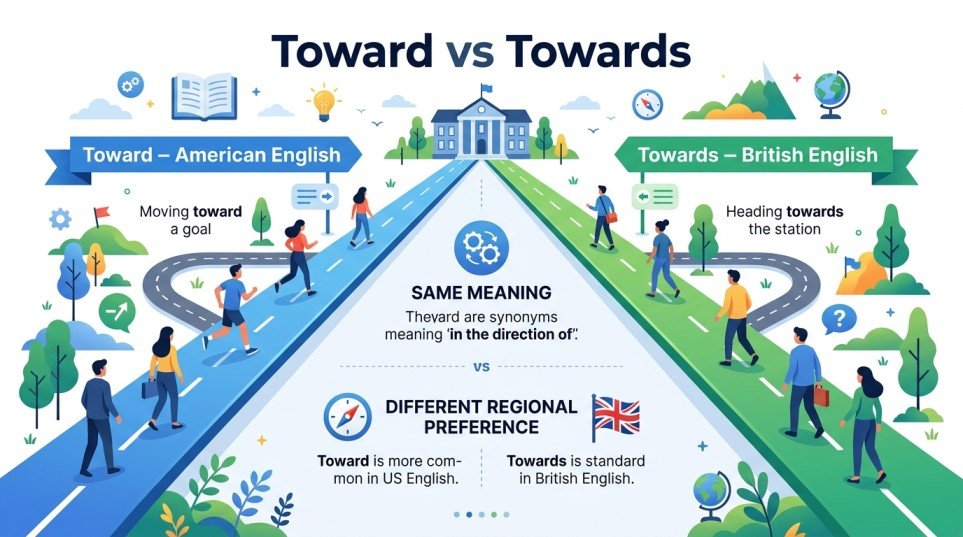
Quick Ans: The difference between toward or towards is mainly regional preference, not meaning. Both words mean “in the direction of” and are grammatically correct. Generally, toward is more common in American English, while towards is more common in British English.
Many English learners and native speakers wonder whether they should use toward or towards in writing and speech. The two words look almost identical. They sound similar. Their meanings are also the same.
As a result, people often assume one must be wrong.
In reality, both forms are correct. The choice usually depends on the type of English you use. American English tends to favor toward. British English, Australian English, and several other varieties often prefer towards.
The confusion becomes more noticeable when writing essays, business emails, academic papers, or website content. Writers want consistency, and they often worry about choosing the wrong version.
Fortunately, the rule is simple. Both words mean the same thing. The key is understanding where each form is more commonly used and maintaining consistency throughout your writing.
This guide explains everything you need to know about toward or towards, including definitions, examples, common mistakes, regional usage, grammar tips, exercises, and frequently asked questions.
Quick Answer: Toward or Towards
The short answer is simple.
| Word | Meaning | Common Usage |
|---|---|---|
| Toward | In the direction of | American English |
| Towards | In the direction of | British English |
Both words mean exactly the same thing.
For example:
- She walked toward the park.
- She walked towards the park.
Both sentences are correct.
The only difference is regional preference.
What Does Toward Mean?
Toward is a preposition that means:
- In the direction of
- Nearing a place or goal
- Regarding a person or thing
- Contributing to something
American English writers commonly use this form.
Examples of Toward
Consider these examples:
- The dog ran toward its owner.
- We drove toward the city.
- She showed kindness toward her neighbors.
- The donation went toward building a new school.
In each sentence, toward indicates direction, attitude, or contribution.
Why American English Prefers Toward
Many American style guides recommend shorter word forms when alternatives exist.
Therefore, publications in the United States often choose:
- Forward instead of forwards
- Backward instead of backwards
- Toward instead of towards
This preference has become standard in American English writing.
What Does Towards Mean?
Towards has the same meaning as toward. There is no difference in definition.
However, this version appears more frequently in British English and other English varieties outside the United States.
Examples of Towards
Look at these examples:
- The child walked towards the playground.
- We moved towards the station.
- His attitude towards customers was excellent.
- The company contributed money towards disaster relief.
Each sentence would remain correct if toward replaced towards.
Why British English Prefers Towards
British English often retains forms ending in s.
For example:
- Afterwards
- Backwards
- Forwards
- Towards
Because these forms are common in British writing, towards naturally appears more often.
Key Differences Between Toward or Towards
Meaning
There is no difference in meaning.
Both words express:
- Direction
- Movement
- Attitude
- Contribution
Grammar
Both function as prepositions.
For example:
- She ran toward the door.
- She ran towards the door.
Both are grammatically correct.
Regional Preference
This is where the main difference appears.
| English Variety | Preferred Form |
|---|---|
| American English | Toward |
| British English | Towards |
| Australian English | Towards |
| Canadian English | Both |
| New Zealand English | Towards |
Formality
Neither word is more formal.
Both are acceptable in:
- Academic writing
- Business writing
- Casual communication
- Professional documents
Consistency matters more than the specific choice.
Advantages and Disadvantages
Advantages of Using Toward
- Preferred in American English
- Common in U.S. publications
- Recommended by many American style guides
- Slightly shorter spelling
Disadvantages of Using Toward
- May look unusual to some British readers
- Less common in certain international publications
Advantages of Using Towards
- Preferred in British English
- Common in international English usage
- Familiar to many global audiences
Disadvantages of Using Towards
- May conflict with American style guidelines
- Less common in U.S. newspapers and academic writing
Therefore, your audience often determines which version works best.
Real World Examples
Academic Writing
A university student in the United States might write:
“Researchers are moving toward a new understanding of climate patterns.”
A student in the United Kingdom might write:
“Researchers are moving towards a new understanding of climate patterns.”
Both sentences are correct.
Business Communication
An American company may write:
“Our efforts are directed toward customer satisfaction.”
Meanwhile, a British company may write:
“Our efforts are directed towards customer satisfaction.”
Again, neither version is wrong.
Everyday Conversation
People rarely notice the difference when speaking because pronunciation is very similar.
As a result, the distinction mainly appears in writing.
Regional and Global Usage
United States
American English strongly favors toward.
Major newspapers, universities, and publishers typically use this form.
United Kingdom
British English usually prefers towards.
Many British style guides recommend it.
Australia and New Zealand
Writers in these countries commonly use towards.
Canada
Canadian English uses both forms. However, towards appears somewhat more frequently.
Consequently, the choice often depends on the publication’s style guide.
Related Concepts and Comparisons
Toward vs Towards vs Forward vs Forwards
The same regional pattern applies to other words.
| American English | British English |
|---|---|
| Toward | Towards |
| Forward | Forwards |
| Backward | Backwards |
| Afterward | Afterwards |
Because these pairs follow similar rules, understanding one helps with the others.
Toward vs To
Many learners confuse these words.
Consider the difference:
- She walked to the store.
- She walked toward the store.
The first sentence means she reached the store.
The second sentence only shows movement in that direction.
Therefore, toward and to are not interchangeable in every situation.
Common Mistakes About Toward or Towards
Thinking One Is Incorrect
Many people believe only one form is grammatically correct.
In reality, both versions are accepted English.
Mixing Styles
A common mistake occurs when writers switch between forms in the same document.
For example:
- We moved toward the building.
- Our attention shifted towards safety concerns.
The writing remains grammatically correct. However, the style becomes inconsistent.
Assuming Meaning Changes
Some learners think towards sounds more formal or more polite.
No meaningful difference exists between the two words.
Following the Wrong Style Guide
Writers should match the style requirements of their audience rather than personal preference alone.
Beginner to Advanced Usage Tips
Beginner Level
Choose one version and use it consistently.
Intermediate Level
Match the form to your audience.
Use:
- Toward for American readers
- Towards for British readers
Advanced Level
Follow professional style guides when writing for publications, universities, or organizations.
This approach ensures consistency and professionalism.
Step By Step Usage Scenario
Imagine you are writing an article for an American audience.
Step 1: Choose American English.
2: Use toward consistently.
3: Avoid switching to towards later in the document.
Now imagine the article targets British readers.
First, select British English conventions.
Next, use towards throughout the content.
Finally, review the document for consistency.
The meaning stays the same, but the style matches the audience.
Exercises With Answers
Exercise 1
Which word is generally preferred in American English?
Answer: Toward.
Exercise 2
Which word is more common in British English?
Answer: Towards.
Exercise 3
True or False: Toward and towards have different meanings.
Answer: False.
Exercise 4
Choose the correct sentence for American English:
A. She walked towards the office.
B. She walked toward the office.
Answer: B.
Exercise 5
Choose the correct sentence for British English:
A. He moved towards the entrance.
B. He moved toward the entrance.
Answer: A.
When Should You Use Toward or Towards?
Use toward when:
- Writing in American English
- Following U.S. style guides
- Creating content for American audiences
Use towards when:
- Writing in British English
- Following UK style guides
- Targeting international audiences that prefer British conventions
The most important rule is consistency.
FAQs About Toward or Towards
What is the difference between toward or towards?
There is no difference in meaning. The distinction is mainly regional, with toward preferred in American English and towards preferred in British English.
Is toward or towards grammatically correct?
Both are grammatically correct and widely accepted.
Which is more common in the United States?
Toward is the preferred form in American English writing.
Which is more common in the United Kingdom?
Towards is more common in British English.
Do toward and towards mean the same thing?
Yes. Both mean “in the direction of” or “regarding.”
Can I use toward and towards interchangeably?
Yes. However, maintain consistency within the same document.
Is towards more formal than toward?
No. Neither form is more formal.
Should academic papers use toward or towards?
Use the form required by the style guide or regional English standard being followed.
Why do American writers prefer toward?
American English often favors shorter forms such as toward, forward, and afterward.
Which version should ESL learners use?
Choose the version that matches the English variety you are studying or using professionally.
Conclusion
Understanding toward or towards is much easier than many people expect. Both words are correct. Both carry the same meaning. Neither is more formal, more accurate, or more grammatical than the other.
The primary difference comes from regional usage. American English generally prefers toward, while British English and several other varieties favor towards.
For most writers, the best approach is consistency. Choose the version that matches your audience and continue using it throughout your document. This creates a polished and professional style.
Whether you write emails, essays, blog posts, academic papers, or business reports, understanding the distinction between toward or towards helps improve clarity and confidence.
Remember the simple rule: the meaning stays the same, but the preferred spelling changes depending on the type of English you use.
Discover More:-
- Theragun vs Hypervolt: Detailed Comparison, Features, and Buying Guide
- Grizzly vs Gorilla: Size, Strength, Fight Analysis, and Key Differences

Jennifer Collins is a professional grammar expert and language educator at gramtivo.com, specializing in English grammar, writing skills, and language improvement. She holds a Master’s degree in English Language and Literature from a recognized university in the United States. With years of teaching and content development experience, she is dedicated to helping learners improve their communication skills with clear and practical guidance.