
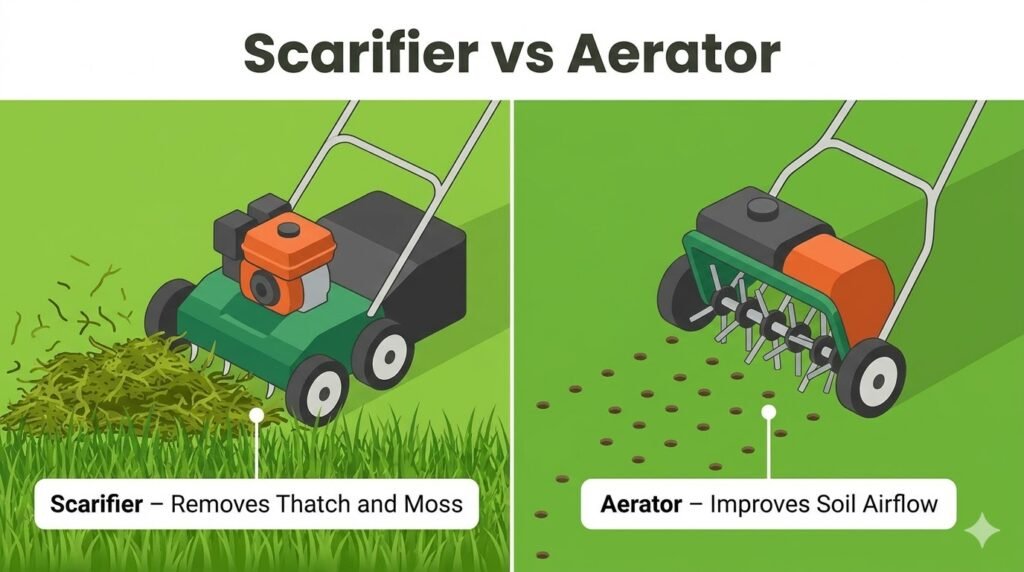
Quick Ans: The difference between scarifier vs aerator lies in how they improve lawn health. A scarifier removes thatch and moss from the lawn surface, while an aerator creates small holes in the soil to improve airflow, water absorption, and root growth. Both tools help lawns grow stronger, but they solve different lawn problems.
Many homeowners wonder about scarifier vs aerator when trying to improve lawn health. Both tools are popular in lawn care. Both help grass grow better. However, they work in very different ways.
A healthy lawn needs good airflow, water absorption, and nutrient access. Over time, problems such as compacted soil or thick layers of dead grass can stop roots from growing properly. As a result, the lawn may turn yellow, thin, or patchy.
Two common solutions are scarifying and aerating. Although the names sound similar, their purposes are different. A scarifier removes moss, debris, and thatch from the lawn surface. Meanwhile, an aerator loosens compacted soil by creating holes.
Understanding the difference between scarifier vs aerator helps you choose the right tool for your lawn. Using the wrong method may waste time and effort. However, using the correct technique can dramatically improve grass growth and overall lawn health.
This guide explains the tools clearly. You will learn definitions, benefits, disadvantages, real examples, common mistakes, and practical exercises.
Quick Answer: Scarifier vs Aerator
To understand scarifier vs aerator, focus on their main purpose.
| Feature | Scarifier | Aerator |
|---|---|---|
| Main Function | Removes thatch and moss | Loosens compacted soil |
| Action | Cuts into lawn surface | Creates holes in soil |
| Target Problem | Thick thatch layer | Poor soil airflow |
| Best Season | Spring or autumn | Spring or fall |
| Result | Cleaner lawn surface | Healthier root growth |
In simple terms, a scarifier cleans the lawn surface, while an aerator improves the soil below.
What Is a Scarifier?
A scarifier is a lawn care tool designed to remove thatch, moss, and dead grass from the surface of the lawn. Thatch is a layer of organic material that builds up between grass blades and soil.
If the thatch layer becomes too thick, water and nutrients struggle to reach the roots. Consequently, the lawn may become weak or unhealthy.
Scarifying solves this problem by cutting into the lawn surface and pulling out debris.
Typical Scarifier Features
Most scarifiers include:
- Rotating blades or tines
- Adjustable depth settings
- Electric or manual operation
- Collection bag for debris
These blades gently cut through the lawn to remove unwanted material.
Common Uses of Scarifying
Scarifying helps with several lawn problems.
- Removing moss
- Eliminating thatch buildup
- Improving water penetration
- Encouraging stronger grass growth
After scarifying, the lawn often looks thin for a short period. However, new grass usually grows thicker afterward.
How Scarifiers Work
The scarifying process usually follows these steps.
- Adjust the blade depth
- Run the scarifier across the lawn
- Blades cut into the surface
- Debris is lifted and removed
- Collect and dispose of removed material
This process refreshes the lawn surface and encourages healthier growth.
What Is an Aerator?
An aerator is a lawn tool that creates small holes in the soil. These holes improve airflow, water absorption, and nutrient movement.
Over time, soil becomes compacted due to foot traffic, rain, and heavy equipment. Compacted soil restricts root growth.
Aeration solves this problem by loosening the soil structure.
Common Types of Aerators
Several types of aerators are used in lawn care.
- Spike aerators
- Plug or core aerators
- Manual aerators
- Motorized aerators
Plug aerators are often the most effective because they remove small soil cores.
Typical Aerator Benefits
Aerating provides multiple lawn improvements.
- Better root growth
- Improved water drainage
- Increased nutrient absorption
- Stronger grass development
Because of these benefits, many lawn professionals recommend aerating once or twice each year.
How Aerators Work
Aerating usually involves the following steps.
- Push or drive the aerator across the lawn
- Tines or spikes penetrate the soil
- Small holes are created
- Air and water enter the soil
- Roots expand into the new spaces
This process significantly improves soil health.
Key Differences Between Scarifier vs Aerator
Purpose
The biggest difference in scarifier vs aerator is their main purpose.
A scarifier removes debris and thatch. An aerator improves soil structure.
Depth of Action
Scarifiers work on the lawn surface. Aerators penetrate deeper into the soil.
Lawn Problems Solved
Scarifiers solve thatch and moss problems. Aerators solve soil compaction issues.
Frequency of Use
Scarifying is usually done once or twice per year. Aerating can also be performed seasonally depending on lawn condition.
Advantages and Disadvantages
Scarifier Advantages
Scarifying provides several benefits.
- Removes moss and thatch
- Improves lawn appearance
- Encourages thicker grass growth
- Helps water reach soil
Scarifier Disadvantages
However, scarifying also has some drawbacks.
- Lawn may look rough temporarily
- Incorrect depth can damage grass
- Requires cleanup of debris
Aerator Advantages
Aeration offers many advantages.
- Improves soil structure
- Promotes deeper root growth
- Enhances water absorption
- Supports healthier lawns
Aerator Disadvantages
There are also a few limitations.
- Requires specialized tools
- May need multiple passes
- Soil cores can create temporary mess
Choosing between scarifier vs aerator depends on the specific lawn issue.
Real World Examples
Lawn With Moss
A lawn covered in moss usually needs scarifying. Removing the moss allows healthy grass to grow again.
Lawn With Hard Soil
If the soil feels hard and water pools on the surface, aeration is often necessary.
Professional Lawn Maintenance
Many professional landscapers use both methods during seasonal lawn care.
First, they scarify to remove debris. Then they aerate to improve soil structure.
These combined methods produce stronger lawns.
Regional and Global Usage
Cool Climate Regions
In cooler climates, lawns often develop moss and thick thatch layers. Scarifying becomes important in these conditions.
High Traffic Lawns
Areas with frequent foot traffic often suffer from soil compaction. Aeration helps restore soil health.
Global Lawn Care Practices
Across the world, both methods are widely used in professional landscaping. Lawn care experts often recommend combining scarifying and aerating for best results.
Related Concepts and Comparisons
Aerator vs Dethatcher
A dethatcher removes thatch similar to a scarifier. However, dethatchers may be less aggressive.
Scarifier vs Rake
A lawn rake removes surface debris. A scarifier cuts deeper into the lawn surface.
Scarifier vs Aerator vs Dethatcher
| Tool | Main Function | Soil Depth |
|---|---|---|
| Scarifier | Removes thatch | Surface layer |
| Aerator | Loosens soil | Deep soil |
| Dethatcher | Removes light thatch | Surface |
These comparisons help clarify the differences in scarifier vs aerator.
Common Mistakes About Scarifier vs Aerator
Using the Wrong Tool
Many people confuse scarifiers with aerators. As a result, they treat the wrong lawn problem.
Scarifying Too Deeply
Setting blades too deep can damage healthy grass roots.
Aerating Dry Soil
Dry soil makes aeration difficult. Moist soil allows tines to penetrate more easily.
Overusing Lawn Equipment
Frequent scarifying or aerating may stress the lawn.
Avoiding these mistakes improves lawn care results.
Beginner to Advanced Lawn Care Tips
Beginner Level
Start by inspecting the lawn carefully. Identify moss buildup or soil compaction before choosing tools.
Intermediate Level
Combine aeration with overseeding to improve lawn thickness.
Advanced Level
Professional lawn care may include:
- Soil testing
- Fertilization plans
- Seasonal aeration schedules
- Scarifying with power equipment
These advanced methods produce professional looking lawns.
Step By Step Lawn Care Scenario
Imagine your lawn looks thin and unhealthy.
If thick moss covers the surface:
- Use a scarifier
- Remove debris
- Rake the lawn
- Overseed if necessary
If the soil feels compacted:
- Use an aerator
- Create holes across the lawn
- Add fertilizer
- Water thoroughly
Choosing the right method ensures better results.
Exercises With Answers
Exercise 1
Which tool removes moss and thatch?
Answer: Scarifier.
Exercise 2
Which tool creates holes in soil?
Answer: Aerator.
Exercise 3
Which problem does aeration solve?
Answer: Soil compaction.
Exercise 4
Which process improves lawn surface health?
Answer: Scarifying.
Exercise 5
True or False: Aerators remove moss from lawns.
Answer: False.
When Should You Choose Scarifier vs Aerator?
Choose a scarifier if you:
- Notice thick moss
- See heavy thatch buildup
- Want to refresh lawn surface
Choose an aerator if you:
- Have compacted soil
- Notice water pooling
- Want stronger root growth
Sometimes the best lawn care strategy uses both tools.
FAQs About Scarifier vs Aerator
What is the main difference between scarifier vs aerator?
A scarifier removes thatch and moss from the lawn surface, while an aerator creates holes in soil to improve airflow and root growth.
Do I need both a scarifier and an aerator?
Many lawns benefit from both. Scarifying cleans the surface, while aerating improves soil health.
Which should I use first, scarifier or aerator?
Most lawn experts recommend scarifying first, followed by aeration.
How often should I scarify my lawn?
Usually once or twice per year, typically in spring or autumn.
How often should I aerate my lawn?
Aeration is often done once per year, although heavily compacted lawns may need more frequent treatment.
Can scarifying damage grass?
Yes, if done too deeply. Proper blade adjustment prevents damage.
Is aeration necessary for all lawns?
Not always. Lawns with soft soil may not need frequent aeration.
What season is best for lawn aeration?
Spring and fall are usually ideal because grass grows actively.
Can I rent lawn aerators?
Yes. Many garden centers rent aerators and other lawn equipment.
Is scarifying the same as dethatching?
They are similar. Scarifying is usually more aggressive than dethatching.
Conclusion
Understanding scarifier vs aerator is essential for maintaining a healthy lawn. Both tools improve grass growth, yet they address different problems.
Scarifiers remove moss, thatch, and dead material from the lawn surface. This process clears the way for water and nutrients to reach the soil.
Aerators improve soil structure by creating small holes that allow air, water, and nutrients to reach grass roots. As a result, roots grow deeper and stronger.
The best approach often combines both techniques. First, scarifying removes surface debris. Then aeration improves soil conditions beneath the grass.
By identifying lawn problems correctly and choosing the right tool, homeowners can create thicker, greener, and healthier lawns.
Discover More:-
- Aquasonic vs Sonicare: Which Electric Toothbrush Is Better?
- Offerpad vs Opendoor: Key Differences, Fees, and Home Selling Guide

Lisa Thompson is a USA-based content writer and language specialist focused on grammar, writing improvement and digital publishing.
She holds a degree in English Language and Communication and has professional experience in educational and web content creation.
As the author of Gramtivo.Com, she aims to help readers improve their writing skills through clear and practical guidance.