
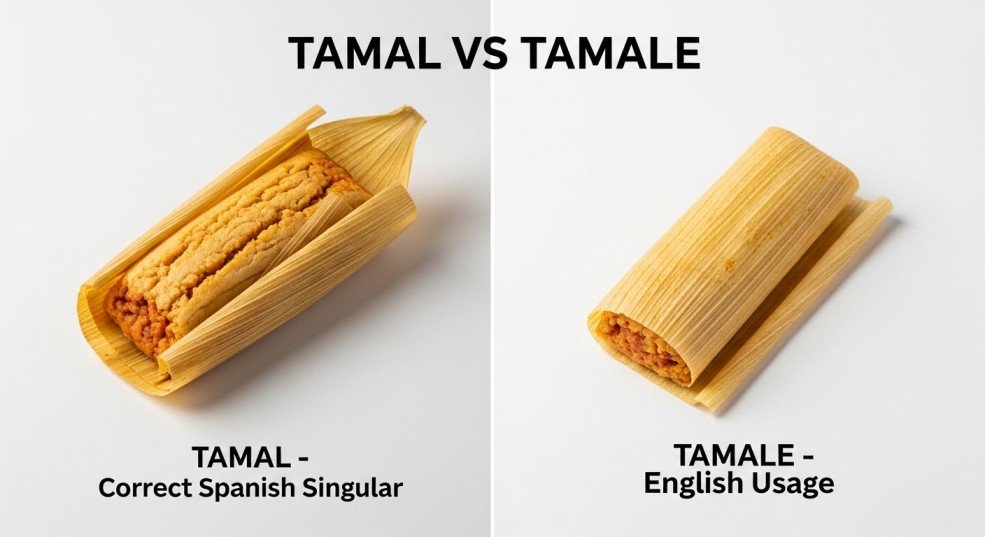
Quick Ans: The main difference between tamal vs tamale is grammatical, not culinary. “Tamal” is the correct singular form in Spanish, while “tamale” is the Anglicized version commonly used in English. Both refer to the same traditional dish made of masa filled with meat or other ingredients and wrapped in a husk.
Many people feel confused about tamal vs tamale. Both words look similar. Both refer to the same delicious food. However, only one is technically correct in Spanish.
The confusion usually starts when English speakers adopt Spanish food names. Over time, some words change slightly. As a result, “tamale” became common in English, even though the original Spanish word is “tamal.”
This difference matters in language, culture, and communication. For example, using the correct term can show respect for cultural traditions. At the same time, understanding both forms helps avoid confusion when reading menus or recipes.
In this guide, you will learn everything about tamal vs tamale. We will explain meanings, grammar rules, cultural context, usage differences, common mistakes, and practical examples. By the end, you will know when to use each word correctly.
Quick Answer: Tamal vs Tamale
To understand tamal vs tamale, focus on language usage.
| Feature | Tamal | Tamale |
|---|---|---|
| Language | Spanish | English adaptation |
| Correct singular form | Yes | No |
| Plural form | Tamales | Tamales |
| Usage | Formal Spanish | Common in English |
In simple terms, “tamal” is correct in Spanish, while “tamale” is widely used in English.
What Is a Tamal?
A tamal is a traditional Mexican dish made from masa, which is a dough made from corn. The masa is filled with ingredients such as meat, cheese, or vegetables. After filling, the dough is wrapped in a corn husk or banana leaf and then steamed.
Common Tamal Fillings
Typical fillings include:
- Chicken with red or green sauce
- Pork with chili sauce
- Cheese with peppers
- Beans or vegetables
Because of its versatility, the tamal appears in many regional variations.
Cultural Importance
Tamales hold deep cultural value in Mexican and Latin American traditions. Families often prepare them during holidays and special occasions.
For example:
- Christmas celebrations
- Family gatherings
- Festivals
Preparation often involves multiple people, making it a social activity.
How Tamales Are Made
The process usually follows these steps:
- Prepare masa dough
- Spread masa on husk or leaf
- Add filling
- Fold and wrap
- Steam until cooked
Steaming gives tamales their soft texture.
What Is a Tamale?
A tamale refers to the same food as a tamal but uses an English adapted spelling. The dish itself does not change. Only the word form differs.
English speakers often use “tamale” because it sounds more natural in English conversation. However, this version does not follow Spanish grammar rules.
Why “Tamale” Exists
Language adaptation often changes original words. In this case, English speakers adjusted “tamal” into “tamale” for easier pronunciation.
Despite this change:
- Restaurants may use either term
- Recipes often use “tamale”
- Native Spanish speakers use “tamal”
Therefore, both words appear frequently, depending on context.
Key Differences Between Tamal vs Tamale
Language Origin
The biggest difference in tamal vs tamale comes from language.
“Tamal” is Spanish. “Tamale” is English influenced.
Grammatical Accuracy
In Spanish grammar:
- Singular = tamal
- Plural = tamales
Using “tamale” in Spanish would be incorrect.
Usage Context
English speakers often say “tamale” in casual settings. Spanish speakers consistently use “tamal.”
Meaning
Both words refer to the same dish. No difference exists in ingredients or preparation.
Advantages and Disadvantages
Using “Tamal”
Advantages:
- Grammatically correct in Spanish
- Culturally accurate
- Preferred in formal or traditional settings
Disadvantages:
- Less common in English conversations
- May sound unfamiliar to some audiences
Using “Tamale”
Advantages:
- Widely understood in English
- Common in menus and recipes
- Easier for English pronunciation
Disadvantages:
- Grammatically incorrect in Spanish
- Less culturally precise
Therefore, choosing between tamal vs tamale depends on audience and context.
Real World Examples
In a Mexican Household
People will say:
- “Voy a comer un tamal.”
This means “I am going to eat a tamal.”
In an English Speaking Restaurant
Menus may say:
- “Chicken tamale with sauce”
In Cooking Blogs
Many English recipes use “tamale” to match audience expectations.
These examples show how context shapes usage.
Regional and Global Usage
In Mexico
The correct term “tamal” is always used. Language rules remain consistent.
In the United States
Both “tamal” and “tamale” appear. However, “tamale” is more common in everyday speech.
In Other Countries
Spanish speaking regions use “tamal.” English speaking regions may prefer “tamale.”
As a result, global usage varies depending on language influence.
Related Concepts and Comparisons
Tamal vs Tamales
“Tamal” is singular. “Tamales” is plural.
Tamale vs Tamales
Although “tamale” is used in English, the plural form still becomes “tamales,” following Spanish rules.
Tamal vs Burrito
A tamal is steamed in a husk. A burrito is wrapped in a tortilla and not steamed.
Common Mistakes About Tamal vs Tamale
Saying “Tamales” as Singular
Incorrect: “I ate one tamales.”
Correct: “I ate one tamal.”
Mixing Language Rules
Using “tamale” in Spanish sentences creates grammatical errors.
Assuming They Are Different Foods
Both words refer to the same dish. Only language differs.
Ignoring Cultural Context
Using correct terms shows awareness and respect for cultural origins.
Avoiding these mistakes improves communication.
Beginner to Advanced Language Tips
Beginner Level
Use “tamale” in casual English conversation. Most people will understand.
Intermediate Level
Learn correct Spanish forms such as “tamal” and “tamales.”
Advanced Level
Use “tamal” when speaking about authentic cuisine or writing formally.
Adjust usage depending on audience and context.
Step By Step Usage Scenario
Imagine ordering food.
If speaking English:
- “I would like one tamale.”
If speaking Spanish:
- “Quiero un tamal.”
Both sentences refer to the same dish. However, each uses language appropriate to the situation.
Exercises With Answers
Exercise 1
Which word is correct in Spanish: tamal or tamale?
Answer: Tamal.
Exercise 2
What is the plural form of tamal?
Answer: Tamales.
Exercise 3
Which term is more common in English?
Answer: Tamale.
Exercise 4
Do tamal and tamale refer to different foods?
Answer: No.
Exercise 5
True or False: “Tamale” is grammatically correct in Spanish.
Answer: False.
When Should You Use Tamal vs Tamale?
Use “tamal” when:
- Speaking Spanish
- Writing formally
- Referring to cultural traditions
Use “tamale” when:
- Speaking English casually
- Writing for general audiences
- Following common menu usage
Choosing the correct term improves clarity and communication.
FAQs About Tamal vs Tamale
What is the difference between tamal vs tamale?
The difference is linguistic. “Tamal” is correct in Spanish, while “tamale” is an English adaptation.
Is tamale incorrect?
It is incorrect in Spanish but widely accepted in English.
What is the plural of tamal?
The plural form is “tamales.”
Why do people say tamale instead of tamal?
English speakers adapted the word for easier pronunciation.
Are tamal and tamale different foods?
No. Both words refer to the same dish.
Which term should I use in a restaurant?
Either works in English, but “tamale” is more common.
Is tamal more authentic?
Yes. “Tamal” reflects the original Spanish term.
Can I use tamale in Spanish sentences?
No. It would be grammatically incorrect.
Do menus use tamal or tamale?
Many English menus use “tamale,” though some use “tamal.”
What is the correct plural for tamale?
Even in English, the plural is usually “tamales.”
Conclusion
Understanding tamal vs tamale is mainly about language, not food. Both words describe the same traditional dish made from masa and fillings wrapped in husks and steamed.
“Tamal” is the correct Spanish singular form and carries cultural and grammatical accuracy. “Tamale,” on the other hand, is an English adaptation that has become widely accepted in casual use.
Choosing the right term depends on context. Use “tamal” when speaking Spanish or discussing authentic cuisine. Use “tamale” when communicating with general English audiences.
Learning this difference improves both language skills and cultural awareness. It also helps you communicate more clearly in conversations, menus, and writing.
Now that you understand tamal vs tamale, you can confidently use both terms in the right situations.
Discover More:-
- Exception vs Acception: Meaning, Differences, and Correct Usage Guide
- Obamacare vs Medicaid: Key Differences, Eligibility, and Coverage Guide

Lisa Thompson is a USA-based content writer and language specialist focused on grammar, writing improvement and digital publishing.
She holds a degree in English Language and Communication and has professional experience in educational and web content creation.
As the author of Gramtivo.Com, she aims to help readers improve their writing skills through clear and practical guidance.