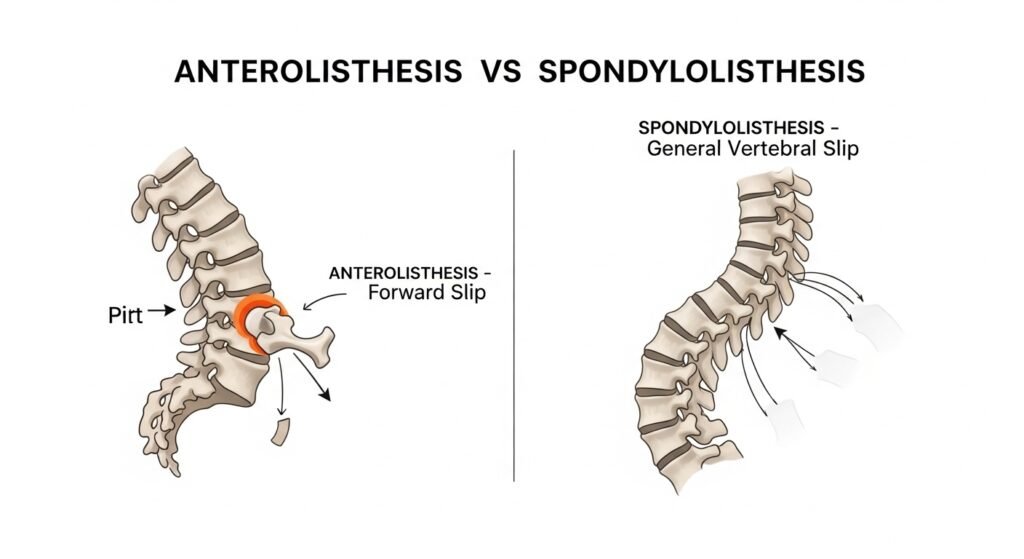
Quick Ans: The main difference between anterolisthesis vs spondylolisthesis is scope and direction. Spondylolisthesis is a general condition where one vertebra slips out of place, while anterolisthesis is a specific type of spondylolisthesis in which the vertebra slips forward. In short, all anterolisthesis cases are spondylolisthesis, but not all spondylolisthesis cases are anterolisthesis.
Many people search for anterolisthesis vs spondylolisthesis when they read a spine report or hear a diagnosis from a doctor. Both terms sound similar. Both relate to the spine. However, they are not exactly the same.
Spondylolisthesis is the broader term. It describes any slipping of a vertebra over another. Anterolisthesis, on the other hand, describes a specific direction of that slip.
This difference may seem small, yet it matters. Treatment, symptoms, and severity can vary depending on the type and direction of the slip. For example, a forward slip may affect nerves differently than a backward slip.
Understanding the difference helps patients ask better questions and follow treatment plans more clearly. It also reduces confusion when reading medical reports.
In this guide, you will learn definitions, causes, symptoms, treatments, and comparisons. You will also explore real world examples, common mistakes, and exercises. By the end, the concept of anterolisthesis vs spondylolisthesis will feel simple and clear.
Quick Answer: Anterolisthesis vs Spondylolisthesis
The easiest way to understand anterolisthesis vs spondylolisthesis is through a simple comparison.
| Feature | Anterolisthesis | Spondylolisthesis |
|---|---|---|
| Definition | Forward slipping of a vertebra | Any slipping of a vertebra |
| Scope | Specific type | General condition |
| Direction | Forward only | Forward, backward, or sideways |
| Medical Use | Describes direction | Describes condition |
In simple terms, anterolisthesis is a type of spondylolisthesis.
What Is Spondylolisthesis?
Spondylolisthesis is a condition in which one vertebra moves out of its normal position over the vertebra below it. This shift can occur in different directions.
The most common directions include:
- Forward
- Backward
- Rarely sideways
Because of this, spondylolisthesis is a general term rather than a specific diagnosis.
Types of Spondylolisthesis
Doctors classify spondylolisthesis into several types:
- Degenerative
- Isthmic
- Congenital
- Traumatic
- Pathological
Each type has a different cause, although the result involves vertebral slippage.
Common Symptoms
Symptoms vary depending on severity.
- Lower back pain
- Muscle tightness
- Nerve pain
- Tingling or numbness
- Difficulty walking
However, some people experience no symptoms at all.
How It Is Diagnosed
Doctors use imaging tests such as:
- X rays
- MRI scans
- CT scans
These tests help determine the degree and direction of the slip.
What Is Anterolisthesis?
Anterolisthesis is a specific type of spondylolisthesis. In this condition, a vertebra slips forward over the one below it.
The term comes from:
- “Antero” meaning front
- “Listhesis” meaning slip
Therefore, the word directly describes a forward movement.
Where It Commonly Occurs
Anterolisthesis most often affects the lower spine, especially:
- Lumbar region
- L4 L5 levels
- L5 S1 levels
These areas carry more body weight, which increases stress on the spine.
Symptoms of Anterolisthesis
Symptoms may include:
- Lower back pain
- Pain radiating to legs
- Stiffness
- Muscle weakness
In more severe cases, nerve compression may occur.
Causes of Anterolisthesis
Common causes include:
- Aging and degeneration
- Spinal injury
- Repetitive stress
- Congenital defects
Although the causes overlap with general spondylolisthesis, the defining factor remains forward slippage.
Key Differences Between Anterolisthesis vs Spondylolisthesis
Scope
The most important difference in anterolisthesis vs spondylolisthesis is scope. Spondylolisthesis is the general condition. Anterolisthesis represents one specific type.
Direction
Anterolisthesis always involves forward movement. Spondylolisthesis can involve forward, backward, or other directions.
Medical Usage
Doctors use spondylolisthesis when describing the condition broadly. They use anterolisthesis when specifying forward slippage.
Clarity
Anterolisthesis provides more detailed information. Spondylolisthesis gives a general overview.
Advantages and Disadvantages of Terminology
Advantages of Using Spondylolisthesis
- Covers all types of vertebral slippage
- Easy to use in general diagnosis
- Widely recognized term
Disadvantages of Using Spondylolisthesis
- Lacks detail about direction
- May cause confusion
Advantages of Using Anterolisthesis
- Clearly describes forward movement
- More precise diagnosis
- Helps guide treatment decisions
Disadvantages of Using Anterolisthesis
- Less commonly understood by patients
- Requires explanation
Therefore, both terms are useful depending on context.
Grading Severity
Doctors often grade spondylolisthesis based on how far the vertebra has slipped.
| Grade | Percentage of Slip |
|---|---|
| Grade 1 | 0 to 25 percent |
| Grade 2 | 25 to 50 percent |
| Grade 3 | 50 to 75 percent |
| Grade 4 | 75 to 100 percent |
These grades apply to anterolisthesis as well because it is a type of spondylolisthesis.
Real World Examples
Example 1: Mild Case
A patient experiences slight back pain. Imaging shows a small forward slip of L4 over L5. The doctor diagnoses Grade 1 anterolisthesis.
Example 2: General Diagnosis
Another patient has vertebral slippage but direction is not specified initially. The doctor uses the term spondylolisthesis until further tests clarify the type.
Example 3: Severe Case
A patient reports leg pain and numbness. Imaging shows significant forward slippage. The diagnosis becomes higher grade anterolisthesis with nerve involvement.
These examples show how anterolisthesis vs spondylolisthesis appears in clinical settings.
Causes and Risk Factors
Common Causes
Several factors contribute to both conditions:
- Aging and wear
- Repetitive strain
- Sports injuries
- Congenital spine issues
Risk Factors
Certain groups face higher risk:
- Older adults
- Athletes
- Individuals with poor posture
- People with spinal injuries
Because anterolisthesis is a subset, these causes apply to both terms.
Treatment Options
Non Surgical Treatment
Most cases start with conservative treatment:
- Physical therapy
- Pain relief medication
- Activity modification
- Bracing
These approaches aim to reduce pain and improve function.
Surgical Treatment
Surgery may be required in severe cases.
Common procedures include:
- Spinal fusion
- Decompression surgery
Doctors recommend surgery when nerve compression or instability becomes serious.
Common Mistakes About Anterolisthesis vs Spondylolisthesis
Treating Terms as Identical
Although related, they are not identical. One is general, while the other is specific.
Ignoring Direction
Direction matters in diagnosis and treatment. Forward and backward slips affect the spine differently.
Assuming All Cases Are Severe
Many cases are mild and manageable without surgery.
Misreading Medical Reports
Patients often see unfamiliar terms and assume different conditions. In reality, anterolisthesis is part of spondylolisthesis.
Beginner to Advanced Understanding
Beginner Level
Focus on the basic idea: vertebra slipping out of place.
Intermediate Level
Learn about direction and grading systems.
Advanced Level
Understand nerve involvement, imaging interpretation, and treatment planning.
This step by step approach helps simplify the anterolisthesis vs spondylolisthesis topic.
Step By Step Diagnostic Scenario
Imagine a patient with back pain.
First, the doctor orders imaging.
Next, the scan shows vertebral slippage.
Then, the doctor identifies the direction of movement.
Finally, the diagnosis becomes either general spondylolisthesis or specific anterolisthesis.
This process shows how doctors move from general to specific terms.
Exercises With Answers
Exercise 1
What is the main difference in anterolisthesis vs spondylolisthesis?
Answer: Anterolisthesis is a forward slip, while spondylolisthesis is any vertebral slip.
Exercise 2
Is anterolisthesis a type of spondylolisthesis?
Answer: Yes.
Exercise 3
Which term is more general?
Answer: Spondylolisthesis.
Exercise 4
Which condition describes forward movement?
Answer: Anterolisthesis.
Exercise 5
True or False: All spondylolisthesis cases are anterolisthesis.
Answer: False.
When Should You Use Anterolisthesis vs Spondylolisthesis?
Use spondylolisthesis when:
- Referring to general vertebral slippage
- Direction is unknown
- Discussing the condition broadly
Use anterolisthesis when:
- Direction is clearly forward
- Detailed diagnosis is needed
- Writing medical reports
Choosing the right term improves communication and clarity.
FAQs About Anterolisthesis vs Spondylolisthesis
What is the difference between anterolisthesis vs spondylolisthesis?
Anterolisthesis refers to forward slippage of a vertebra, while spondylolisthesis includes any direction of slippage.
Is anterolisthesis serious?
Severity depends on the grade. Many mild cases cause minimal symptoms.
Can spondylolisthesis heal on its own?
It usually does not reverse completely, but symptoms can improve with treatment.
Which is more common, anterolisthesis or other types?
Forward slippage is one of the most common forms of spondylolisthesis.
Do both conditions cause pain?
They can, but some people remain symptom free.
Is surgery always required?
No. Most cases respond to non surgical treatment.
How is anterolisthesis diagnosed?
Doctors use imaging such as X rays and MRI scans.
Can exercise help spondylolisthesis?
Yes. Physical therapy strengthens muscles and supports the spine.
What happens if it gets worse?
Severe cases may compress nerves and require surgery.
Are these conditions related to aging?
Yes. Degeneration is a common cause, especially in older adults.
Conclusion
Understanding anterolisthesis vs spondylolisthesis becomes easier when you focus on scope and direction. Spondylolisthesis describes the general condition of vertebral slippage. Anterolisthesis identifies a specific forward movement within that condition.
Although the terms sound complex, the difference is simple. One is broad, while the other is precise. This distinction helps doctors diagnose accurately and guide treatment effectively.
Patients benefit from knowing these terms. Clear understanding improves communication with healthcare providers. It also reduces confusion when reading medical reports.
Most importantly, many cases are manageable. Early diagnosis, proper care, and lifestyle adjustments can reduce symptoms and improve quality of life.
By learning the difference between anterolisthesis vs spondylolisthesis, you can better understand spinal health and make informed decisions about treatment.
Discover More:-
- Ipamorelin vs Tesamorelin: Key Differences, Benefits, and Peptide Comparison
- OD vs Ophthalmologist: Key Differences, Training, and Eye Care Guide

Jennifer Collins is a professional grammar expert and language educator at gramtivo.com, specializing in English grammar, writing skills, and language improvement. She holds a Master’s degree in English Language and Literature from a recognized university in the United States. With years of teaching and content development experience, she is dedicated to helping learners improve their communication skills with clear and practical guidance.