
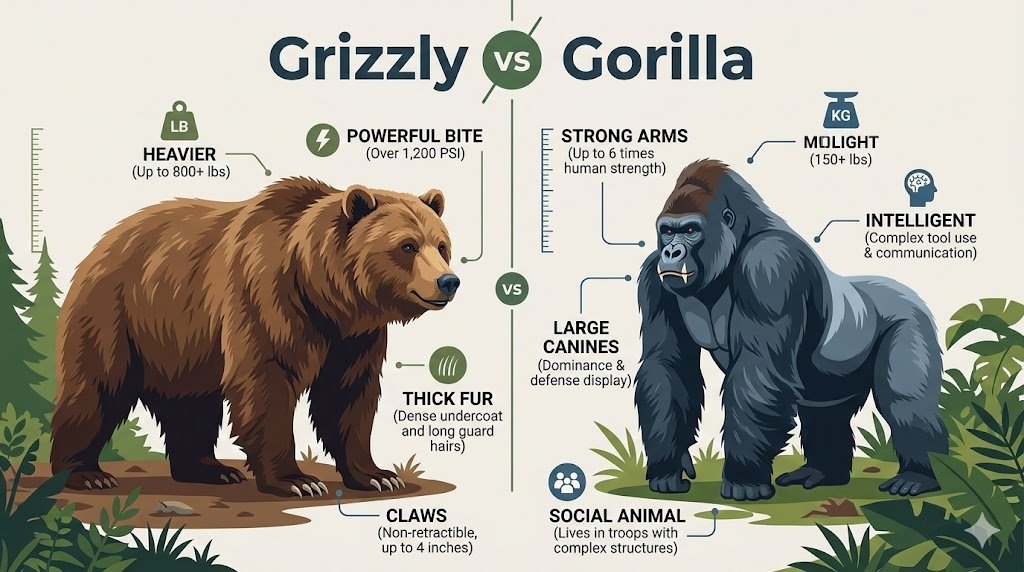
Quick Ans: The main difference between a grizzly vs gorilla is species, size, and fighting ability. A grizzly bear is larger, heavier, and equipped with sharp claws and powerful jaws, while a gorilla relies on strong arms and intelligence. In most realistic scenarios, a grizzly would likely overpower a gorilla due to its size and natural weapons.
The debate about grizzly vs gorilla is very popular online. Many people wonder who would win in a fight. Others are simply curious about how these two powerful animals compare.
However, they are very different animals. One is a massive bear built for hunting and survival in harsh climates. The other is a powerful primate known for intelligence and social behavior.
Because they live on different continents, they would never meet in the wild. Still, people continue to compare them for strength, speed, bite force, and overall power.
In this article, you will learn the real differences between a grizzly vs gorilla. We will explore size, strength, behavior, habitat, advantages, disadvantages, and realistic fight analysis. By the end, you will understand which animal has the physical edge and why.
Quick Answer: Grizzly vs Gorilla
Here is a simple comparison of grizzly vs gorilla.
| Feature | Grizzly Bear | Gorilla |
|---|---|---|
| Species | Bear | Great ape |
| Average Weight | 400–800 kg | 140–200 kg |
| Height | Up to 8 feet standing | Up to 5.5 feet standing |
| Natural Weapons | Claws and teeth | Bite and arm strength |
| Habitat | North America | Central Africa |
| Likely Fight Outcome | Strong advantage | Lower advantage |
In short, a grizzly is bigger, heavier, and better equipped for combat. A gorilla is strong but not built to fight predators like bears.
What Is a Grizzly Bear?
A grizzly bear is a subspecies of the brown bear. The scientific name is Ursus arctos horribilis. Grizzlies live mainly in North America, especially in Alaska, western Canada, and parts of the northwestern United States.
Grizzlies are known for:
- Massive size
- Thick fur
- Long curved claws
- Extremely powerful bite
They are omnivores. This means they eat meat and plants. Their diet includes fish, berries, small mammals, and even large animals like elk.
Because they survive in cold and competitive environments, they are built for power and endurance.
What Is a Gorilla?
A gorilla is the largest living primate. The most well-known type is the Western gorilla. Gorillas live in forests in Central Africa.
They are known for:
- Strong arms
- Broad chest
- Large canine teeth
- High intelligence
Gorillas are mostly herbivores. They eat leaves, stems, fruit, and bamboo. Although they are powerful, they are generally peaceful animals.
Unlike bears, gorillas do not regularly fight other large predators. Instead, they use displays and intimidation to avoid conflict.
Size Comparison in Grizzly vs Gorilla
Size plays a major role in the grizzly vs gorilla debate.
Grizzly Size
- Weight: 400 to 800 kilograms
- Standing height: Up to 8 feet
- Paw size: Large enough to crush bone
Gorilla Size
- Weight: 140 to 200 kilograms
- Standing height: About 5 to 5.5 feet
- Arm span: Up to 8 feet
Although gorillas have impressive arm reach, grizzlies outweigh them by hundreds of kilograms. Therefore, the bear has a clear size advantage.
Strength and Physical Power
Grizzly Strength
Grizzlies can:
- Flip large rocks
- Break bones with one swipe
- Run up to 35 miles per hour
- Bite with crushing force
Their claws can grow up to 4 inches long. In addition, their bite force is strong enough to break thick bone.
Gorilla Strength
Gorillas are extremely strong for their size. They can:
- Lift several times their body weight
- Tear apart vegetation
- Deliver powerful punches
However, their strength is mostly designed for climbing and dominance within their group. It is not meant for fighting large carnivores.
As a result, in the grizzly vs gorilla comparison, the bear has the edge in raw power.
Natural Weapons Comparison
One of the biggest differences in grizzly vs gorilla is weaponry.
| Feature | Grizzly | Gorilla |
|---|---|---|
| Claws | Yes, long and sharp | No |
| Teeth | Long and thick | Large canines |
| Fur Protection | Thick and dense | Thinner |
| Fat Layer | Thick | Thin |
Grizzlies have claws built for digging and fighting. Moreover, their thick fur and fat provide extra protection.
Gorillas, on the other hand, rely mostly on biting and arm strength. Therefore, they lack the defensive tools that bears possess.
Behavior and Temperament
Grizzly Behavior
Grizzlies can be aggressive when threatened. They defend territory, food, and cubs fiercely. Furthermore, they are experienced predators.
Gorilla Behavior
Gorillas are generally peaceful. Silverbacks protect their troop, but they prefer to scare threats away rather than fight.
Because of this difference, a grizzly is more accustomed to violent encounters.
Real World Scenario: Who Would Win?
It is important to remember that grizzly vs gorilla fights do not happen in nature. They live on different continents.
However, if we imagine a neutral environment:
- The grizzly is heavier.
- The grizzly has claws.
- The grizzly has thicker skin and fat.
- The grizzly has hunting experience.
Although a gorilla could deliver powerful blows, it would struggle against the bear’s claws and bite.
Therefore, in most realistic scenarios, the grizzly would likely win.
Advantages and Disadvantages
Grizzly Advantages
- Larger body mass
- Sharp claws
- Thick protection
- Predatory instinct
Grizzly Disadvantages
- Slower arm movement compared to primates
- Less agility in climbing
Gorilla Advantages
- Strong arms
- High intelligence
- Quick upper body movement
Gorilla Disadvantages
- No claws
- Much lighter
- Not built to fight large carnivores
When comparing grizzly vs gorilla, the bear holds more combat advantages.
Regional and Habitat Differences
Grizzly Habitat
Grizzlies live in:
- Forests
- Mountains
- Tundra
They survive in cold climates and hibernate during winter.
Gorilla Habitat
Gorillas live in:
- Tropical rainforests
- Dense vegetation
- Warm climates
These environments shape their physical traits. For example, grizzlies need fat for cold weather. Gorillas rely on plant abundance.
Common Mistakes in the Grizzly vs Gorilla Debate
Ignoring Size Difference
Many people forget the huge weight gap. Size matters in animal combat.
Overestimating Gorilla Strength
Although gorillas are strong, they are not superhuman. Internet myths exaggerate their power.
Forgetting Natural Weapons
Claws are a major factor. Gorillas do not have them.
Assuming Intelligence Equals Victory
While gorillas are intelligent, instinct and weaponry often matter more in physical fights.
Beginner to Advanced Analysis
Beginner View
The bigger animal usually wins. In this case, the grizzly is bigger.
Intermediate View
Consider bite force, claw damage, and fat protection. All favor the bear.
Advanced View
Energy systems, muscle fiber types, and combat experience also matter. Bears regularly fight other large animals. Gorillas do not.
Therefore, advanced analysis strengthens the conclusion in the grizzly vs gorilla comparison.
Exercises With Answers
Exercise 1
Which animal weighs more in the grizzly vs gorilla comparison?
Answer: Grizzly bear.
Exercise 2
Which animal has long, sharp claws?
Answer: Grizzly bear.
Exercise 3
Which animal is more intelligent socially?
Answer: Gorilla.
Exercise 4
Do grizzlies and gorillas live on the same continent?
Answer: No.
Exercise 5
Which animal has thicker skin and fat protection?
Answer: Grizzly bear.
Related Comparisons
People often compare:
- Lion vs gorilla
- Tiger vs bear
- Grizzly vs polar bear
Each comparison depends on size, weapons, and behavior. However, in grizzly vs gorilla, the bear clearly has more combat advantages.
FAQs About Grizzly vs Gorilla
Who would win in a grizzly vs gorilla fight?
In most realistic scenarios, a grizzly bear would likely win due to size, claws, and bite strength.
Is a gorilla stronger than a grizzly?
No. While gorillas are strong for their size, grizzlies are much larger and more powerful overall.
Can a gorilla punch harder than a bear?
A gorilla can punch powerfully; however, a bear’s claw swipe and bite are far more destructive.
Do grizzlies and gorillas ever meet in the wild?
No. Grizzlies live in North America, while gorillas live in Central Africa.
Which animal has a stronger bite in grizzly vs gorilla?
The grizzly bear has a significantly stronger bite force.
Are gorillas aggressive animals?
Generally no. Gorillas are peaceful unless threatened.
Is a grizzly the strongest bear?
Grizzlies are very strong, although Kodiak and polar bears can be even larger.
Could a gorilla outsmart a grizzly?
Intelligence helps in social situations; however, it would not likely overcome the size and weapon disadvantage.
Why is the grizzly favored in grizzly vs gorilla debates?
Because it has superior mass, claws, thick protection, and predatory experience.
Is this comparison realistic?
No. It is hypothetical since the animals live on different continents.
Conclusion
The grizzly vs gorilla debate is fascinating, but the outcome becomes clearer when you examine the facts. Grizzlies are larger, heavier, and equipped with deadly claws and powerful jaws. Gorillas are intelligent and strong, yet they lack natural weapons designed for predator combat.
Although both animals are impressive in their own environments, they are built for different purposes. The grizzly survives harsh climates and fights large prey. Meanwhile, the gorilla thrives in social forest groups and avoids serious conflict.
Therefore, in a direct physical encounter, the grizzly would most likely have the advantage. Still, both animals deserve respect for their unique strengths.
Understanding the science behind grizzly vs gorilla helps separate fact from myth. Instead of relying on internet exaggeration, focus on biology, physics, and real world behavior.

Robert Mitchell is a U.S.-based writer at Gramtivo.Com who focuses on grammar, writing improvement, and language-related content. He holds a degree in English and Linguistics from a U.S. university. His work aims to help readers enhance their writing skills with clear and practical guidance.