
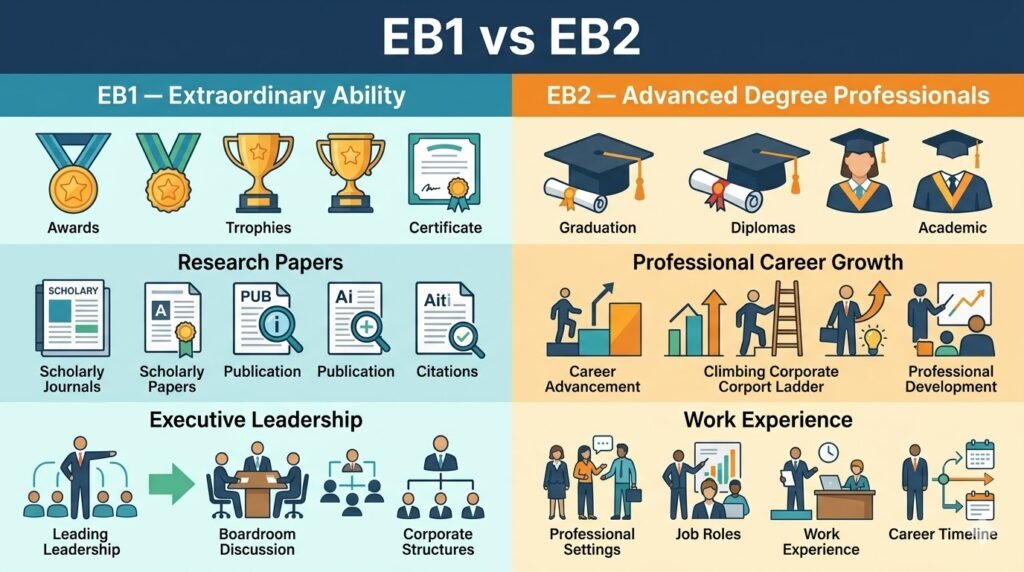
Quick Ans: The main difference between EB1 vs EB2 is the level of qualifications required for U.S. employment-based immigration. EB1 is designed for individuals with extraordinary ability, outstanding professors, or multinational executives, while EB2 is for professionals with advanced degrees or exceptional ability in their field. Both lead to a U.S. green card, but EB1 generally has stricter requirements and faster processing.
Many professionals who want to work and live in the United States often compare EB1 vs EB2 immigration categories. Both belong to employment-based green card programs. Both allow skilled individuals to become permanent residents. However, their eligibility requirements and application processes are different.
Understanding these differences is important. Choosing the correct category can affect approval chances, waiting times, and paperwork requirements.
For example, some applicants qualify for EB1 because of exceptional achievements or leadership roles. Others apply under EB2 because they have advanced degrees or strong professional experience.
In many cases, applicants mistakenly apply for the wrong category. That mistake can delay the immigration process or reduce approval chances.
Learning the differences between EB1 vs EB2 helps professionals, researchers, executives, and skilled workers choose the best immigration path. This guide explains eligibility, advantages, disadvantages, examples, and common mistakes to help you understand both categories clearly.
Quick Answer: EB1 vs EB2
To quickly understand EB1 vs EB2, focus on eligibility and applicant profile.
| Feature | EB1 | EB2 |
|---|---|---|
| Skill Level | Highest category | High but slightly lower |
| Main Applicants | Extraordinary ability, executives | Advanced degree professionals |
| Job Offer Required | Sometimes not required | Usually required |
| Processing Speed | Often faster | Often slower |
| Competition | Lower because standards are high | Higher due to larger applicant pool |
In simple terms, EB1 is for top level professionals, while EB2 is for highly educated or skilled professionals.
What Is EB1?
EB1 is the first preference employment-based immigrant visa category in the United States. It is designed for individuals with exceptional achievements or leadership roles.
Three main subcategories exist within EB1.
EB1A: Extraordinary Ability
This category applies to individuals with outstanding achievements in fields such as:
- Science
- Arts
- Education
- Business
- Athletics
Applicants must demonstrate national or international recognition.
Examples include:
- Award-winning scientists
- Famous artists
- Olympic athletes
- Highly cited researchers
Notably, EB1A does not require a job offer, which makes it unique among employment-based visas.
EB1B: Outstanding Professors and Researchers
This category applies to academics with significant research achievements.
Requirements usually include:
- International recognition
- Several years of research or teaching experience
- A permanent job offer from a U.S. university or research institution
EB1C: Multinational Managers or Executives
This category applies to executives working for multinational companies.
Requirements typically include:
- Management or executive role
- Work with a company that has offices both outside and inside the United States
- Transfer to a U.S. branch
Because of these categories, EB1 is often considered the top employment-based immigration option.
What Is EB2?
EB2 is the second preference employment-based immigrant visa category. It is designed for professionals who demonstrate advanced education or exceptional ability.
Two main subcategories exist.
EB2 Advanced Degree
This category applies to professionals who have:
- A master’s degree or higher
- Or a bachelor’s degree plus at least five years of professional experience
Common applicants include:
- Engineers
- Doctors
- Scientists
- IT professionals
- Financial analysts
EB2 Exceptional Ability
Applicants in this category must show exceptional ability in fields such as:
- Science
- Business
- Arts
However, the level of achievement is generally lower than EB1 requirements.
EB2 National Interest Waiver (NIW)
Some applicants qualify for National Interest Waiver, which allows them to skip the job offer requirement if their work benefits the United States.
For example:
- Medical researchers
- Renewable energy experts
- Public health professionals
Therefore, EB2 can also provide flexibility for certain highly skilled professionals.
Key Differences Between EB1 vs EB2
Eligibility Level
The most important difference in EB1 vs EB2 is the level of achievement required.
EB1 requires extraordinary accomplishments or leadership roles. EB2 requires advanced education or professional expertise.
Job Offer Requirement
Some EB1 categories allow applicants to self-petition without a job offer. EB2 usually requires employer sponsorship unless the applicant qualifies for National Interest Waiver.
Processing Time
Because EB1 has stricter standards, fewer people qualify. As a result, processing is often faster. EB2 typically has longer waiting periods due to high demand.
Approval Difficulty
EB1 has higher standards but fewer applicants. EB2 has lower standards but greater competition.
Advantages and Disadvantages
EB1 Advantages
- Faster processing times
- No labor certification required in many cases
- Self-petition possible for EB1A
- Higher priority in visa allocation
EB1 Disadvantages
- Extremely strict eligibility criteria
- Requires strong evidence of achievements
- Not suitable for many professionals
EB2 Advantages
- Wider eligibility for skilled professionals
- Suitable for advanced degree holders
- National Interest Waiver option available
EB2 Disadvantages
- Often requires employer sponsorship
- Labor certification may be required
- Longer waiting times for many countries
These factors influence the choice between EB1 vs EB2.
Real World Examples
Research Scientist
A globally recognized researcher with numerous publications may qualify for EB1A.
A scientist with a master’s degree and strong professional experience may apply under EB2.
Corporate Executive
A multinational company manager transferred to the U.S. may qualify under EB1C.
Skilled Professional
An experienced software engineer with an advanced degree may qualify for EB2.
These examples show how applicant background determines eligibility.
Regional and Global Usage
High Demand Countries
Applicants from countries such as India and China often face longer waiting periods in EB2 due to visa backlogs.
Global Applicants
Professionals from Europe, Canada, and many other regions often experience shorter waiting times.
Because of demand differences, some applicants try to qualify for EB1 to avoid long delays.
Thus, the EB1 vs EB2 decision often depends on both qualifications and country of origin.
Related Immigration Categories
EB1 vs EB2 vs EB3
| Category | Skill Level | Typical Applicants |
|---|---|---|
| EB1 | Extraordinary ability | Executives, elite researchers |
| EB2 | Advanced degree professionals | Engineers, doctors |
| EB3 | Skilled workers | Technicians, support professionals |
EB2 vs H1B Visa
H1B is a temporary work visa. EB2 leads directly to permanent residence.
Understanding these categories helps applicants plan their immigration pathway.
Common Mistakes About EB1 vs EB2
Applying for EB1 Without Strong Evidence
Many applicants overestimate their achievements. EB1 requires significant recognition.
Ignoring EB2 National Interest Waiver
Some applicants overlook NIW even though it removes the job offer requirement.
Weak Documentation
Immigration petitions require strong evidence such as:
- Awards
- Publications
- Recommendation letters
Choosing the Wrong Category
Incorrect classification may lead to delays or rejection.
Avoiding these mistakes improves approval chances.
Beginner to Advanced Immigration Tips
Beginner Level
Start by reviewing eligibility requirements carefully. Compare qualifications with EB1 and EB2 criteria.
Intermediate Level
Collect strong supporting documents such as research publications, employment records, and recommendation letters.
Advanced Level
Consult immigration experts to prepare strong petitions and improve approval chances.
Strategic planning can significantly increase success rates.
Step By Step Application Scenario
Imagine a professional planning to immigrate to the United States.
If applying for EB1:
- Gather evidence of extraordinary achievements
- Submit immigration petition
- Provide supporting documentation
- Apply for adjustment of status or immigrant visa
If applying for EB2:
- Obtain job offer from U.S. employer
- Complete labor certification process
- Submit immigrant petition
- Apply for permanent residence
Although both lead to green cards, the application paths differ.
Exercises With Answers
Exercise 1
Which immigration category requires extraordinary ability?
Answer: EB1.
Exercise 2
Which category is designed for advanced degree professionals?
Answer: EB2.
Exercise 3
Which category often has faster processing times?
Answer: EB1.
Exercise 4
Which program may require labor certification?
Answer: EB2.
Exercise 5
True or False: EB1 always requires a job offer.
Answer: False.
When Should You Choose EB1 vs EB2?
Choose EB1 if you:
- Have international recognition
- Hold executive leadership roles
- Have major achievements in your field
Choose EB2 if you:
- Hold an advanced degree
- Have strong professional experience
- Work in specialized professional fields
Selecting the correct category improves success chances.
FAQs About EB1 vs EB2
What is the main difference between EB1 vs EB2?
EB1 is designed for extraordinary ability or top executives, while EB2 targets advanced degree professionals and individuals with exceptional ability.
Which category processes faster, EB1 or EB2?
EB1 often processes faster because fewer applicants meet its strict requirements.
Can someone apply for EB1 and EB2 at the same time?
Yes. Some applicants submit petitions in both categories to increase approval chances.
Does EB2 require a job offer?
Usually yes, but applicants may qualify for National Interest Waiver to avoid employer sponsorship.
Is EB1 harder to get than EB2?
Yes. EB1 requires stronger achievements and international recognition.
Which visa category is better for researchers?
Highly recognized researchers may qualify for EB1B. Others often apply through EB2.
Do both EB1 and EB2 lead to green cards?
Yes. Both categories lead to U.S. permanent residence.
Is labor certification required for EB1?
No. EB1 categories usually do not require labor certification.
Can entrepreneurs apply for EB2?
Yes. Entrepreneurs may qualify through EB2 National Interest Waiver if their work benefits the U.S.
Which category has more applicants worldwide?
EB2 generally has more applicants because its eligibility requirements are broader.
Conclusion
Understanding EB1 vs EB2 is essential for professionals seeking U.S. permanent residency through employment. Both categories offer pathways to a green card, but they serve different types of applicants.
EB1 targets individuals with extraordinary achievements, leadership roles, or international recognition. Because standards are extremely high, the number of applicants remains smaller. As a result, processing times are often faster.
EB2 focuses on professionals with advanced degrees or exceptional abilities. Many skilled workers qualify under this category, which explains the higher demand and longer waiting times in some countries.
Choosing the right category depends on qualifications, career achievements, and immigration strategy. Applicants with exceptional recognition may benefit from EB1, while advanced degree professionals often find EB2 more accessible.
Careful preparation, strong documentation, and strategic planning increase approval chances in both categories.
Discover More:-
- Offerpad vs Opendoor: Key Differences, Fees, and Home Selling Guide
- Aquasonic vs Sonicare: Which Electric Toothbrush Is Better?

Jennifer Collins is a professional grammar expert and language educator at gramtivo.com, specializing in English grammar, writing skills, and language improvement. She holds a Master’s degree in English Language and Literature from a recognized university in the United States. With years of teaching and content development experience, she is dedicated to helping learners improve their communication skills with clear and practical guidance.