
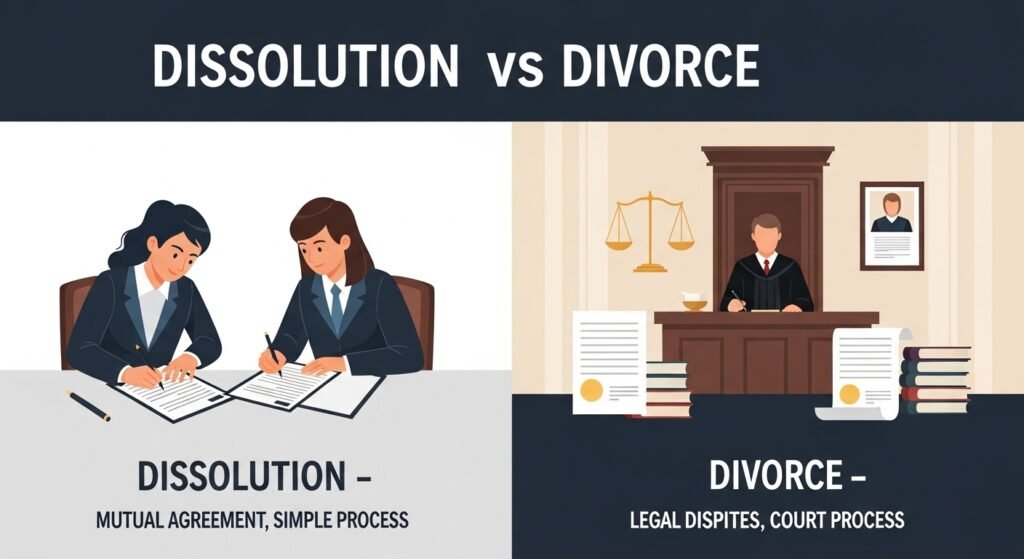
Quick Ans: The main difference between dissolution vs divorce lies in legal process and agreement. Dissolution is usually a simpler, mutual agreement to end a marriage without major disputes, while divorce often involves court proceedings to resolve conflicts over property, custody, or support. Both legally end a marriage, but the path and complexity can vary.
Many couples search for dissolution vs divorce when considering how to end a marriage. Both options legally end a relationship. Both affect finances, property, and sometimes children.
However, they are not the same.
The confusion often comes from the terms themselves. In some places, the words are used interchangeably. In other regions, they describe very different legal processes.
For example, some couples want a peaceful and quick separation. Others face disagreements about assets or child custody. Because of this, choosing the right legal path becomes important.
Understanding dissolution vs divorce helps people make informed decisions. It can reduce stress, save time, and lower legal costs. It also helps you prepare for what lies ahead.
In this guide, you will learn definitions, differences, advantages, disadvantages, real world examples, and common mistakes. You will also find practical exercises and FAQs to strengthen your understanding.
Quick Answer: Dissolution vs Divorce
To understand dissolution vs divorce, focus on agreement and legal complexity.
| Feature | Dissolution | Divorce |
|---|---|---|
| Agreement | Mutual agreement | May involve disputes |
| Court Involvement | Minimal | Often higher |
| Process Speed | Faster | Slower |
| Cost | Lower | Higher |
| Conflict Level | Low | Can be high |
In simple terms, dissolution is cooperative, while divorce may be contested.
What Is a Dissolution?
A dissolution is a legal process that ends a marriage through mutual agreement. Both spouses agree on major issues such as property division, finances, and child custody.
Because both parties cooperate, the process is usually simpler.
Key Features of Dissolution
Dissolution often includes:
- Agreement between spouses
- Limited court involvement
- Faster resolution
- Lower legal costs
In many cases, couples file jointly and submit a settlement agreement.
How Dissolution Works
The process typically follows these steps:
- Both spouses agree to end the marriage
- They create a written agreement
- They file legal documents together
- A judge reviews the agreement
- The marriage is legally ended
Since disputes are resolved in advance, court hearings are often minimal.
When Dissolution Is Used
Dissolution works best when:
- Both parties agree on key issues
- There are no major conflicts
- Communication remains respectful
- Financial matters are straightforward
As a result, dissolution is often called an uncontested separation.
What Is a Divorce?
A divorce is a legal process that ends a marriage, often involving court intervention to resolve disagreements. Unlike dissolution, divorce may include disputes over assets, custody, or financial support.
Because conflicts may arise, the process can take longer.
Key Features of Divorce
Divorce commonly involves:
- Legal disputes between spouses
- Court hearings and decisions
- Lawyers representing each party
- Longer timelines
In many cases, the court makes final decisions when spouses cannot agree.
Types of Divorce
Different forms of divorce exist:
- Contested divorce where spouses disagree
- Uncontested divorce where agreement exists
- No fault divorce based on irreconcilable differences
Each type affects time, cost, and complexity.
How Divorce Works
The typical process includes:
- One spouse files for divorce
- The other responds
- Both sides present evidence
- Court hearings take place
- A judge issues a final order
Because of legal procedures, divorce can become complex.
Key Differences Between Dissolution vs Divorce
Agreement Level
The most important difference in dissolution vs divorce is agreement. Dissolution requires mutual understanding. Divorce may involve disagreements.
Time Required
Dissolution usually finishes faster. Divorce may take months or even years depending on disputes.
Cost
Lower legal involvement makes dissolution cheaper. Divorce often requires lawyers and court fees.
Emotional Impact
Dissolution tends to be less stressful. Divorce can be emotionally challenging due to conflict.
Legal Complexity
Dissolution involves fewer legal steps. Divorce may include detailed legal proceedings.
Advantages and Disadvantages
Dissolution Advantages
- Faster process
- Lower cost
- Less stress
- Greater control over outcomes
Dissolution Disadvantages
- Requires full agreement
- Not suitable for high conflict cases
- May not address complex disputes
Divorce Advantages
- Resolves disputes legally
- Protects rights through court decisions
- Handles complex financial issues
Divorce Disadvantages
- Higher cost
- Longer process
- More emotional stress
Choosing between dissolution vs divorce depends on the situation and relationship dynamics.
Real World Examples
Example 1: Mutual Separation
A couple agrees to end their marriage peacefully. They divide assets and agree on child custody. In this case, dissolution is the best option.
Example 2: Disputed Assets
One spouse disagrees about property division. The other wants financial support. This situation requires divorce to resolve disputes.
Example 3: Child Custody Conflict
Parents cannot agree on custody arrangements. The court must decide. Therefore, divorce becomes necessary.
These examples show how dissolution vs divorce applies in real situations.
Regional and Global Usage
Legal Terminology Differences
In some countries, dissolution and divorce mean the same thing. In others, dissolution refers to a simplified legal process.
United States Example
Certain states use “dissolution of marriage” as a legal term for ending a marriage. However, the process may still resemble divorce depending on the situation.
Global Perspective
Different countries have different laws. Some emphasize mediation, while others rely on court decisions.
Understanding local laws is important when comparing dissolution vs divorce.
Related Concepts and Comparisons
Separation vs Divorce
Separation means living apart without ending the marriage legally. Divorce ends the marriage completely.
Annulment vs Dissolution
Annulment declares a marriage invalid. Dissolution ends a valid marriage.
Dissolution vs Divorce vs Separation
| Feature | Dissolution | Divorce | Separation |
|---|---|---|---|
| Ends Marriage | Yes | Yes | No |
| Agreement Needed | Yes | Not always | Sometimes |
| Court Role | Minimal | High | Low |
These comparisons provide a broader understanding of relationship laws.
Common Mistakes About Dissolution vs Divorce
Assuming They Are Always the Same
In some places, the terms differ significantly. Always check local legal definitions.
Ignoring Legal Requirements
Even dissolution requires legal paperwork. Skipping steps can delay the process.
Choosing Dissolution Without Agreement
Dissolution only works when both parties agree. Otherwise, it may fail.
Underestimating Complexity
Some cases involve complex finances or custody issues. Divorce may be necessary.
Avoiding these mistakes helps ensure a smoother process.
Beginner to Advanced Tips
Beginner Level
Understand basic legal terms. Research local laws before making decisions.
Intermediate Level
Consult a legal professional. Prepare financial documents and agreements.
Advanced Level
Use mediation to resolve disputes. Create detailed agreements for assets and custody.
Careful planning improves outcomes in both dissolution and divorce.
Step By Step Scenario
Imagine a couple deciding to end their marriage.
If they choose dissolution:
- They discuss and agree on all issues
- They prepare a settlement agreement
- They file jointly
- The court approves the agreement
If they choose divorce:
- One spouse files the case
- The other responds
- Disputes are addressed
- Court hearings occur
- A judge makes final decisions
The same goal exists, but the process differs greatly.
Exercises With Answers
Exercise 1
Which option requires mutual agreement in the dissolution vs divorce comparison?
Answer: Dissolution.
Exercise 2
Which process may involve court disputes?
Answer: Divorce.
Exercise 3
Which option is usually faster?
Answer: Dissolution.
Exercise 4
Which process is typically more expensive?
Answer: Divorce.
Exercise 5
True or False: Dissolution always involves conflict.
Answer: False.
When Should You Choose Dissolution vs Divorce?
Choose dissolution if you:
- Agree on major issues
- Want a faster process
- Prefer lower costs
- Seek a peaceful resolution
Choose divorce if you:
- Have disagreements
- Need legal protection
- Face complex financial issues
- Require court decisions
The right choice depends on your situation.
FAQs About Dissolution vs Divorce
What is the main difference between dissolution vs divorce?
Dissolution is a mutual agreement to end a marriage, while divorce may involve court decisions and disputes.
Is dissolution the same as divorce?
Not always. In some regions, dissolution is a simplified legal process, while divorce can be more complex.
Which is faster, dissolution or divorce?
Dissolution is usually faster because both parties agree on terms.
Is dissolution cheaper than divorce?
Yes. Dissolution typically costs less due to fewer legal proceedings.
Can dissolution involve lawyers?
Yes, but it often requires less legal involvement than divorce.
What happens if couples disagree during dissolution?
If disagreements arise, the case may shift toward divorce proceedings.
Is divorce always contested?
No. Some divorces are uncontested, but they may still involve legal steps.
Does dissolution require court approval?
Yes. A judge must approve the agreement to make it legally binding.
Can children be involved in dissolution?
Yes. Custody and support must still be agreed upon.
Which option is less stressful?
Dissolution is generally less stressful due to cooperation.
Conclusion
Understanding dissolution vs divorce helps individuals make informed legal and emotional decisions. Both processes end a marriage, yet they differ in complexity, cost, and level of agreement.
Dissolution offers a simpler and faster path when both spouses agree. It reduces stress and legal expenses. This option works best for cooperative situations with clear agreements.
Divorce, however, becomes necessary when disagreements exist. It provides a legal framework to resolve conflicts and protect rights. Although it may take longer and cost more, it ensures fair outcomes in complex cases.
Choosing between dissolution vs divorce depends on communication, financial matters, and personal circumstances. Careful planning and professional guidance can make the process smoother.
By understanding these differences, you can approach the situation with clarity and confidence.
Discover More:-
- Ipamorelin vs Tesamorelin: Key Differences, Benefits, and Peptide Comparison
- Commutation vs Pardon: Key Legal Differences Explained

Lisa Thompson is a USA-based content writer and language specialist focused on grammar, writing improvement and digital publishing.
She holds a degree in English Language and Communication and has professional experience in educational and web content creation.
As the author of Gramtivo.Com, she aims to help readers improve their writing skills through clear and practical guidance.