
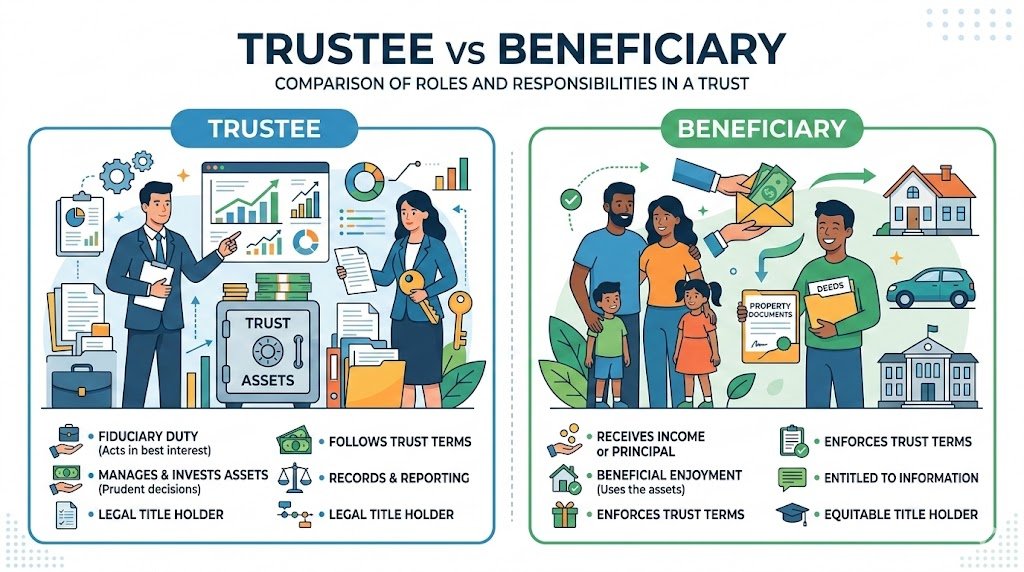
Quick Ans: The key difference between trustee vs beneficiary is their role in a trust. A trustee manages and controls the trust assets, while a beneficiary receives the benefits from those assets. In simple terms, the trustee is responsible for managing, and the beneficiary is entitled to benefit.
Many people get confused about trustee vs beneficiary when dealing with estate planning or trusts. The words sound formal. The roles can seem complicated. However, the difference is simple once explained clearly.
A trust is a legal arrangement. It helps protect assets. It also ensures that money or property is handled properly. Within that arrangement, two important roles exist: the trustee and the beneficiary.
The trustee manages. The beneficiary receives.
Confusion often happens when someone is asked to become a trustee or when a family member is named as a beneficiary. People may not know their rights, duties, or risks. Therefore, understanding trustee vs beneficiary is very important before signing any legal document.
In this guide, you will learn the definitions, responsibilities, advantages, disadvantages, real world examples, common mistakes, and frequently asked questions. By the end, you will clearly understand how these two roles differ and how they work together.
Quick Answer: Trustee vs Beneficiary
Here is a simple overview of trustee vs beneficiary.
| Feature | Trustee | Beneficiary |
|---|---|---|
| Main Role | Manages the trust | Receives benefits |
| Control Over Assets | Yes | No direct control |
| Legal Duty | Fiduciary duty | Limited or no duty |
| Liability Risk | High | Low |
| Decision Making | Yes | Usually no |
In short:
- Trustee equals manager and decision maker.
- Beneficiary equals recipient and benefit holder.
What Is a Trustee?
A trustee is a person or institution responsible for managing a trust according to its terms. The trustee must act in the best interest of the beneficiaries.
In legal terms, the trustee has a fiduciary duty. This means they must act honestly, carefully, and without personal gain.
Responsibilities of a Trustee
A trustee must:
- Manage trust assets
- Invest funds wisely
- Distribute money as required
- Keep accurate records
- Follow the trust document
- Communicate with beneficiaries
For example, if a trust holds real estate, the trustee ensures taxes are paid and property is maintained.
Types of Trustees
There are different types of trustees:
- Individual trustee, such as a family member
- Corporate trustee, such as a bank
- Successor trustee, who takes over if the original trustee cannot serve
Therefore, the trustee role carries serious legal responsibility.
What Is a Beneficiary?
A beneficiary is a person or organization that receives benefits from the trust. These benefits can include money, property, or income.
Unlike the trustee, a beneficiary does not manage the trust assets.
Rights of a Beneficiary
Although beneficiaries do not control the trust, they have rights:
- Right to receive distributions
- Right to information about the trust
- Right to hold the trustee accountable
- Right to legal action if the trustee violates duties
For example, if a trust provides education funds, the beneficiary may receive payments for tuition.
Thus, in trustee vs beneficiary, the beneficiary is the person protected by the trust.
Key Differences Between Trustee vs Beneficiary
Control and Authority
A trustee has legal control over trust assets. In contrast, a beneficiary usually has no direct control.
Legal Responsibility
Trustees have fiduciary duties and can be sued for mismanagement. Meanwhile, beneficiaries generally have no management liability.
Decision Making Power
The trustee decides how and when to distribute assets, based on the trust document. However, the beneficiary receives according to those rules.
Risk Level
Trustees carry legal risk if they fail in their duties. Beneficiaries typically carry no management risk.
Advantages and Disadvantages
Trustee Advantages
- Authority to manage assets
- Ability to shape financial outcomes
- Possible compensation for service
Trustee Disadvantages
- High legal responsibility
- Personal liability risk
- Time consuming duties
- Complex tax and legal rules
Beneficiary Advantages
- Receives financial benefit
- Low responsibility
- Protected by law
Beneficiary Disadvantages
- Limited control
- Dependent on trustee decisions
- Possible delays in distribution
Therefore, the trustee vs beneficiary comparison shows that one role carries power and responsibility, while the other carries benefit and protection.
Real World Examples
Family Trust Scenario
Imagine parents create a trust for their child.
- The parent or appointed person acts as trustee.
- The child is the beneficiary.
The trustee manages investments and releases money for school or living expenses.
Business Trust Scenario
A company creates a trust to manage employee retirement funds.
- A corporate trustee manages the investments.
- Employees are beneficiaries.
In both cases, the trustee manages, and the beneficiary receives.
Types of Trusts and Role Impact
Understanding trustee vs beneficiary also requires knowing the type of trust.
Revocable Trust
The person who creates the trust can change it. Often, they act as trustee during their lifetime.
Irrevocable Trust
Once created, it cannot easily be changed. The trustee operates independently.
Testamentary Trust
Created through a will after death.
Depending on the trust type, trustee powers and beneficiary rights may vary.
Legal and Financial Responsibilities
Trustee Legal Duties
Trustees must:
- Act in good faith
- Avoid conflicts of interest
- Invest prudently
- Keep records
- Provide reports
Failure to meet these duties can lead to lawsuits.
Beneficiary Legal Position
Beneficiaries can:
- Request information
- Review financial records
- Challenge trustee actions in court
Therefore, trustee vs beneficiary involves a balance of power and accountability.
Common Mistakes About Trustee vs Beneficiary
Assuming They Are the Same Role
Some people believe trustee and beneficiary mean the same thing. In reality, they have opposite responsibilities.
Ignoring Fiduciary Duty
A trustee who treats trust assets like personal property risks legal trouble.
Not Reading the Trust Document
Both trustees and beneficiaries must understand the trust terms carefully.
Assuming Beneficiaries Control the Trust
Beneficiaries cannot usually demand changes unless the trustee violates legal duties.
Beginner to Advanced Understanding
Beginner Level
A trustee manages. A beneficiary receives.
Intermediate Level
The trustee must follow fiduciary duties and act prudently.
Advanced Level
Trustees must understand tax laws, investment standards, reporting requirements, and potential liability.
Meanwhile, beneficiaries may need legal advice if disputes arise.
Step By Step Role Comparison
Suppose a trust holds $500,000 for a minor child.
If you are the trustee:
- Invest the funds wisely.
- Pay school fees when required.
- Keep detailed records.
- Report annually.
If you are the beneficiary:
- Receive funds according to rules.
- Request information if needed.
- Ensure trustee follows terms.
Clearly, trustee vs beneficiary involves very different daily responsibilities.
Exercises With Answers
Exercise 1
Who manages the assets in a trust?
Answer: The trustee.
Exercise 2
Who receives benefits from the trust?
Answer: The beneficiary.
Exercise 3
Who has fiduciary duty in trustee vs beneficiary?
Answer: The trustee.
Exercise 4
Can a beneficiary sue a trustee for misconduct?
Answer: Yes.
Exercise 5
True or False: Beneficiaries control trust investments.
Answer: False.
When Should You Accept Each Role?
Accepting the Trustee Role
Consider becoming a trustee if you:
- Are organized
- Understand financial responsibility
- Can act fairly
- Have time for administration
Accepting the Beneficiary Role
As a beneficiary, you simply receive according to the trust terms. However, you should:
- Stay informed
- Request updates
- Seek advice if needed
Before accepting either role, fully understand the legal implications of trustee vs beneficiary.
Related Concepts and Comparisons
Executor vs Trustee
An executor manages a will after death. A trustee manages a trust, which may continue for years.
Grantor vs Trustee
The grantor creates the trust. The trustee manages it.
Trustee vs Beneficiary vs Settlor
| Role | Function |
|---|---|
| Settlor | Creates trust |
| Trustee | Manages trust |
| Beneficiary | Receives benefit |
Understanding these related roles clarifies the full trust structure.
FAQs About Trustee vs Beneficiary
What is the main difference between trustee vs beneficiary?
The trustee manages and controls the trust assets, while the beneficiary receives financial benefits from the trust.
Can the same person be both trustee and beneficiary?
Yes, in some trusts one person may serve as both, especially in revocable living trusts.
Who has more power in trustee vs beneficiary?
The trustee has decision making authority, but must act in the beneficiary’s best interest.
Can a beneficiary remove a trustee?
In certain cases, yes. A court may remove a trustee for misconduct or breach of duty.
Is a trustee personally liable?
Yes, trustees can be personally liable if they mismanage assets or violate fiduciary duties.
Do beneficiaries pay taxes on trust income?
It depends on the trust structure and local tax law.
Can a trustee change beneficiaries?
No, unless the trust document allows changes.
What happens if a trustee dies?
A successor trustee named in the document takes over.
Do beneficiaries have to approve trustee decisions?
Usually no, unless specified in the trust document.
Why is understanding trustee vs beneficiary important?
Because each role carries different rights, responsibilities, and legal risks.
Conclusion
The difference between trustee vs beneficiary is clear once you understand the roles. A trustee manages and controls trust assets with legal responsibility. A beneficiary receives the benefits and holds rights to protection.
While trustees carry significant duties and potential liability, beneficiaries enjoy financial advantages with limited responsibility. Therefore, choosing to serve as a trustee requires careful thought, organization, and legal awareness.
If you are asked to act as trustee, review the trust document carefully and seek legal advice if needed. If you are a beneficiary, stay informed and understand your rights.
By fully understanding trustee vs beneficiary, you can confidently navigate estate planning and trust management decisions.

Jennifer Collins is a professional grammar expert and language educator at gramtivo.com, specializing in English grammar, writing skills, and language improvement. She holds a Master’s degree in English Language and Literature from a recognized university in the United States. With years of teaching and content development experience, she is dedicated to helping learners improve their communication skills with clear and practical guidance.