
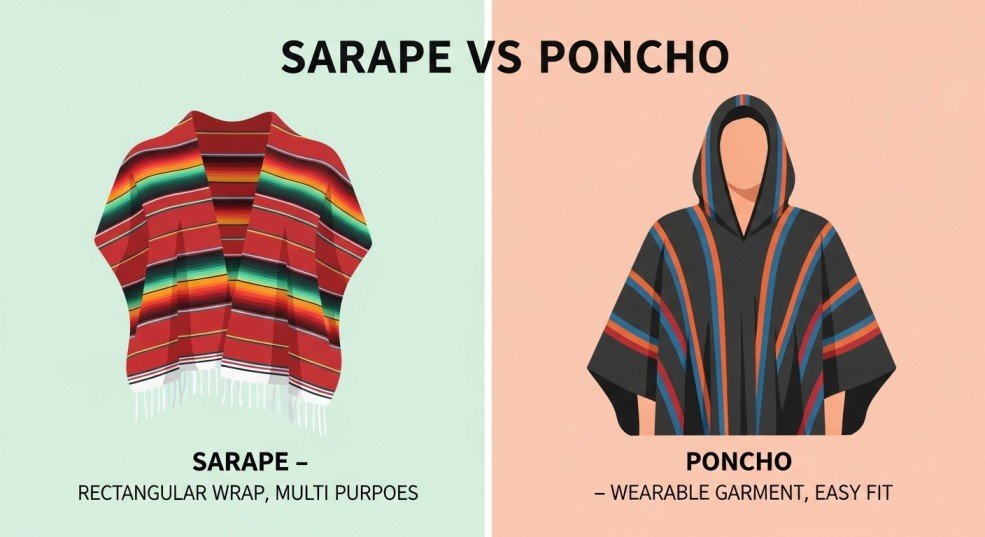
Quick Ans: The main difference between sarape vs poncho is design and function. A sarape is a long rectangular woven blanket worn over the shoulders or used as a wrap, while a poncho is a garment with a hole in the center for the head, designed to be worn easily like clothing. Both are traditional Latin American textiles, yet their structure and usage differ.
Many people search for sarape vs poncho because the two look similar at first glance. Both are colorful. Both are made from woven fabric.
However, they are not the same.
A sarape is more like a blanket or shawl. A poncho is a wearable garment with a fixed shape. Because of this difference, each item serves a unique purpose.
Confusion often happens in markets, online stores, or cultural discussions. Some people use the terms interchangeably. Others may buy one while expecting the other.
Understanding the difference between sarape vs poncho helps you choose the right item. It also improves your knowledge of cultural clothing and textile traditions.
This guide explains everything clearly. You will learn definitions, advantages, disadvantages, real world examples, common mistakes, and more. By the end, the difference will be easy to understand.
Quick Answer: Sarape vs Poncho
To quickly understand sarape vs poncho, focus on shape and wearability.
| Feature | Sarape | Poncho |
|---|---|---|
| Shape | Rectangular blanket | Garment with head opening |
| Wearing Style | Draped over shoulders | Worn through head hole |
| Structure | Open fabric | Fixed clothing form |
| Use | Wrap, decoration, blanket | Clothing and protection |
| Origin Style | Mexican traditional textile | Widespread in Latin America |
In simple terms, a sarape is a wrap, while a poncho is a wearable garment.
What Is a Sarape?
A sarape is a long, rectangular piece of woven fabric. People drape it over their shoulders or wrap it around their body.
Sarapes are often brightly colored and feature striped or patterned designs.
Typical Sarape Features
Several characteristics define a sarape:
- Rectangular shape
- No hole or opening
- Colorful woven patterns
- Lightweight or medium weight fabric
Because it has no fixed structure, a sarape can be used in different ways.
Common Sarape Uses
People use sarapes for both practical and decorative purposes:
- Shoulder wrap
- Blanket
- Shawl
- Decorative textile
- Travel cover
In addition, sarapes are sometimes used in cultural events or traditional dress.
Cultural Background
Sarapes are strongly associated with Mexico. They have a long history in traditional craftsmanship and textile art.
Artisans often weave them using wool or cotton. Designs vary by region, which adds cultural value to each piece.
What Is a Poncho?
A poncho is a garment made from a single piece of fabric with a hole in the center for the head. It hangs evenly over the front and back of the body.
Unlike a sarape, a poncho is designed to be worn without adjustment.
Typical Poncho Features
Common features include:
- Central head opening
- Loose fit
- Symmetrical design
- Simple structure
Because of its shape, a poncho is easy to wear and remove.
Common Poncho Uses
Ponchos are widely used for:
- Protection from cold
- Rain coverage
- Casual fashion
- Outdoor activities
Some ponchos are thick and warm, while others are waterproof for rain protection.
Cultural Background
Ponchos are popular across many parts of Latin America, including Mexico, Peru, and Chile.
Different regions produce unique styles using local materials and patterns.
Key Differences Between Sarape vs Poncho
Structure
The most important difference in sarape vs poncho is structure. A sarape is a flat rectangular cloth. A poncho has a hole for the head and forms a wearable garment.
Ease of Use
Ponchos are easier to wear because they require no adjustment. Sarapes need to be draped or wrapped manually.
Function
Sarapes are flexible and serve multiple purposes. Ponchos focus mainly on clothing and protection.
Mobility
Ponchos stay in place during movement. Sarapes may shift if not secured properly.
Advantages and Disadvantages
Sarape Advantages
Sarapes offer several benefits:
- Multi purpose use
- Easy to fold and carry
- Can be styled in different ways
- Works as blanket or wrap
Sarape Disadvantages
Some limitations include:
- Requires adjustment to wear
- May slip off shoulders
- Less secure in windy conditions
Poncho Advantages
Ponchos provide practical advantages:
- Easy to wear
- Stays in place
- Good protection from weather
- Comfortable for daily use
Poncho Disadvantages
However, ponchos also have drawbacks:
- Limited styling flexibility
- Fixed shape
- Cannot be used as blanket easily
Choosing between sarape vs poncho depends on how you plan to use it.
Real World Examples
Travel Use
A traveler may carry a sarape because it works as a blanket on long journeys. A poncho, however, is better for staying warm while walking outdoors.
Outdoor Activities
Hikers often choose ponchos for rain protection. Meanwhile, campers may use sarapes for warmth at night.
Cultural Events
At festivals, sarapes are often worn as decorative wraps. Ponchos are worn as traditional clothing in many regions.
These examples show how usage differs in real life.
Regional and Global Usage
Mexico
Sarapes are closely tied to Mexican culture. They are often handmade and represent regional identity.
South America
Ponchos are widely used across countries like Peru and Chile. Many communities rely on them for warmth in colder climates.
Global Fashion
Both items appear in modern fashion. Designers often adapt traditional patterns for global audiences.
Therefore, the sarape vs poncho comparison reflects both culture and function.
Related Concepts and Comparisons
Sarape vs Shawl
A shawl is similar to a sarape but usually smaller and more delicate.
Poncho vs Cape
A cape is worn over the shoulders like a poncho but does not always include a head opening.
Sarape vs Poncho vs Shawl
| Feature | Sarape | Poncho | Shawl |
|---|---|---|---|
| Shape | Rectangular | Fixed garment | Flexible wrap |
| Opening | None | Head hole | None |
| Use | Multi purpose | Clothing | Light covering |
Understanding these comparisons helps clarify the differences further.
Common Mistakes About Sarape vs Poncho
Using the Terms Interchangeably
Many people assume sarape and poncho mean the same thing. In reality, their structure and function differ.
Buying the Wrong Item
Some buyers expect a poncho but receive a sarape without a head opening.
Ignoring Cultural Context
Both items have cultural significance. Treating them as generic fashion items can overlook their heritage.
Choosing the Wrong Use
Using a sarape in windy conditions may be inconvenient. A poncho works better in such cases.
Avoiding these mistakes improves your buying and usage experience.
Beginner to Advanced Usage Tips
Beginner Level
Start with a lightweight poncho for easy wear. Try a sarape as a simple shoulder wrap.
Intermediate Level
Experiment with styling a sarape in different ways. Use ponchos for outdoor activities.
Advanced Level
Explore handmade textiles. Choose region specific designs for cultural authenticity.
As your understanding grows, you can use both items more effectively.
Step By Step Usage Scenario
Imagine you need something for travel.
If you choose a sarape:
- Fold and pack easily
- Use as blanket during rest
- Wrap around shoulders when cold
- Use as decorative layer
If you choose a poncho:
- Wear by placing over head
- Adjust evenly on both sides
- Use for warmth or rain protection
- Remove easily when indoors
Both items serve useful roles, but the experience differs.
Exercises With Answers
Exercise 1
Which item has a head opening in the sarape vs poncho comparison?
Answer: Poncho.
Exercise 2
Which item is rectangular in shape?
Answer: Sarape.
Exercise 3
Which is easier to wear quickly?
Answer: Poncho.
Exercise 4
Which item can be used as a blanket?
Answer: Sarape.
Exercise 5
True or False: A sarape has a fixed garment structure.
Answer: False.
When Should You Choose Sarape vs Poncho?
Choose a sarape if you:
- Want a multi purpose textile
- Need a travel blanket
- Prefer flexible styling
Choose a poncho if you:
- Want easy to wear clothing
- Need protection from weather
- Prefer secure fit
Your choice depends on comfort, function, and situation.
FAQs About Sarape vs Poncho
What is the main difference between sarape vs poncho?
A sarape is a rectangular wrap, while a poncho is a garment with a head opening.
Is a sarape the same as a poncho?
No. In the sarape vs poncho comparison, a sarape is a flat textile, while a poncho is wearable clothing.
Which is easier to wear, sarape or poncho?
A poncho is easier because it slips over the head without adjustment.
Can a sarape be used as clothing?
Yes. It can be draped over the shoulders, but it does not have a fixed shape like a poncho.
Are ponchos used for rain protection?
Yes. Many ponchos are designed to protect against rain and wind.
Is a sarape warm?
It can be warm depending on the material, especially wool.
Which is more versatile, sarape or poncho?
A sarape is more versatile because it can be used as a blanket, wrap, or decoration.
Do both items have cultural significance?
Yes. Both are important in Latin American textile traditions.
Can ponchos be used as blankets?
Not usually, because of the head opening.
Which is better for travel, sarape or poncho?
It depends. Sarapes offer more uses, while ponchos provide easier wear.
Conclusion
Understanding sarape vs poncho helps you choose the right textile for your needs. Both items come from rich cultural traditions and offer practical benefits.
A sarape is a flexible, rectangular cloth that works as a wrap, blanket, or decorative piece. It provides versatility and creative styling options.
A poncho is a structured garment designed for easy wear and protection. It stays in place and works well for outdoor activities and changing weather conditions.
Your decision depends on how you plan to use the item. Choose a sarape for flexibility and multiple uses. Choose a poncho for convenience and reliable coverage.
With this knowledge, you can confidently select the option that fits your lifestyle and preferences.
Discover More:-
- Tamal vs Tamale: Meaning, Grammar Differences, and Usage Guide
- Springtail vs Flea: Differences, Identification, and Control Guide

Jennifer Collins is a professional grammar expert and language educator at gramtivo.com, specializing in English grammar, writing skills, and language improvement. She holds a Master’s degree in English Language and Literature from a recognized university in the United States. With years of teaching and content development experience, she is dedicated to helping learners improve their communication skills with clear and practical guidance.